




What are Plasmodesmata and Desmosomes?
Answer
 Verified
564.9k+ views
Hint: Cell membrane is the outer membranous covering of the protoplast or cell protoplasm. Cell membrane is also called a plasma membrane. To serve special types of functions the cell membrane has to be modified. The common modifications are – microvilli, lomasomes, sheaths, pores, intercellular junctions.
Complete Answer-
Intercellular junctions are contacts between adjacent cells which in case of animal cells are separated by narrow intercellular spaces and contain tissue fluid. The important ones are – Interdigitations, Intercellular Bridges, Tight Junctions, Gap Junctions, Desmosomes, Terminal Bars, Plasmodesmata.
Now, we talk about only the two in detail –
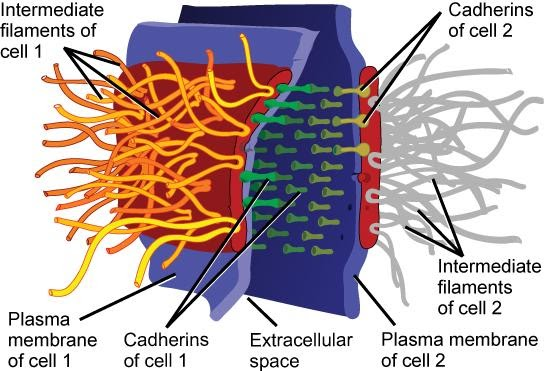
1. Desmosomes: These are circular regions where adjacent membranes possess disc-shaped thickening on the inner side, a number of tonofibrils and trans-membrane linkers embedded in dense intercellular material. They act as ‘spot welds’ and keep the cells firmly together. They occur in epithelia subjected to disruption. They are found in cardiac muscle, epithelia, etc. and they are also known as Macula Adherens.
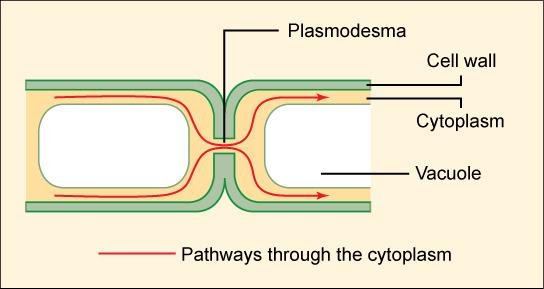
2. Plasmodesmata: These are protoplasmic bridges amongst plant cells which occur in the areas of cell wall pits or pores. Materials may pass from cell to cell through plasmodesmata. They form a protoplasmic continuum called symplast. A plasmodesmata consists of a canal, having a simple or branched tubule called a desmotubule. Desmotubule is an extension of the endoplasmic reticulum. Plasmodesmata is basically of two types:
Primary – These are formed at the time of cell division and responsible for growth and development.
Secondary – They are formed between mature cells and they share different functional properties.
Note:
Functions of cell membrane:
- It protects cells from injury.
- It forms various types of junctions to keep the cells together.
- By forming plasmodesmata, the cell membranes establish cytoplasmic continuity between adjacent cells.
Complete Answer-
Intercellular junctions are contacts between adjacent cells which in case of animal cells are separated by narrow intercellular spaces and contain tissue fluid. The important ones are – Interdigitations, Intercellular Bridges, Tight Junctions, Gap Junctions, Desmosomes, Terminal Bars, Plasmodesmata.
Now, we talk about only the two in detail –
1. Desmosomes: These are circular regions where adjacent membranes possess disc-shaped thickening on the inner side, a number of tonofibrils and trans-membrane linkers embedded in dense intercellular material. They act as ‘spot welds’ and keep the cells firmly together. They occur in epithelia subjected to disruption. They are found in cardiac muscle, epithelia, etc. and they are also known as Macula Adherens.
2. Plasmodesmata: These are protoplasmic bridges amongst plant cells which occur in the areas of cell wall pits or pores. Materials may pass from cell to cell through plasmodesmata. They form a protoplasmic continuum called symplast. A plasmodesmata consists of a canal, having a simple or branched tubule called a desmotubule. Desmotubule is an extension of the endoplasmic reticulum. Plasmodesmata is basically of two types:
Primary – These are formed at the time of cell division and responsible for growth and development.
Secondary – They are formed between mature cells and they share different functional properties.
Note:
Functions of cell membrane:
- It protects cells from injury.
- It forms various types of junctions to keep the cells together.
- By forming plasmodesmata, the cell membranes establish cytoplasmic continuity between adjacent cells.
Recently Updated Pages
If x a + bt + ct2 where x is in meters and t is in class 11 physics CBSE

A car covers the first half distance between two places class 11 physics CBSE
The resultant of two vectors overrightarrow P and overrightarrow class 11 physics CBSE
Find the value of cos 135 class 11 maths CBSE
A mass M is held in place by an applied force F and class 11 physics CBSE
A solution of glucose in water is labelled as 10 dfracwv class 11 chemistry CBSE
Trending doubts
One Metric ton is equal to kg A 10000 B 1000 C 100 class 11 physics CBSE
Find the value of the expression given below sin 30circ class 11 maths CBSE
What do you mean by retardation What is its SI uni class 11 physics CBSE
Draw a diagram of nephron and explain its structur class 11 biology CBSE
10 examples of friction in our daily life
Difference between physical and chemical change class 11 chemistry CBSE