




Why are membranes described as proteins in a sea of lipids? Explain with an example?
Answer
 Verified
479.4k+ views
Hint: The membrane surrounding a cell is called plasma membrane or cell membrane in animal cells and plasmalemma in plant cells. The cell membrane is composed of 40-50% protein and 50-60% lipids; both components vary in their composition. Lipids of plasma membranes are of different types- phospholipids- 55%, glycolipids-5%, steroids-20%, other lipids-20%.
Complete answer:
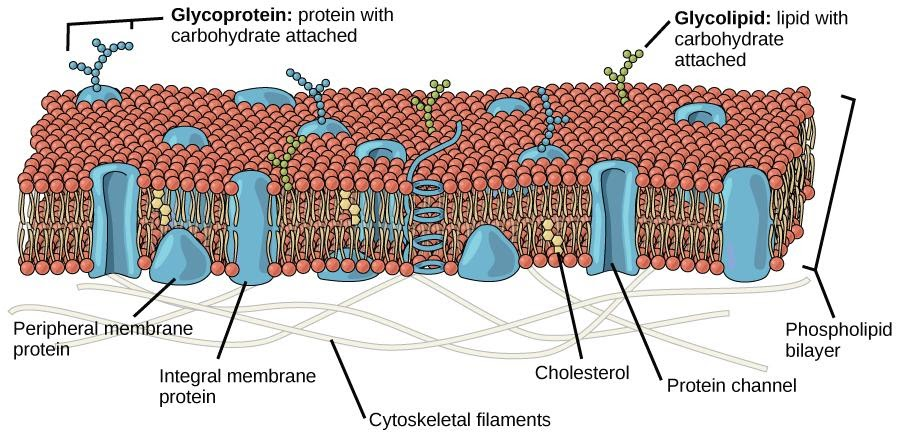
Different models were proposed for the structure of plasma membrane, but the most widely accepted model of the plasma membrane is the “fluid mosaic model” which was proposed by Singer and Nicolson in 1972. This model states that membrane is composed of lipids and proteins organized as follows:
A. Lipid molecules form a lipid bilayer.
B. The protein molecules are embedded within the lipid bilayer.
Lipid bilayer: A lipid molecule is amphipathic- containing a hydrophilic head and a hydrophobic tail. The hydrophilic ends are oriented toward the outside of the membrane of the cell, while their hydrophobic tails are oriented inward, constituting the interior hydrophobic region of the membrane. The tail of the lipid molecules may contain both saturated and unsaturated fatty acids.
Membrane proteins: Integral proteins are embedded within the lipid bilayer and can move laterally within them. The domain of the protein molecule within the lipid bilayer is hydrophobic while that lying outside the bilayer is hydrophilic. Transmembrane proteins pass through the lipid bilayer and are exposed on both sides of the bilayer.
The outer surface of the membrane is rich in glycoproteins or glycolipids (carbohydrate groups), while the inner surface is negatively charged due to the presence of unsaturated fatty acid chains in the lipid molecule of the inner monolayer.
Membranes are referred to as proteins in a sea of lipids because lipids and proteins are arranged in a mosaic fashion and do not appear as a rigid structure. The lipid bilayer is fluid and the lipid molecules are in the form of liquid crystals I.e., they are not fixed in a position and neither free to move. The membrane protein can move laterally within the lipid bilayer.
Note:
Functions of plasma membrane: Enclosing and protecting the cell from the external environment, regulating the import and export of materials inside and outside the cell, metabolic functions, recognition, and communication between different cells and cell to cell adhesion. Communication and adhesion are carried out by receptors, which are transmembrane proteins or integral proteins.
Complete answer:
Different models were proposed for the structure of plasma membrane, but the most widely accepted model of the plasma membrane is the “fluid mosaic model” which was proposed by Singer and Nicolson in 1972. This model states that membrane is composed of lipids and proteins organized as follows:
A. Lipid molecules form a lipid bilayer.
B. The protein molecules are embedded within the lipid bilayer.
Lipid bilayer: A lipid molecule is amphipathic- containing a hydrophilic head and a hydrophobic tail. The hydrophilic ends are oriented toward the outside of the membrane of the cell, while their hydrophobic tails are oriented inward, constituting the interior hydrophobic region of the membrane. The tail of the lipid molecules may contain both saturated and unsaturated fatty acids.
Membrane proteins: Integral proteins are embedded within the lipid bilayer and can move laterally within them. The domain of the protein molecule within the lipid bilayer is hydrophobic while that lying outside the bilayer is hydrophilic. Transmembrane proteins pass through the lipid bilayer and are exposed on both sides of the bilayer.
The outer surface of the membrane is rich in glycoproteins or glycolipids (carbohydrate groups), while the inner surface is negatively charged due to the presence of unsaturated fatty acid chains in the lipid molecule of the inner monolayer.
Membranes are referred to as proteins in a sea of lipids because lipids and proteins are arranged in a mosaic fashion and do not appear as a rigid structure. The lipid bilayer is fluid and the lipid molecules are in the form of liquid crystals I.e., they are not fixed in a position and neither free to move. The membrane protein can move laterally within the lipid bilayer.
Note:
Functions of plasma membrane: Enclosing and protecting the cell from the external environment, regulating the import and export of materials inside and outside the cell, metabolic functions, recognition, and communication between different cells and cell to cell adhesion. Communication and adhesion are carried out by receptors, which are transmembrane proteins or integral proteins.
Recently Updated Pages
Master Class 11 Computer Science: Engaging Questions & Answers for Success

Master Class 11 Business Studies: Engaging Questions & Answers for Success
Master Class 11 Economics: Engaging Questions & Answers for Success
Master Class 11 English: Engaging Questions & Answers for Success
Master Class 11 Maths: Engaging Questions & Answers for Success
Master Class 11 Biology: Engaging Questions & Answers for Success
Trending doubts
One Metric ton is equal to kg A 10000 B 1000 C 100 class 11 physics CBSE
There are 720 permutations of the digits 1 2 3 4 5 class 11 maths CBSE
Discuss the various forms of bacteria class 11 biology CBSE
Draw a diagram of a plant cell and label at least eight class 11 biology CBSE
State the laws of reflection of light
Explain zero factorial class 11 maths CBSE