




Where are Meibomian glands found in the human body?
Answer
 Verified
621.3k+ views
Hint: These are exocrine glands that are situated in the part of the body whose function is to visualize things. In addition to it, Meibomian glands are also called tarsal glands.
Complete step by step answer: Meibomian glands are a type of exocrine glands which are holocrine in nature. Holocrine is actually a term that is used to define the mode of secretion in exocrine glands. The product is secreted by rupturing the plasma membrane of the cell leading to cell death. Meibomian glands are a part of the human eye. It is found along the rims or margin of the eyelid inside the tarsal plate. The tarsal plate is the dense connective tissue that lines each eyelid and provides support and shape to the eye. Meibomian glands secrete an oily substance called meibum which prevents evaporation of the eye’s tear film. The major component of meibum is lipids.
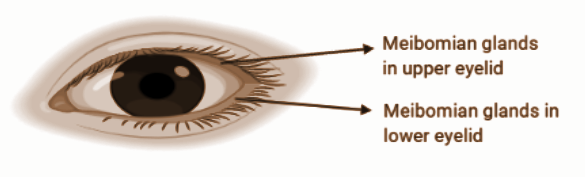
Spilling of tears onto the cheeks is prevented by the meibum by trapping the tears between the oiled edge and the eyeball thus making the closed lids airtight. On the upper lids around fifty meibomian glands are present and on the lower lid, the count is around twenty-five.
Note: Dry eyes are one of the common eye conditions caused by dysfunctional meibomian glands. It may also cause blepharitis. A person’s age or hormones can be a reason for the dysfunctional meibomian glands. It is also caused by some medical prescriptions which mainly consist of isotretinoin. Treatment of dysfunctional meibomian glands includes warm compresses by consulting an ophthalmologist.
Complete step by step answer: Meibomian glands are a type of exocrine glands which are holocrine in nature. Holocrine is actually a term that is used to define the mode of secretion in exocrine glands. The product is secreted by rupturing the plasma membrane of the cell leading to cell death. Meibomian glands are a part of the human eye. It is found along the rims or margin of the eyelid inside the tarsal plate. The tarsal plate is the dense connective tissue that lines each eyelid and provides support and shape to the eye. Meibomian glands secrete an oily substance called meibum which prevents evaporation of the eye’s tear film. The major component of meibum is lipids.
Spilling of tears onto the cheeks is prevented by the meibum by trapping the tears between the oiled edge and the eyeball thus making the closed lids airtight. On the upper lids around fifty meibomian glands are present and on the lower lid, the count is around twenty-five.
Note: Dry eyes are one of the common eye conditions caused by dysfunctional meibomian glands. It may also cause blepharitis. A person’s age or hormones can be a reason for the dysfunctional meibomian glands. It is also caused by some medical prescriptions which mainly consist of isotretinoin. Treatment of dysfunctional meibomian glands includes warm compresses by consulting an ophthalmologist.
Recently Updated Pages
The given figure shows two endocrine glands marked class 11 biology NEET_UG

Match columnI with columnII and select the correct class 11 biology NEET
Match column I with column II and select the correct class 11 biology NEET_UG
Which floral family has left 9 right + 1 arrangement class 11 biology NEET_UG
Which is not a variety of sheep A Lohi B Beetal C Nellore class 11 biology NEET_UG
Match column I with column II and select the correct class 11 biology NEET_UG
Trending doubts
One Metric ton is equal to kg A 10000 B 1000 C 100 class 11 physics CBSE
Draw a diagram of a plant cell and label at least eight class 11 biology CBSE
Difference Between Prokaryotic Cells and Eukaryotic Cells
Draw a well labelled diagram of reflex arc and explain class 11 biology CBSE
Two of the body parts which do not appear in MRI are class 11 biology CBSE
1 ton equals to A 100 kg B 1000 kg C 10 kg D 10000 class 11 physics CBSE