




How are corresponding angles used in everyday life?
Answer
 Verified
581.1k+ views
Hint: Here we need to explain the applications of the corresponding angles. We know that the corresponding angles are defined as the angles which are on the same corner of the transversal line. The transversal line is the line that cuts two or more parallel lines. So we will use this definition and we will give examples in which the concept of corresponding angles is used.
Complete step by step solution:
We know that the corresponding angles are defined as the angles which are on the same corner of the transversal line. Here the transversal line is the line that cuts two or more parallel lines.
The first example in which the concept of corresponding angles is used is the railway tracks.
Let’s draw the figure to understand the use of corresponding angles.
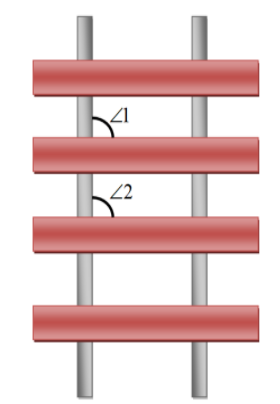
We can see that the track lines are parallel to each other. So using the definition of the corresponding angles, we can say that \[\angle 1\] and \[\angle 2\] are the corresponding angles.
The second example in which the concept of corresponding angles is used is Rubik’s cube.
Let’s draw the figure of Rubik’s cube to understand the use of corresponding angles.
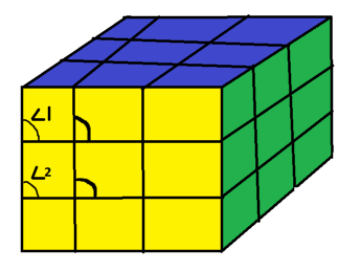
Here we can see that all the lines are parallel to each other in the cube. So the marked angles \[\angle 1\] and \[\angle 2\] are the corresponding angles.
Hence, these are the applications of the corresponding angles in real life.
Note:
Here we need to keep in mind that the corresponding angles made by the parallel lines are always equal to each other. Parallel lines are the lines that do not intersect each other and are at a distance apart from each other. When a transversal line cuts two or more parallel lines, then interior angles are equal to each other. Also, the interior angles on the same side of the transverse line are equal.
Complete step by step solution:
We know that the corresponding angles are defined as the angles which are on the same corner of the transversal line. Here the transversal line is the line that cuts two or more parallel lines.
The first example in which the concept of corresponding angles is used is the railway tracks.
Let’s draw the figure to understand the use of corresponding angles.
We can see that the track lines are parallel to each other. So using the definition of the corresponding angles, we can say that \[\angle 1\] and \[\angle 2\] are the corresponding angles.
The second example in which the concept of corresponding angles is used is Rubik’s cube.
Let’s draw the figure of Rubik’s cube to understand the use of corresponding angles.
Here we can see that all the lines are parallel to each other in the cube. So the marked angles \[\angle 1\] and \[\angle 2\] are the corresponding angles.
Hence, these are the applications of the corresponding angles in real life.
Note:
Here we need to keep in mind that the corresponding angles made by the parallel lines are always equal to each other. Parallel lines are the lines that do not intersect each other and are at a distance apart from each other. When a transversal line cuts two or more parallel lines, then interior angles are equal to each other. Also, the interior angles on the same side of the transverse line are equal.
Recently Updated Pages
Master Class 12 Business Studies: Engaging Questions & Answers for Success

Master Class 12 Biology: Engaging Questions & Answers for Success
Master Class 12 Chemistry: Engaging Questions & Answers for Success
Class 12 Question and Answer - Your Ultimate Solutions Guide
Master Class 11 Social Science: Engaging Questions & Answers for Success
Master Class 11 English: Engaging Questions & Answers for Success
Trending doubts
Find the sum of series 1 + 2 + 3 + 4 + 5 + + 100 class 9 maths CBSE
Fill the blanks with the suitable prepositions 1 The class 9 english CBSE
Difference Between Plant Cell and Animal Cell
How many hours before the closure of election must class 9 social science CBSE
What is pollution? How many types of pollution? Define it
Name 10 Living and Non living things class 9 biology CBSE