



How are chromatin, chromatid, and chromosomes related to each other?
A. Chromatin occurs as a diffuse network of fine filaments in the non-dividing nucleus.
B. At the time of cell division, chromatin material becomes condensed into a rod-like structure called chromosomes.
C. Each chromosome has a centromere and two arms called chromatids.
D. All of the above.
Answer
 Verified
682.8k+ views
Hint: They are all different organizations and arrangements of DNA in various forms.
Complete answer:
A cell consists of a nucleus that has liquid fluid inside it called nucleoplasm. This nucleoplasm contains an interwoven thread-like structure called chromatin. It is found in the interphase of the cell cycle.
At the starting stage of cell division, these chromatin threads start to condense and turn into long threads resulting in the formation of rod-like bodies called chromosomes. They are found in the mitotic phase of the cell cycle.
These chromosomes consist of DNA and proteins which pass the information from one generation to the next. Each chromosome consists of several genes which are the hereditary units in an organism while DNA is called the hereditary material.
A chromatid is simply one of the copies of the duplicated chromosome, these chromatids are generally attached to the other copy by a structure called a centromere. These duplicated chromosomes which are joined together by centromere separate during cell division.
So, the correct answer is D) All of the above.
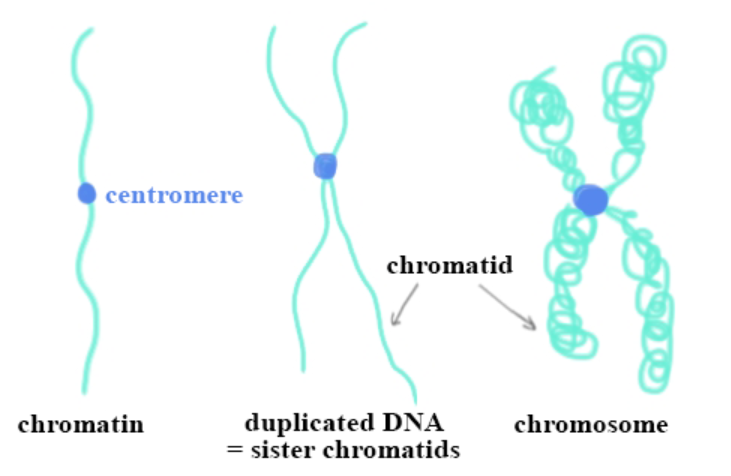
Note: Centromere consists of specialized proteins called kinetochores at the time of cell division, where spindle fibers attach and they pull sister chromatids apart during cell division.
Complete answer:
A cell consists of a nucleus that has liquid fluid inside it called nucleoplasm. This nucleoplasm contains an interwoven thread-like structure called chromatin. It is found in the interphase of the cell cycle.
At the starting stage of cell division, these chromatin threads start to condense and turn into long threads resulting in the formation of rod-like bodies called chromosomes. They are found in the mitotic phase of the cell cycle.
These chromosomes consist of DNA and proteins which pass the information from one generation to the next. Each chromosome consists of several genes which are the hereditary units in an organism while DNA is called the hereditary material.
A chromatid is simply one of the copies of the duplicated chromosome, these chromatids are generally attached to the other copy by a structure called a centromere. These duplicated chromosomes which are joined together by centromere separate during cell division.
So, the correct answer is D) All of the above.
Note: Centromere consists of specialized proteins called kinetochores at the time of cell division, where spindle fibers attach and they pull sister chromatids apart during cell division.
Recently Updated Pages
Which will be the least stable resonating structure class 11 chemistry CBSE

How many 5 digit telephone numbers can be construc-class-11-maths-CBSE
How do you find the angle of the resultant vector class 11 physics CBSE
Draw labelled diagram of the following i Gram seed class 11 biology CBSE
1 Quintal is equal to a 110 kg b 10 kg c 100kg d 1000 class 11 physics CBSE
What is the need and importance of classification class 11 biology CBSE
Trending doubts
Find the value of the expression given below sin 30circ class 11 maths CBSE
One Metric ton is equal to kg A 10000 B 1000 C 100 class 11 physics CBSE
10 examples of friction in our daily life
Draw a diagram of a plant cell and label at least eight class 11 biology CBSE
Difference between physical and chemical change class 11 chemistry CBSE
Proton was discovered by A Thomson B Rutherford C Chadwick class 11 chemistry CBSE