




What are called the centre of curvature and radius of curvature of the mirror?
Answer
 Verified
536.4k+ views
Hint: A mirror is a piece of glass that reflects light. When focussed via the lens of the eye or a camera, light that bounces off a mirror reflects a picture of whatever is in front of it. Mirrors reflect light in an equal but opposite direction, reversing the direction of the picture. This allows the spectator to see themselves or things behind them, as well as objects that are in their field of view but are at an angle from them, such as behind a corner.
Complete answer:
The centre of curvature of a curve is located at a position on the normal vector that is a distance from the curve equal to the radius of curvature. If the curvature is zero, it is the point at infinity.
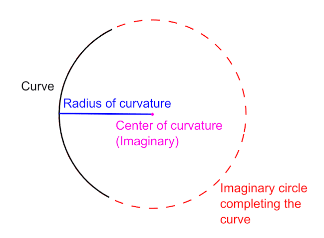
The osculating circle is located at the curve's centre of curvature. The junction point of two infinitely near normal lines to the curve was designated by Cauchy as the centre of curvature C.
The evolute of the curve is made up of the locus of centres of curvature for each point on the curve. The term "lens and mirrors" is commonly used in physics to refer to the study of lenses and mirrors. The radius of curvature, R, is the reciprocal of the curvature in differential geometry. It is equal to the radius of the circular arc that best approximates the curve at that point for a curve. The radius of curvature of a surface is the radius of a circle that best matches a normal section or combinations of normal sections.
Note: The circle, which has a curvature equal to the reciprocal of its radius, is the canonical example of a curve. Curvature is higher in smaller circles because they bend more sharply. The curvature of a differentiable curve's osculating circle, or the circle that best approximates the curve at this point, is the curvature of the curve. A straight line has zero curvature. In contrast to the tangent, which is a vector quantity, the curvature at a point is usually a scalar quantity, which means it may be represented as a single real number.
Complete answer:
The centre of curvature of a curve is located at a position on the normal vector that is a distance from the curve equal to the radius of curvature. If the curvature is zero, it is the point at infinity.
The osculating circle is located at the curve's centre of curvature. The junction point of two infinitely near normal lines to the curve was designated by Cauchy as the centre of curvature C.
The evolute of the curve is made up of the locus of centres of curvature for each point on the curve. The term "lens and mirrors" is commonly used in physics to refer to the study of lenses and mirrors. The radius of curvature, R, is the reciprocal of the curvature in differential geometry. It is equal to the radius of the circular arc that best approximates the curve at that point for a curve. The radius of curvature of a surface is the radius of a circle that best matches a normal section or combinations of normal sections.
Note: The circle, which has a curvature equal to the reciprocal of its radius, is the canonical example of a curve. Curvature is higher in smaller circles because they bend more sharply. The curvature of a differentiable curve's osculating circle, or the circle that best approximates the curve at this point, is the curvature of the curve. A straight line has zero curvature. In contrast to the tangent, which is a vector quantity, the curvature at a point is usually a scalar quantity, which means it may be represented as a single real number.
Recently Updated Pages
Master Class 11 English: Engaging Questions & Answers for Success

Master Class 11 Social Science: Engaging Questions & Answers for Success
Master Class 11 Maths: Engaging Questions & Answers for Success
Master Class 11 Biology: Engaging Questions & Answers for Success
Master Class 11 Physics: Engaging Questions & Answers for Success
Master Class 11 Chemistry: Engaging Questions & Answers for Success
Trending doubts
Explain the Treaty of Vienna of 1815 class 10 social science CBSE
First Cotton Mill of India
In which year voting age was reduced from 21 to 18?
What planets have no moons Which one has only one moon class 10 physics CBSE
What is the full form of POSCO class 10 social science CBSE
Define Potential, Developed, Stock and Reserved resources