




What are analog and digital signals? Explain with a diagram.
Answer
 Verified
630.3k+ views
Hint: Analog signals are continuous signals in which one quantity which is varying with respect to time is represented. While digital signals use discrete signals which are discontinuous. Both of them are used to transfer information. The graph of analog signal is denoted as sine waves while the graph of digital signal is in the form of square waves.
Complete step by step answer:
First we will define both the types of the signals. Then we will mention some points of differences between them and then check which of them is more efficient.
Analog signals: An analog signal is a continuous signal. The analog signal is a continuous signal. Many devices use analog signals. In particular sensors typically output is an analog signal or voltage that varies based on something being sensed like light, heat or humidity.
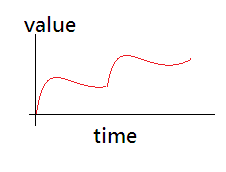
Digital signals: A digital signal is the one in which the original information is converted into a string of bits before being transmitted over some channel. A radio signal is an example of digital signal. Digital signals are used to send information over long distances and these signals suffer less interference than analog signals. Digital signals are time separated signals which are generated using digital modulation.
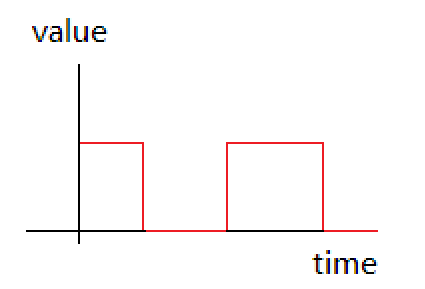
It is clear from the above diagram that digital signal takes discrete values. Generally, these values are either represented as high-low or $0 - 1$ .
Additional Information:
WIFI signals are both digital signals as well as analog signal
Note:
Digital signals are non-continuous signals while on the other hand, analog signals are continuous signals . It is possible that some electrical component has both the signals. There are converters available which can convert analog signal to digital signal and vice-versa. Analog systems are of low cost and portable but they draw larger amounts of power. While digital signals draw negligible power but have high cost.
Complete step by step answer:
First we will define both the types of the signals. Then we will mention some points of differences between them and then check which of them is more efficient.
Analog signals: An analog signal is a continuous signal. The analog signal is a continuous signal. Many devices use analog signals. In particular sensors typically output is an analog signal or voltage that varies based on something being sensed like light, heat or humidity.
Digital signals: A digital signal is the one in which the original information is converted into a string of bits before being transmitted over some channel. A radio signal is an example of digital signal. Digital signals are used to send information over long distances and these signals suffer less interference than analog signals. Digital signals are time separated signals which are generated using digital modulation.
It is clear from the above diagram that digital signal takes discrete values. Generally, these values are either represented as high-low or $0 - 1$ .
Additional Information:
WIFI signals are both digital signals as well as analog signal
Note:
Digital signals are non-continuous signals while on the other hand, analog signals are continuous signals . It is possible that some electrical component has both the signals. There are converters available which can convert analog signal to digital signal and vice-versa. Analog systems are of low cost and portable but they draw larger amounts of power. While digital signals draw negligible power but have high cost.
Recently Updated Pages
Master Class 12 Economics: Engaging Questions & Answers for Success

Master Class 12 Social Science: Engaging Questions & Answers for Success
Master Class 12 English: Engaging Questions & Answers for Success
Master Class 12 Maths: Engaging Questions & Answers for Success
Master Class 12 Physics: Engaging Questions & Answers for Success
Master Class 12 Biology: Engaging Questions & Answers for Success
Trending doubts
Draw a labelled sketch of the human eye class 12 physics CBSE
Which are the Top 10 Largest Countries of the World?
Draw ray diagrams each showing i myopic eye and ii class 12 physics CBSE
Which is the correct genotypic ratio of mendel dihybrid class 12 biology CBSE
Differentiate between homogeneous and heterogeneous class 12 chemistry CBSE
Which animal never drinks water in its entire life class 12 biology CBSE