



Arbaz plans to tile his kitchen with square tiles. Each side of the tile is $10$ cm. His kitchen is $220$ cm in length and $180$ cm breadth. How many tiles will he need?
Answer
 Verified
547.9k+ views
Hint: We are given each side of the tile is $10$ cm. His kitchen is $220$ cm in length and $180$ cm breadth. To find the number of tiles arbaz needs, find the area for one tile and the area of the kitchen floor.
Complete step-by-step answer:
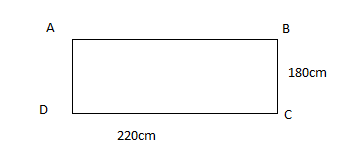
Now first in problem we are given that Arbaz plans to tile his kitchen with square tiles. Also, Each side of the tile is $10$ cm.
Since it is a square, area of one tile$=10\times 10$
Simplifying we get,
area of one tile$=100$ sq. cm ………… (1)
After that, the kitchen is $220$ cm in length and $180$ cm breadth.
So, the length of kitchen (l)$=220$ cm and breadth of kitchen(b)$=180$ cm.
Now, area of kitchen floor$=\text{l}\times \text{b}$
area of kitchen floor$=220\times 180$
Simplifying in simple form we get,
area of kitchen floor$=39,600$ sq. cm …………. (2)
The number of tiles needed$=\dfrac{\text{area of kitchen floor}}{\text{area of one tile}}$
So, from (1) and (2) substituting the values we get,
The number of tiles needed$=\dfrac{39600}{100}$
The number of tiles needed$=396$ tiles
Therefore, the number of tiles needed were $396$ tiles.
Additional information:
Area is the region bounded by the shape of an object. The space covered by the figure or any geometric shapes is the area of the shape. The area of all the shapes depends upon its dimensions and properties. Different shapes have different areas. The area of the square is different from the area of the kite. If two objects have a similar shape then it's not necessary that the area covered by them will be equal unless and until the dimensions of both the shapes are also equal.
Note: Here keep in mind that, first we have found the area of one tile and after that area of kitchen floor. We have used the formula that, number of tiles needed$=\dfrac{\text{area of kitchen floor}}{\text{area of one tile}}$.
Complete step-by-step answer:
Now first in problem we are given that Arbaz plans to tile his kitchen with square tiles. Also, Each side of the tile is $10$ cm.
Since it is a square, area of one tile$=10\times 10$
Simplifying we get,
area of one tile$=100$ sq. cm ………… (1)
After that, the kitchen is $220$ cm in length and $180$ cm breadth.
So, the length of kitchen (l)$=220$ cm and breadth of kitchen(b)$=180$ cm.
Now, area of kitchen floor$=\text{l}\times \text{b}$
area of kitchen floor$=220\times 180$
Simplifying in simple form we get,
area of kitchen floor$=39,600$ sq. cm …………. (2)
The number of tiles needed$=\dfrac{\text{area of kitchen floor}}{\text{area of one tile}}$
So, from (1) and (2) substituting the values we get,
The number of tiles needed$=\dfrac{39600}{100}$
The number of tiles needed$=396$ tiles
Therefore, the number of tiles needed were $396$ tiles.
Additional information:
Area is the region bounded by the shape of an object. The space covered by the figure or any geometric shapes is the area of the shape. The area of all the shapes depends upon its dimensions and properties. Different shapes have different areas. The area of the square is different from the area of the kite. If two objects have a similar shape then it's not necessary that the area covered by them will be equal unless and until the dimensions of both the shapes are also equal.
Note: Here keep in mind that, first we have found the area of one tile and after that area of kitchen floor. We have used the formula that, number of tiles needed$=\dfrac{\text{area of kitchen floor}}{\text{area of one tile}}$.

Recently Updated Pages
Master Class 11 English: Engaging Questions & Answers for Success

Master Class 11 Maths: Engaging Questions & Answers for Success
Class 11 Question and Answer - Your Ultimate Solutions Guide
Master Class 11 Biology: Engaging Questions & Answers for Success
Master Class 11 Physics: Engaging Questions & Answers for Success
Master Class 11 Accountancy: Engaging Questions & Answers for Success
Trending doubts
Full Form of IASDMIPSIFSIRSPOLICE class 7 social science CBSE
List of coprime numbers from 1 to 100 class 7 maths CBSE
How many thousands make a crore class 7 maths CBSE
Differentiate between map and globe class 7 social science CBSE
The southernmost point of the Indian mainland is known class 7 social studies CBSE
AIM To prepare stained temporary mount of onion peel class 7 biology CBSE