




Aradhana was sticking pictures on a chart of length 60 cm and breadth 50 cm. She left a border of 4 cm all round. How much space was left for sticking the pictures?
Answer
 Verified
640.2k+ views
Hint: we will first find the area of the rectangle by finding the product of the length and breadth. We will then find the dimensions of the smaller rectangular area by subtracting $\left( 2\times 4 \right)cm=8cm$ from both the length and breadth that was given originally and then find the area.
Complete step by step solution:
In this question we have been given that Aradhana was sticking pictures on a chart of dimensions of 60 cm by 50 cm. We are further given that she left a border of 4 cm all round, and we have to find the space left for her to stick the pictures. So, according to the question, the figure of the same would be,
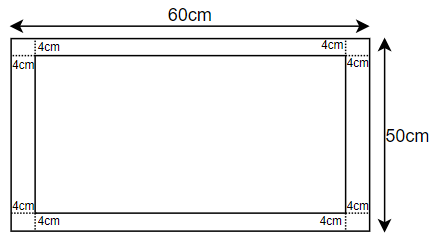
We will start by finding the area of the original rectangular chart, which can be found out by taking the product of the length and breadth of the chart paper. The length and breadth of the chart are given as 60 cm and 50 cm, thus the area of the chart would be,
$60cm\times 50cm=3000c{{m}^{2}}$
We are also given that a border of 4 cm was left on all the sides of the chart paper, so its dimensions will change too. The length of the chart paper was originally 60 cm, so after leaving a border of 4 cm on both the sides, the new length would be, $\left( 60-4\times 2 \right)cm=\left( 60-8cm \right)=52cm$. Similarly, the original breadth of the chart paper was 50 cm, so after leaving a border of 4 cm on both sides, the breadth would be, $\left( 50-4\times 2 \right)cm=\left( 50-8cm \right)=42cm$. So, the dimensions of the chart paper where Aradhana would be sticking the pictures will be, length of 52 cm by breadth of 42 cm. So, the area of this space in the chart would be the product of the length and breadth. So, we get,
$52cm\times 42cm=2184c{{m}^{2}}$
Therefore, the area used by Aradhana to stick the pictures is $2184c{{m}^{2}}$.
Note: Generally, the students subtract the length and breadth borders from the original length and breadth once instead of twice. This would give an incorrect answer. Also, if the question were to find the amount of space left out or that got wasted, one could find it by subtracting the area of the smaller rectangle from the larger one.
Complete step by step solution:
In this question we have been given that Aradhana was sticking pictures on a chart of dimensions of 60 cm by 50 cm. We are further given that she left a border of 4 cm all round, and we have to find the space left for her to stick the pictures. So, according to the question, the figure of the same would be,
We will start by finding the area of the original rectangular chart, which can be found out by taking the product of the length and breadth of the chart paper. The length and breadth of the chart are given as 60 cm and 50 cm, thus the area of the chart would be,
$60cm\times 50cm=3000c{{m}^{2}}$
We are also given that a border of 4 cm was left on all the sides of the chart paper, so its dimensions will change too. The length of the chart paper was originally 60 cm, so after leaving a border of 4 cm on both the sides, the new length would be, $\left( 60-4\times 2 \right)cm=\left( 60-8cm \right)=52cm$. Similarly, the original breadth of the chart paper was 50 cm, so after leaving a border of 4 cm on both sides, the breadth would be, $\left( 50-4\times 2 \right)cm=\left( 50-8cm \right)=42cm$. So, the dimensions of the chart paper where Aradhana would be sticking the pictures will be, length of 52 cm by breadth of 42 cm. So, the area of this space in the chart would be the product of the length and breadth. So, we get,
$52cm\times 42cm=2184c{{m}^{2}}$
Therefore, the area used by Aradhana to stick the pictures is $2184c{{m}^{2}}$.
Note: Generally, the students subtract the length and breadth borders from the original length and breadth once instead of twice. This would give an incorrect answer. Also, if the question were to find the amount of space left out or that got wasted, one could find it by subtracting the area of the smaller rectangle from the larger one.
Recently Updated Pages
Master Class 11 English: Engaging Questions & Answers for Success

Master Class 11 Social Science: Engaging Questions & Answers for Success
Master Class 11 Maths: Engaging Questions & Answers for Success
Master Class 11 Biology: Engaging Questions & Answers for Success
Master Class 11 Physics: Engaging Questions & Answers for Success
Master Class 11 Chemistry: Engaging Questions & Answers for Success
Trending doubts