



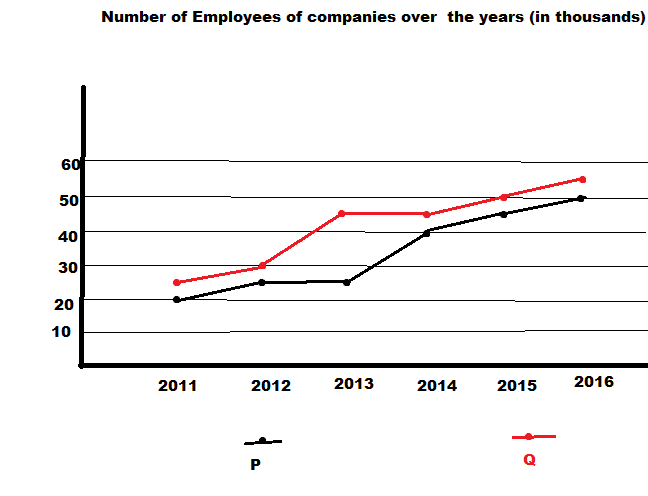
What is the approximate percentage increase in the total employees of the companies from 2013 to 2016?
A.50%
B.10.5%
C.9.5%
D.9.2%
Answer
 Verified
592.5k+ views
Hint: From the graph , first calculate the total number of employees in both the companies act 2013 and the total number of employees in both the companies at 2016. Then calculate the percentage increase using the formula $\dfrac{{increase{\text{ }}in{\text{ }}number}}{{{\text{original value}}}}*100$
Complete step-by-step answer:
Step 1 :
From the graph ,
The number of employees at company P in the year 2013 is 25000
The number of employees at company Q in the year 2013 is 45000
Therefore the total number of workers in both the companies act 2013 = $25000 + 45000 = 70000$
Step 2:
Now from the graph,
The number of employees at company P in the year 2016 is 50000
The number of employees at company Q in the year 2016 is 55000
Therefore the total number of workers in both the companies at 2016 = $50000 + 55000 = 105000$
Step 3 :
Now we are asked to find the percentage increase of total employees of both the companies.
Increase in percentage =$\dfrac{{increase{\text{ }}in{\text{ }}number}}{{{\text{original value}}}}*100$
Here the increase in number is the difference between the number of employees in both the companies at 2016 and the total number of employees of both the companies act 2013.
And the original value is the number of employees in 2013.
Therefore ,
Percentage increase
$
= \dfrac{{105000 - 70000}}{{70000}}*100 \\
= \dfrac{{35000}}{{70000}}*100 \\
= \dfrac{1}{2}*100 \\
= 50\% \\
$
Therefore the increase in percentage of the total number of employees in both the companies is 50%
The correct option is A.
Note: Steps used to calculate the percentage increase:
1. Calculate the difference (increase) between the two numbers you are comparing.
2.Increase = New Number - Original Number.
3. Divide the increase by the original number and multiply the answer by 100.
4.% increase = Increase ÷ Original Number × 100.
Complete step-by-step answer:
Step 1 :
From the graph ,
The number of employees at company P in the year 2013 is 25000
The number of employees at company Q in the year 2013 is 45000
Therefore the total number of workers in both the companies act 2013 = $25000 + 45000 = 70000$
Step 2:
Now from the graph,
The number of employees at company P in the year 2016 is 50000
The number of employees at company Q in the year 2016 is 55000
Therefore the total number of workers in both the companies at 2016 = $50000 + 55000 = 105000$
Step 3 :
Now we are asked to find the percentage increase of total employees of both the companies.
Increase in percentage =$\dfrac{{increase{\text{ }}in{\text{ }}number}}{{{\text{original value}}}}*100$
Here the increase in number is the difference between the number of employees in both the companies at 2016 and the total number of employees of both the companies act 2013.
And the original value is the number of employees in 2013.
Therefore ,
Percentage increase
$
= \dfrac{{105000 - 70000}}{{70000}}*100 \\
= \dfrac{{35000}}{{70000}}*100 \\
= \dfrac{1}{2}*100 \\
= 50\% \\
$
Therefore the increase in percentage of the total number of employees in both the companies is 50%
The correct option is A.
Note: Steps used to calculate the percentage increase:
1. Calculate the difference (increase) between the two numbers you are comparing.
2.Increase = New Number - Original Number.
3. Divide the increase by the original number and multiply the answer by 100.
4.% increase = Increase ÷ Original Number × 100.
Recently Updated Pages
Master Class 8 Social Science: Engaging Questions & Answers for Success

Master Class 8 English: Engaging Questions & Answers for Success
Class 8 Question and Answer - Your Ultimate Solutions Guide
Master Class 8 Maths: Engaging Questions & Answers for Success
Master Class 8 Science: Engaging Questions & Answers for Success
Master Class 7 English: Engaging Questions & Answers for Success
Trending doubts
What is BLO What is the full form of BLO class 8 social science CBSE
Citizens of India can vote at the age of A 18 years class 8 social science CBSE
Full form of STD, ISD and PCO
Advantages and disadvantages of science
Right to vote is a AFundamental Right BFundamental class 8 social science CBSE
What are the 12 elements of nature class 8 chemistry CBSE