




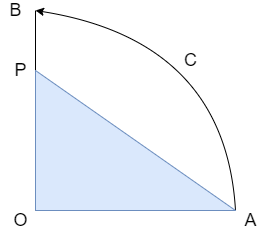
AOBCA is a quadrant of a circle of radius 3.5 cm with centre at O. P is a point on OB such that OP is 2 cm. the area of the non – shaded region is
(a) 12.25 sq. cm
(b) 6.125 sq. cm
(c) 12.5 sq. cm
(d) None of the above.
Answer
 Verified
597.3k+ views
Hint:
We solve this problem by using the removal of the area concept.
We remove the area of the shaded region from the area of the quadrant to get the required area.
We have the formula of area of quadrant o circle of radius \[r\] is given as
\[A=\dfrac{\pi {{r}^{2}}}{4}\]
We also have the formula of area of a triangle as
\[A=\dfrac{1}{2}\left( base \right)\left( height \right)\]
Complete step by step answer:
We are asked to find the area of the non – shaded region.
Let us use the removal of the area concept to solve this problem.
Let us consider the quadrant AOBCA
We are given that the radius of the quadrant as 3.5 cm
By using the above statement to given figure then we get
\[\Rightarrow OA=OB=3.5\]
Let us assume that the area of the quadrant as \[{{A}_{1}}\]
We know that the formula of area of quadrant o circle of radius \[r\] is given as
\[A=\dfrac{\pi {{r}^{2}}}{4}\]
By using the above formula to given quadrant then we get
\[\Rightarrow {{A}_{1}}=\dfrac{\pi {{\left( OA \right)}^{2}}}{4}\]
We know that the value \[\pi =\dfrac{22}{7}\] and \[OA=3.5\]
By substituting the required values in above area equation then we get
\[\begin{align}
& \Rightarrow {{A}_{1}}=\dfrac{1}{4}\times \dfrac{22}{7}\times 3.5\times 3.5 \\
& \Rightarrow {{A}_{1}}=\dfrac{11\times 0.5\times 3.5}{2} \\
& \Rightarrow {{A}_{1}}=9.625 \\
\end{align}\]
Now, let us consider the triangle \[\Delta AOP\]
We know that the quadrant is the quarter circle
By using the above condition we can say that
\[\Rightarrow \angle POA={{90}^{\circ }}\]
We are given that the length of OP as 2 cm
Now, let us assume that the area of the triangle as \[{{A}_{2}}\]
We know that the formula of area of triangle as
\[A=\dfrac{1}{2}\left( base \right)\left( height \right)\]
By using the above formula to given triangle then we get
\[\Rightarrow {{A}_{2}}=\dfrac{1}{2}\left( OP \right)\left( OA \right)\]
By substituting the required values in above equation then we get
\[\begin{align}
& \Rightarrow {{A}_{2}}=\dfrac{1}{2}\times 2\times 3.5 \\
& \Rightarrow {{A}_{2}}=3.5 \\
\end{align}\]
Now, let us assume that the area of non – shaded region as \[A\]
By using the concept of removal of area then we get
\[\begin{align}
& \Rightarrow A={{A}_{1}}-{{A}_{2}} \\
& \Rightarrow A=9.625-3.5 \\
& \Rightarrow A=6.125 \\
\end{align}\]
Therefore, we can conclude that the area of non – shaded region is 6.125 sq. cm
So, option (b) is the correct answer.
Note:
Students may make mistakes in taking the quadrant of the circle.
The quadrant of the circle is nothing but the quarter circle so that the area of the quadrant will be \[\dfrac{1}{4}\] times the area of the circle.
But students may not consider the quadrant as a quarter circle and assume it as a sector in which the area is undetermined.
But it is a standard condition that the quadrant is the quarter circle.
We solve this problem by using the removal of the area concept.
We remove the area of the shaded region from the area of the quadrant to get the required area.
We have the formula of area of quadrant o circle of radius \[r\] is given as
\[A=\dfrac{\pi {{r}^{2}}}{4}\]
We also have the formula of area of a triangle as
\[A=\dfrac{1}{2}\left( base \right)\left( height \right)\]
Complete step by step answer:
We are asked to find the area of the non – shaded region.
Let us use the removal of the area concept to solve this problem.
Let us consider the quadrant AOBCA
We are given that the radius of the quadrant as 3.5 cm
By using the above statement to given figure then we get
\[\Rightarrow OA=OB=3.5\]
Let us assume that the area of the quadrant as \[{{A}_{1}}\]
We know that the formula of area of quadrant o circle of radius \[r\] is given as
\[A=\dfrac{\pi {{r}^{2}}}{4}\]
By using the above formula to given quadrant then we get
\[\Rightarrow {{A}_{1}}=\dfrac{\pi {{\left( OA \right)}^{2}}}{4}\]
We know that the value \[\pi =\dfrac{22}{7}\] and \[OA=3.5\]
By substituting the required values in above area equation then we get
\[\begin{align}
& \Rightarrow {{A}_{1}}=\dfrac{1}{4}\times \dfrac{22}{7}\times 3.5\times 3.5 \\
& \Rightarrow {{A}_{1}}=\dfrac{11\times 0.5\times 3.5}{2} \\
& \Rightarrow {{A}_{1}}=9.625 \\
\end{align}\]
Now, let us consider the triangle \[\Delta AOP\]
We know that the quadrant is the quarter circle
By using the above condition we can say that
\[\Rightarrow \angle POA={{90}^{\circ }}\]
We are given that the length of OP as 2 cm
Now, let us assume that the area of the triangle as \[{{A}_{2}}\]
We know that the formula of area of triangle as
\[A=\dfrac{1}{2}\left( base \right)\left( height \right)\]
By using the above formula to given triangle then we get
\[\Rightarrow {{A}_{2}}=\dfrac{1}{2}\left( OP \right)\left( OA \right)\]
By substituting the required values in above equation then we get
\[\begin{align}
& \Rightarrow {{A}_{2}}=\dfrac{1}{2}\times 2\times 3.5 \\
& \Rightarrow {{A}_{2}}=3.5 \\
\end{align}\]
Now, let us assume that the area of non – shaded region as \[A\]
By using the concept of removal of area then we get
\[\begin{align}
& \Rightarrow A={{A}_{1}}-{{A}_{2}} \\
& \Rightarrow A=9.625-3.5 \\
& \Rightarrow A=6.125 \\
\end{align}\]
Therefore, we can conclude that the area of non – shaded region is 6.125 sq. cm
So, option (b) is the correct answer.
Note:
Students may make mistakes in taking the quadrant of the circle.
The quadrant of the circle is nothing but the quarter circle so that the area of the quadrant will be \[\dfrac{1}{4}\] times the area of the circle.
But students may not consider the quadrant as a quarter circle and assume it as a sector in which the area is undetermined.
But it is a standard condition that the quadrant is the quarter circle.
Recently Updated Pages
Master Class 12 Economics: Engaging Questions & Answers for Success

Master Class 12 English: Engaging Questions & Answers for Success
Master Class 12 Social Science: Engaging Questions & Answers for Success
Master Class 12 Maths: Engaging Questions & Answers for Success
Master Class 12 Physics: Engaging Questions & Answers for Success
Master Class 10 English: Engaging Questions & Answers for Success
Trending doubts
Explain the Treaty of Vienna of 1815 class 10 social science CBSE
Why is it 530 pm in india when it is 1200 afternoon class 10 social science CBSE
What is the full form of POSCO class 10 social science CBSE
Define Potential, Developed, Stock and Reserved resources
The speaker of the Lok Sabha is elected by the APresident class 10 social science CBSE
Complete the sentence with the most appropriate word class 10 english CBSE