




Anti-Markovnikov’s Rule for addition reaction is not observed by which of the following compound
A. Propene
B. 1-Butene
C. But-2-ene
D. Pent-2-ene
Answer
 Verified
584.1k+ views
Hint: Anti-Markovnikov rule, also known as the Kharasch Effect, states that when a polar molecule is added to an unsymmetrical alkene in the presence of a peroxide bond, the negative part of the polar compound gets attached to the C-atom having more number of H-atoms compared to the other unsaturated C-atom.
Complete Step by step answer: We know that whenever a polar molecule is added to an unsymmetrical alkene the general product that is formed when the negative part attacks the C-atom having more number of substituents(lesser no. of H-atoms) which is due to the higher hyperconjugative and inductive effects reducing the positive charge density on the given C-atom. The product obtained in this case is called Markovnikov product.
This can be shown by the following reaction:
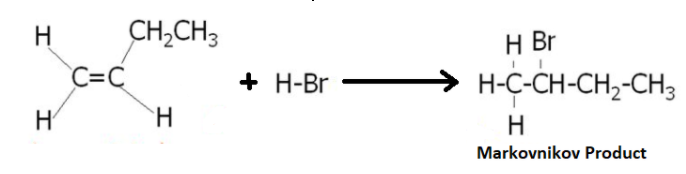
When we use Benzoyl peroxide or $O_2$, the product obtained changes from Markovnikov Product to Anti-Markovnikov product as shown below
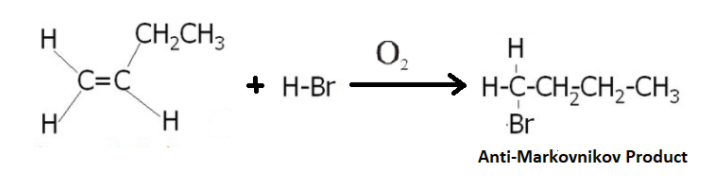
Now in this question we have been asked to find the alkene which does not observe the Anti-Markovnikov Rule. We Know that this rule is observed in unsymmetrical alkenes. So we will check each and every option.
A. Propene: Propene is an unsymmetrical alkene with double bond between $C-1$ and $C-2$, so this will give both Markovnikov as well as Anti-Markovnikov product. So option A is incorrect.
B. 1-Butene: 1-Butene is an unsymmetrical alkene with double bond between $C-1$ and $C-2$, so this will give both Markovnikov as well as Anti-Markovnikov product. So option B is incorrect.
C. But-2-ene: But-2-ene is a symmetrical alkene with double bond between $C-2$ and $C-3$, so this will give only one product and therefore does not observe the Anti-Markovnikov rule for additional reaction. So option C is Correct.
D. Pent-2-ene: Pent-2-ene is an unsymmetrical alkene with double bond between $C-2$ and $C-3$, so this will give both Markovnikov as well as Anti-Markovnikov product. So option D is incorrect.
So, the correct option is C. But-2-ene.
Note: In the case of anti-markovnikov products, the stability of carbocation is irrelevant as the mechanism involved in this case is the Free radical addition mechanism. It generally represents the exact opposite of that of markovnikov rule.
Complete Step by step answer: We know that whenever a polar molecule is added to an unsymmetrical alkene the general product that is formed when the negative part attacks the C-atom having more number of substituents(lesser no. of H-atoms) which is due to the higher hyperconjugative and inductive effects reducing the positive charge density on the given C-atom. The product obtained in this case is called Markovnikov product.
This can be shown by the following reaction:
When we use Benzoyl peroxide or $O_2$, the product obtained changes from Markovnikov Product to Anti-Markovnikov product as shown below
Now in this question we have been asked to find the alkene which does not observe the Anti-Markovnikov Rule. We Know that this rule is observed in unsymmetrical alkenes. So we will check each and every option.
A. Propene: Propene is an unsymmetrical alkene with double bond between $C-1$ and $C-2$, so this will give both Markovnikov as well as Anti-Markovnikov product. So option A is incorrect.
B. 1-Butene: 1-Butene is an unsymmetrical alkene with double bond between $C-1$ and $C-2$, so this will give both Markovnikov as well as Anti-Markovnikov product. So option B is incorrect.
C. But-2-ene: But-2-ene is a symmetrical alkene with double bond between $C-2$ and $C-3$, so this will give only one product and therefore does not observe the Anti-Markovnikov rule for additional reaction. So option C is Correct.
D. Pent-2-ene: Pent-2-ene is an unsymmetrical alkene with double bond between $C-2$ and $C-3$, so this will give both Markovnikov as well as Anti-Markovnikov product. So option D is incorrect.
So, the correct option is C. But-2-ene.
Note: In the case of anti-markovnikov products, the stability of carbocation is irrelevant as the mechanism involved in this case is the Free radical addition mechanism. It generally represents the exact opposite of that of markovnikov rule.
Recently Updated Pages
Master Class 12 Economics: Engaging Questions & Answers for Success

Master Class 12 English: Engaging Questions & Answers for Success
Master Class 12 Social Science: Engaging Questions & Answers for Success
Master Class 12 Maths: Engaging Questions & Answers for Success
Master Class 12 Physics: Engaging Questions & Answers for Success
Master Class 11 Social Science: Engaging Questions & Answers for Success
Trending doubts
One Metric ton is equal to kg A 10000 B 1000 C 100 class 11 physics CBSE
Difference Between Prokaryotic Cells and Eukaryotic Cells
Find the value of the expression given below sin 30circ class 11 maths CBSE
1 ton equals to A 100 kg B 1000 kg C 10 kg D 10000 class 11 physics CBSE
Two of the body parts which do not appear in MRI are class 11 biology CBSE
Draw a diagram of nephron and explain its structur class 11 biology CBSE