



Answer the following questions:
(i) Give the other two names of ethanol.
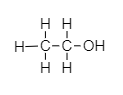
(ii) Give the structural formula of ethanol.
(iii) Give two properties of ethanol
(iv) Explain the action of phosphorus trichloride with ethanol. Write the balanced chemical equation of the above reaction.
Answer
 Verified
672.6k+ views
Hint: Ethanol is a straight-chain alcohol, and its molecular formula is ${ C }_{ 2 }{ H }_{ 5 }{ OH }$. Ethanol, also called pure alcohol, grain alcohol, or drinking alcohol, is a volatile, flammable, colorless liquid.
Complete answer:
(i) The other two names of ethanol are cologne spirit and alcohol.
(ii) The structural formula of ethanol is;
(iii) The two properties of ethanol are;
It is a monohydric primary alcohol. The melting point of ethanol is ${ -117 }^{ \circ }{ C }$ and the boiling point is ${ 78.5 }^{ \circ }{ C }$
When ethanol burns in the air it gives a blue flame, forming carbon dioxide and water. Ethanol reacts with active metals to form metal ethoxide and water.
For example: when ethanol reacts with sodium metal it will form sodium ethoxide.
(iv) The action of phosphorus trichloride with ethanol: ${ PCl }_{ 3 }$ reacts with ethanol it gives phosphorus acid and ethyl chloride. The following reaction will take place;
${ PCl }_{ 3 }{ +3C }_{ 2 }{ H }_{ 5 }{ OH\rightarrow }{ H }_{ 3 }{ PO }_{ 3 }{ +3CH }_{ 3 }{ CH }_{ 2 }{ Cl }$
Additional Information:
Uses of ethanol are:
It is used as the fluid in thermometers.
It is used in the preparation of organic compounds.
It is used in the manufacture of paints, varnishes, and medicines.
Note: The possibility to make a mistake is that when ${ PCl }_{ 3 }$ reacts with ethanol phosphorus acid will be produced while ${ PCl }_{ 5 }$ reacts with ethanol then phosphorus oxychloride will be formed. Don’t confuse between these two compounds.
Complete answer:
(i) The other two names of ethanol are cologne spirit and alcohol.
(ii) The structural formula of ethanol is;
(iii) The two properties of ethanol are;
It is a monohydric primary alcohol. The melting point of ethanol is ${ -117 }^{ \circ }{ C }$ and the boiling point is ${ 78.5 }^{ \circ }{ C }$
When ethanol burns in the air it gives a blue flame, forming carbon dioxide and water. Ethanol reacts with active metals to form metal ethoxide and water.
For example: when ethanol reacts with sodium metal it will form sodium ethoxide.
(iv) The action of phosphorus trichloride with ethanol: ${ PCl }_{ 3 }$ reacts with ethanol it gives phosphorus acid and ethyl chloride. The following reaction will take place;
${ PCl }_{ 3 }{ +3C }_{ 2 }{ H }_{ 5 }{ OH\rightarrow }{ H }_{ 3 }{ PO }_{ 3 }{ +3CH }_{ 3 }{ CH }_{ 2 }{ Cl }$
Additional Information:
Uses of ethanol are:
It is used as the fluid in thermometers.
It is used in the preparation of organic compounds.
It is used in the manufacture of paints, varnishes, and medicines.
Note: The possibility to make a mistake is that when ${ PCl }_{ 3 }$ reacts with ethanol phosphorus acid will be produced while ${ PCl }_{ 5 }$ reacts with ethanol then phosphorus oxychloride will be formed. Don’t confuse between these two compounds.
Recently Updated Pages
Which will be the least stable resonating structure class 11 chemistry CBSE

How many 5 digit telephone numbers can be construc-class-11-maths-CBSE
How do you find the angle of the resultant vector class 11 physics CBSE
Draw labelled diagram of the following i Gram seed class 11 biology CBSE
1 Quintal is equal to a 110 kg b 10 kg c 100kg d 1000 class 11 physics CBSE
What is the need and importance of classification class 11 biology CBSE
Trending doubts
Find the value of the expression given below sin 30circ class 11 maths CBSE
One Metric ton is equal to kg A 10000 B 1000 C 100 class 11 physics CBSE
10 examples of friction in our daily life
Draw a diagram of a plant cell and label at least eight class 11 biology CBSE
Difference between physical and chemical change class 11 chemistry CBSE
Proton was discovered by A Thomson B Rutherford C Chadwick class 11 chemistry CBSE