




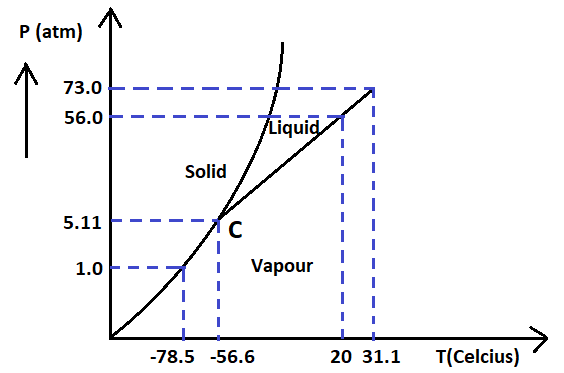
Answer the following questions based on the P-T phase diagram of $C{O_2}$.
(A) $C{O_2}$ at 1 atm pressure and temperature -60$^ \circ C$ is compressed isothermally. Does it go through a liquid phase?
(B) What happens when $C{O_2}$ at 4 atm pressure is cooled from room temperature at constant pressure?
(C) Describe qualitatively the change in a given mass of solid $C{O_2}$ at 10 atm pressure and temperature -60$^ \circ C$ as it is heated upto room temperature at constant pressure.
(D) $C{O_2}$ is heated to a temperature 70$^ \circ C$ and compressed isothermally. What changes in its properties do you expect to observe?
Answer
 Verified
585k+ views
Hint: To answer this question the graph must be studied carefully and necessary calculations should be made while solving the questions. The given graph is a pressure-temperature graph of a gas. The graph is also showing the different phases of the gas at different conditions of temperature and pressure.
Complete step by step answer:
Let’s look at the answer of the given question:
-In part (A) the gas is compressed isothermally at 1 atm pressure and -60$^ \circ C$ temperature. This temperature lies in the vapour phase of the gas. So, from the graph it is evident that the gas will get directly converted to solid.
Hence, it will not pass through the liquid phase.
-In part (B) the gas is cooled at 4 atm pressure which is less than 5.11 atm from room temperature. The gas will get directly converted into solid form without going through the liquid phase.
-In part (C) the gas is heated to room temperature from 10 atm pressure and -60$^ \circ C$ temperature. On heating the gas will first get converted to liquid and then to vapour form.
-In part (D) the gas is heated to 70$^ \circ C$ and compressed isothermally. 70$^ \circ C$ is much higher than the critical temperature, hence, no further liquefaction will occur. It will exist in vapour form only but will show more real gas behavior.
Note: Critical temperature of a gas is a temperature above which a gas cannot be liquefied however high pressure may be applied on the gas. A phase is a chemically and physically homogeneous part of a system. A substance can exist in all the three phases at the same temperature at a given pressure. This point is known as the Triple point of the substance.
Complete step by step answer:
Let’s look at the answer of the given question:
-In part (A) the gas is compressed isothermally at 1 atm pressure and -60$^ \circ C$ temperature. This temperature lies in the vapour phase of the gas. So, from the graph it is evident that the gas will get directly converted to solid.
Hence, it will not pass through the liquid phase.
-In part (B) the gas is cooled at 4 atm pressure which is less than 5.11 atm from room temperature. The gas will get directly converted into solid form without going through the liquid phase.
-In part (C) the gas is heated to room temperature from 10 atm pressure and -60$^ \circ C$ temperature. On heating the gas will first get converted to liquid and then to vapour form.
-In part (D) the gas is heated to 70$^ \circ C$ and compressed isothermally. 70$^ \circ C$ is much higher than the critical temperature, hence, no further liquefaction will occur. It will exist in vapour form only but will show more real gas behavior.
Note: Critical temperature of a gas is a temperature above which a gas cannot be liquefied however high pressure may be applied on the gas. A phase is a chemically and physically homogeneous part of a system. A substance can exist in all the three phases at the same temperature at a given pressure. This point is known as the Triple point of the substance.
Recently Updated Pages
Master Class 11 Computer Science: Engaging Questions & Answers for Success

Master Class 11 Business Studies: Engaging Questions & Answers for Success
Master Class 11 Economics: Engaging Questions & Answers for Success
Master Class 11 English: Engaging Questions & Answers for Success
Master Class 11 Maths: Engaging Questions & Answers for Success
Master Class 11 Biology: Engaging Questions & Answers for Success
Trending doubts
One Metric ton is equal to kg A 10000 B 1000 C 100 class 11 physics CBSE
There are 720 permutations of the digits 1 2 3 4 5 class 11 maths CBSE
Discuss the various forms of bacteria class 11 biology CBSE
Draw a diagram of a plant cell and label at least eight class 11 biology CBSE
State the laws of reflection of light
Explain zero factorial class 11 maths CBSE