




Animals without vertebral column are known as
(a) Vertebrates
(b) Invertebrates
(c) Mammals
(d) Fungi
Answer
 Verified
596.7k+ views
Hint: These include all animals aside from the subphylum Vertebrata. They exist anywhere. They are so much that it is almost impossible to count them all. There are numerous different sizes and shapes and supply services that are vital to our survival.
Complete step by step answer:
Animals without vertebral columns are known as Invertebrates. Instead, most of the invertebrates have an exoskeleton that encompasses the entire body. Basically, these are small and don’t grow very large. They do not possess lungs since they respire through their skin. Since they can't produce their own food, Invertebrates are heterotrophic. Reproduction occurs through the fission of gametes.
Additional information: Invertebrates contain all the animals that do not come within the vertebrates group. Those who have vertebral columns are known as vertebrates. There are mainly four sorts of invertebrates as listed below by Phylum.
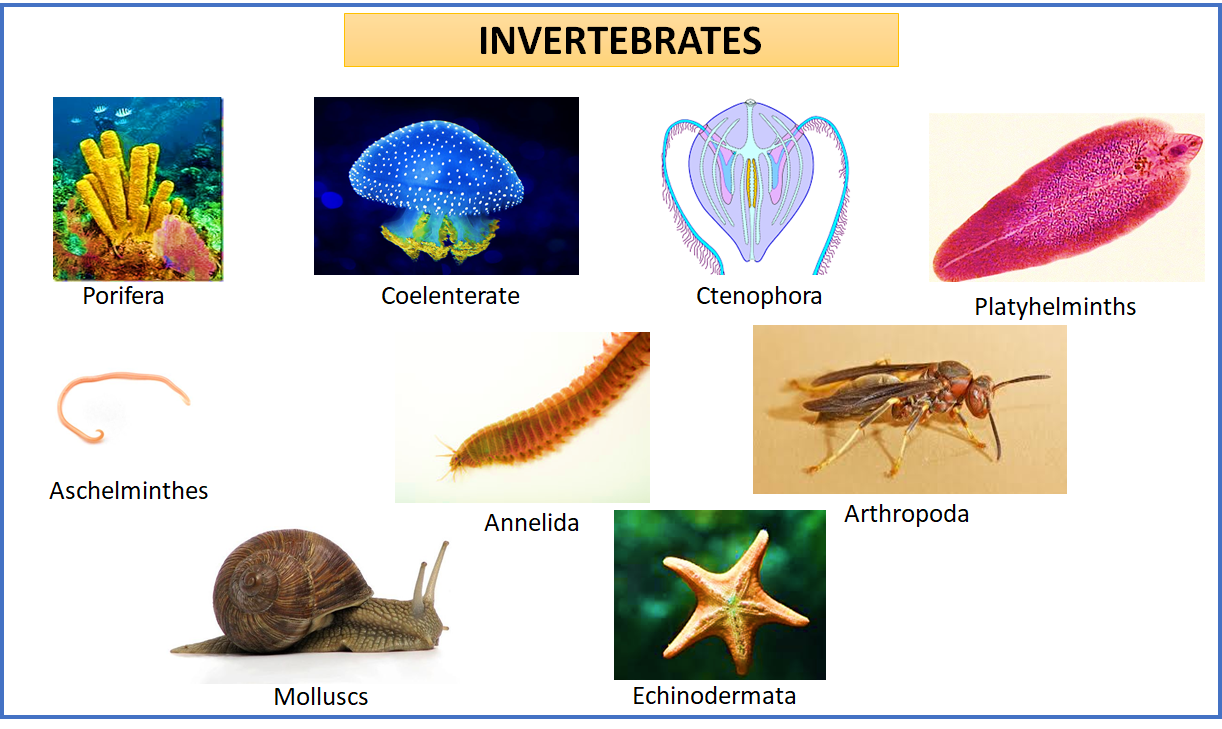 Phylum Mollusca: These animals do not contain the segmented body. Mollusca skin made up of a mantle that releases a shell.
Phylum Annelida: The group of Annelids contains numerous worms. Their bodies are segmented. Phylum Arthropods: Arthropods are animals that do contain a segmented body. Their bodies are bilaterally symmetrical with a powerful exoskeleton. Phylum Coelenterata: The body of Coelenterates possesses radially symmetrical. They are diploblastic animals.
So, the correct answer is 'Invertebrates'.
Note: The observation of invertebrates has also benefited enforcement, as arthropods, and particularly insects, were found to be a source of data for forensic investigators. Invertebrates also are employed by scientists within the field of aquatic biomonitoring to judge the consequences of pollution and global climate change.
Complete step by step answer:
Animals without vertebral columns are known as Invertebrates. Instead, most of the invertebrates have an exoskeleton that encompasses the entire body. Basically, these are small and don’t grow very large. They do not possess lungs since they respire through their skin. Since they can't produce their own food, Invertebrates are heterotrophic. Reproduction occurs through the fission of gametes.
Additional information: Invertebrates contain all the animals that do not come within the vertebrates group. Those who have vertebral columns are known as vertebrates. There are mainly four sorts of invertebrates as listed below by Phylum.
Phylum Annelida: The group of Annelids contains numerous worms. Their bodies are segmented. Phylum Arthropods: Arthropods are animals that do contain a segmented body. Their bodies are bilaterally symmetrical with a powerful exoskeleton. Phylum Coelenterata: The body of Coelenterates possesses radially symmetrical. They are diploblastic animals.
So, the correct answer is 'Invertebrates'.
Note: The observation of invertebrates has also benefited enforcement, as arthropods, and particularly insects, were found to be a source of data for forensic investigators. Invertebrates also are employed by scientists within the field of aquatic biomonitoring to judge the consequences of pollution and global climate change.
Recently Updated Pages
Three beakers labelled as A B and C each containing 25 mL of water were taken A small amount of NaOH anhydrous CuSO4 and NaCl were added to the beakers A B and C respectively It was observed that there was an increase in the temperature of the solutions contained in beakers A and B whereas in case of beaker C the temperature of the solution falls Which one of the following statements isarecorrect i In beakers A and B exothermic process has occurred ii In beakers A and B endothermic process has occurred iii In beaker C exothermic process has occurred iv In beaker C endothermic process has occurred

Master Class 11 Social Science: Engaging Questions & Answers for Success
Master Class 11 Physics: Engaging Questions & Answers for Success
Master Class 11 Maths: Engaging Questions & Answers for Success
Master Class 11 Economics: Engaging Questions & Answers for Success
Master Class 11 Computer Science: Engaging Questions & Answers for Success
Three beakers labelled as A B and C each containing 25 mL of water were taken A small amount of NaOH anhydrous CuSO4 and NaCl were added to the beakers A B and C respectively It was observed that there was an increase in the temperature of the solutions contained in beakers A and B whereas in case of beaker C the temperature of the solution falls Which one of the following statements isarecorrect i In beakers A and B exothermic process has occurred ii In beakers A and B endothermic process has occurred iii In beaker C exothermic process has occurred iv In beaker C endothermic process has occurred
Master Class 11 Social Science: Engaging Questions & Answers for Success
Master Class 11 Physics: Engaging Questions & Answers for Success
Trending doubts
One Metric ton is equal to kg A 10000 B 1000 C 100 class 11 physics CBSE
There are 720 permutations of the digits 1 2 3 4 5 class 11 maths CBSE
State and prove Bernoullis theorem class 11 physics CBSE
Difference Between Prokaryotic Cells and Eukaryotic Cells
1 Quintal is equal to a 110 kg b 10 kg c 100kg d 1000 class 11 physics CBSE
Discuss the various forms of bacteria class 11 biology CBSE