




Animals with self-fertilization is
(a) Paragonimus
(b) Dugesia
(c) Taenia solium
(d) None of them
Answer
 Verified
601.2k+ views
Hint: The process of self-fertilization or autogamy occurs in hermaphrodite or bisexual organisms. Autogamy is predominantly observed in the form of self-pollination, a reproductive mechanism employed by many flowering plants, numerous protozoans, and many invertebrates.
Complete answer
That means self-fertilization is a process where the fusion of male and female gametes (sex cells) occurs which were produced by the same individual. In this condition, the male reproductive organs mature first. This occurs in the younger, immature proglottids. As it has been seen that newer proglottids develop from the neck region, the protandrous proglottids get moved closer to the middle region of the tapeworm, during that time they become mature. Both male and female reproductive organs are seen side by side in the mature proglottids. Those mature proglottids can self-fertilize or cross-fertilize with other mature proglottids then.
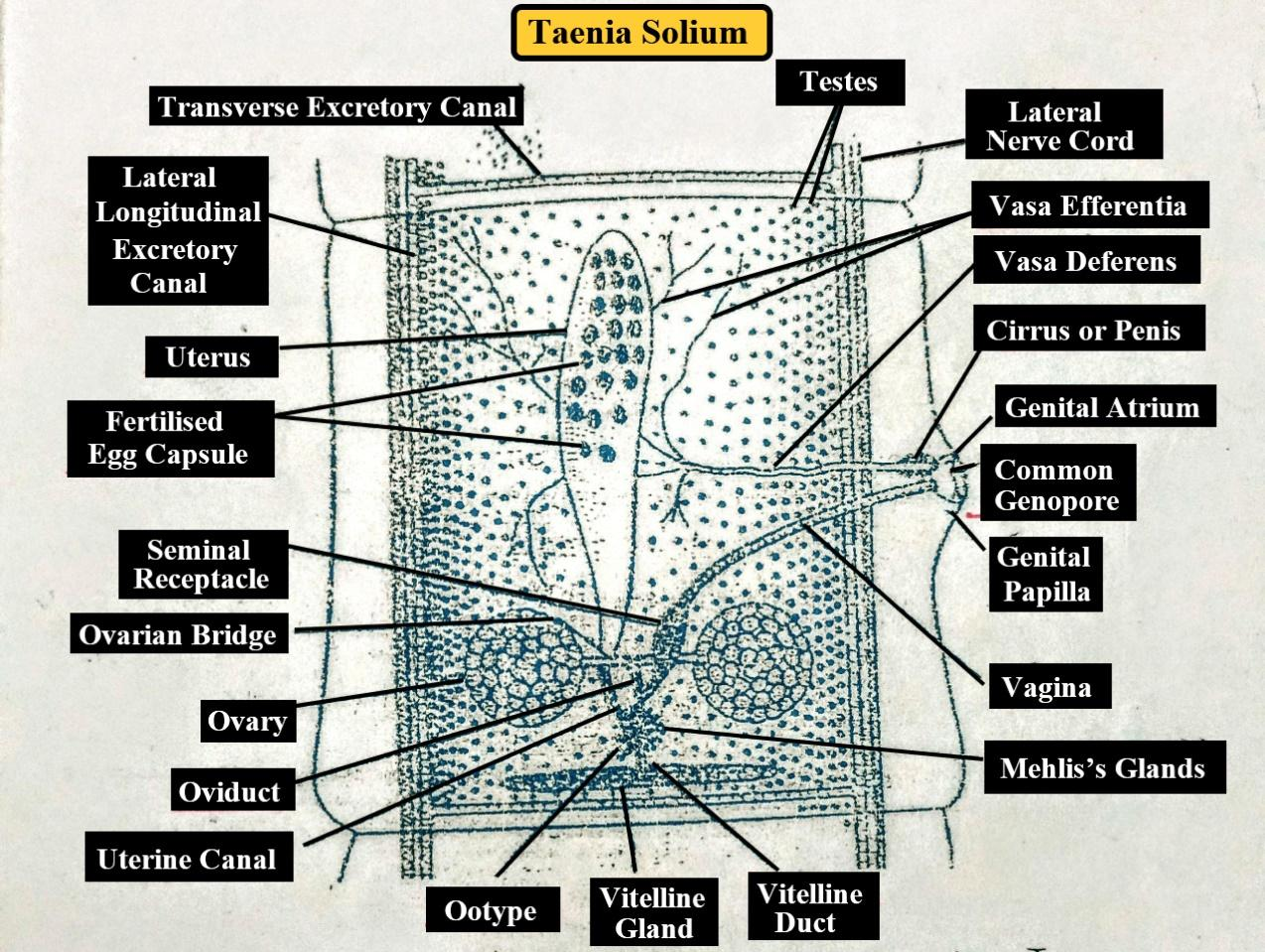
So, the correct answer is,’(c) Taenia solium’.
Additional information:
1) As an evolutionary and reproductive mechanism, autogamy or selfing allows an isolated individual to create a local population and stabilizes desirable genetic strains.
2) One of the most common evolutionary changes in plants is the transition from outcrossing to self-fertilization, yet only about 10–15% of flowering plants are predominantly selfing.
3) Self-pollination has a major limitation associated with predominantly outbreeding species is the decrease in plant performance and fitness associated with inbreeding depression, i.e. the accumulation of deleterious alleles in the progeny.
4) possibility of self-fertilization also offers new ways for hybrid breeding based on the development of homogenous inbred lines.
Note: In Taenia solium cross-fertilization also occurs where sperms produced in a proglottid fertilize ova produced in another mature proglottid of the same worm. In paragonimus and dugesia self-fertilization is absent. In human te disease, taeniasis is caused by the infection that occurs with the adult stage of the tapeworms Taenia saginata and Taenia solium. Human diseases like cysticercosis/neurocysticercosis results from infection with the larvae (cysticerci) of the Taenia solium. These parasites took their usual hosts for the cysticerci are cattle and swine respectively, from which humans become infected with the matured Taenia species.
Complete answer
That means self-fertilization is a process where the fusion of male and female gametes (sex cells) occurs which were produced by the same individual. In this condition, the male reproductive organs mature first. This occurs in the younger, immature proglottids. As it has been seen that newer proglottids develop from the neck region, the protandrous proglottids get moved closer to the middle region of the tapeworm, during that time they become mature. Both male and female reproductive organs are seen side by side in the mature proglottids. Those mature proglottids can self-fertilize or cross-fertilize with other mature proglottids then.
So, the correct answer is,’(c) Taenia solium’.
Additional information:
1) As an evolutionary and reproductive mechanism, autogamy or selfing allows an isolated individual to create a local population and stabilizes desirable genetic strains.
2) One of the most common evolutionary changes in plants is the transition from outcrossing to self-fertilization, yet only about 10–15% of flowering plants are predominantly selfing.
3) Self-pollination has a major limitation associated with predominantly outbreeding species is the decrease in plant performance and fitness associated with inbreeding depression, i.e. the accumulation of deleterious alleles in the progeny.
4) possibility of self-fertilization also offers new ways for hybrid breeding based on the development of homogenous inbred lines.
Note: In Taenia solium cross-fertilization also occurs where sperms produced in a proglottid fertilize ova produced in another mature proglottid of the same worm. In paragonimus and dugesia self-fertilization is absent. In human te disease, taeniasis is caused by the infection that occurs with the adult stage of the tapeworms Taenia saginata and Taenia solium. Human diseases like cysticercosis/neurocysticercosis results from infection with the larvae (cysticerci) of the Taenia solium. These parasites took their usual hosts for the cysticerci are cattle and swine respectively, from which humans become infected with the matured Taenia species.
Recently Updated Pages
Master Class 12 Social Science: Engaging Questions & Answers for Success

Master Class 12 Physics: Engaging Questions & Answers for Success
Master Class 12 Maths: Engaging Questions & Answers for Success
Master Class 12 Economics: Engaging Questions & Answers for Success
Master Class 12 Chemistry: Engaging Questions & Answers for Success
Master Class 12 Business Studies: Engaging Questions & Answers for Success
Trending doubts
Which are the Top 10 Largest Countries of the World?
Draw a labelled sketch of the human eye class 12 physics CBSE
Explain the structure of megasporangium class 12 biology CBSE
What are the major means of transport Explain each class 12 social science CBSE
How many chromosomes are found in human ovum a 46 b class 12 biology CBSE
The diagram of the section of a maize grain is given class 12 biology CBSE