




What is the angle subtended by \[1m\] pole at a distance \[1km\] on the ground in sexagesimal measure?
(A) \[\dfrac{9}{50\pi }\]
(B) \[\dfrac{9}{5\pi }\]
(C) \[3.4\min \]
(D) \[3.5\min \]
Answer
 Verified
545.4k+ views
Hint: We will first suppose that the angle subtended by the pole as \[\theta \]. The given description figures out a right angled triangle, which has the \[1m\] pole as the perpendicular and the \[1km\] on the ground as the base. We will now use the trigonometric function of tangent as only the perpendicular and base is given. Solving the expression gives the value of \[\theta \].
Complete step by step solution:
According to the given question, we have to find the angle subtended by the pole on the ground at a distance of \[1km\].
Sexagesimal measure refers to the use of minutes and seconds while describing or representing an angle which was previously described only using degrees.
Example - \[121.13{{5}^{\circ }}\sim {{121}^{\circ }}8'6''\]
In the question, we are given a pole which is \[1m\] long. The pole subtends an angle on the ground at a distance of \[1km\].
Let us suppose that the angle subtended by the pole on the ground be \[\theta \].
We have,
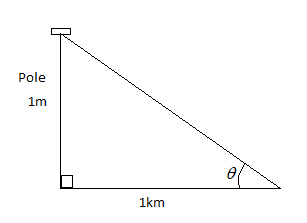
Since, we know the values of perpendicular and the base, so we can use the tangent function to find the angle subtended.
We have,
\[\tan \theta =\dfrac{1m}{1km}\]
As we know that, \[1km=1000m\]
So, we have,
\[\Rightarrow \tan \theta =\dfrac{1m}{1000m}=0.001\]
As we can see that the value of \[\tan \theta \] is very small, so we can assume that \[\tan \theta \] approximately as \[\theta \]
\[\theta ={{0.001}^{\circ }}\]
We can see there are no such answers in the options given.
We will convert it into radians and we get,
\[\Rightarrow \theta ={{0.001}^{\circ }}\times \dfrac{{{180}^{\circ }}}{\pi }\]
\[\Rightarrow \theta =\dfrac{1}{1000}\times \dfrac{180}{\pi }\]
\[\Rightarrow \theta =\dfrac{1}{100}\times \dfrac{18}{\pi }\]
\[\Rightarrow \theta =\dfrac{9}{50\pi }\]
Therefore, the angle subtended by a pole on the ground is (A) \[\dfrac{9}{50\pi }\].
So, the correct answer is “Option A”.
Note: Making the figure of the description as given in the question gives a clear sight of what to be found and also the ‘how’ as well. When we solved the trigonometric function, we got a value which was very small than 1. So we took \[\tan \theta \approx \theta ={{0.001}^{\circ }}\]. And the value of the angle we got was not in the options provided, so we converted it into the radians form. So, it is advisable to keep an eye on the options as well while solving the question and modify wherever required.
Complete step by step solution:
According to the given question, we have to find the angle subtended by the pole on the ground at a distance of \[1km\].
Sexagesimal measure refers to the use of minutes and seconds while describing or representing an angle which was previously described only using degrees.
Example - \[121.13{{5}^{\circ }}\sim {{121}^{\circ }}8'6''\]
In the question, we are given a pole which is \[1m\] long. The pole subtends an angle on the ground at a distance of \[1km\].
Let us suppose that the angle subtended by the pole on the ground be \[\theta \].
We have,
Since, we know the values of perpendicular and the base, so we can use the tangent function to find the angle subtended.
We have,
\[\tan \theta =\dfrac{1m}{1km}\]
As we know that, \[1km=1000m\]
So, we have,
\[\Rightarrow \tan \theta =\dfrac{1m}{1000m}=0.001\]
As we can see that the value of \[\tan \theta \] is very small, so we can assume that \[\tan \theta \] approximately as \[\theta \]
\[\theta ={{0.001}^{\circ }}\]
We can see there are no such answers in the options given.
We will convert it into radians and we get,
\[\Rightarrow \theta ={{0.001}^{\circ }}\times \dfrac{{{180}^{\circ }}}{\pi }\]
\[\Rightarrow \theta =\dfrac{1}{1000}\times \dfrac{180}{\pi }\]
\[\Rightarrow \theta =\dfrac{1}{100}\times \dfrac{18}{\pi }\]
\[\Rightarrow \theta =\dfrac{9}{50\pi }\]
Therefore, the angle subtended by a pole on the ground is (A) \[\dfrac{9}{50\pi }\].
So, the correct answer is “Option A”.
Note: Making the figure of the description as given in the question gives a clear sight of what to be found and also the ‘how’ as well. When we solved the trigonometric function, we got a value which was very small than 1. So we took \[\tan \theta \approx \theta ={{0.001}^{\circ }}\]. And the value of the angle we got was not in the options provided, so we converted it into the radians form. So, it is advisable to keep an eye on the options as well while solving the question and modify wherever required.
Recently Updated Pages
Master Class 11 Computer Science: Engaging Questions & Answers for Success

Master Class 11 Business Studies: Engaging Questions & Answers for Success
Master Class 11 Economics: Engaging Questions & Answers for Success
Master Class 11 English: Engaging Questions & Answers for Success
Master Class 11 Maths: Engaging Questions & Answers for Success
Master Class 11 Biology: Engaging Questions & Answers for Success
Trending doubts
One Metric ton is equal to kg A 10000 B 1000 C 100 class 11 physics CBSE
There are 720 permutations of the digits 1 2 3 4 5 class 11 maths CBSE
Discuss the various forms of bacteria class 11 biology CBSE
Draw a diagram of a plant cell and label at least eight class 11 biology CBSE
State the laws of reflection of light
Explain zero factorial class 11 maths CBSE