




Anapsid skull is found in _____
A.Crocodiles
B.Chelonia
C.Squamata
D.Rhynchocephalia
Answer
 Verified
602.4k+ views
Hint: Anapsid is a type of skull in which the skull lacks more than one skull openings which is the fenestra near the temple. This type of skull is very primitive and belongs to the subclass of reptiles, The Synapsids and Diapsids evolved from the ancestral stock making the anapsid paraphyletic.
Complete step by step answer:
Crocodiles- Crocodiles have a diapsid type of skull and they are a group of amniote tetrapods which developed two holes at each side of their skull about three hundred million years ago during the Carboniferous period. These diapsids are very diverse and include all types of crocodiles, snakes, lizards, tuatara, birds, and turtles.
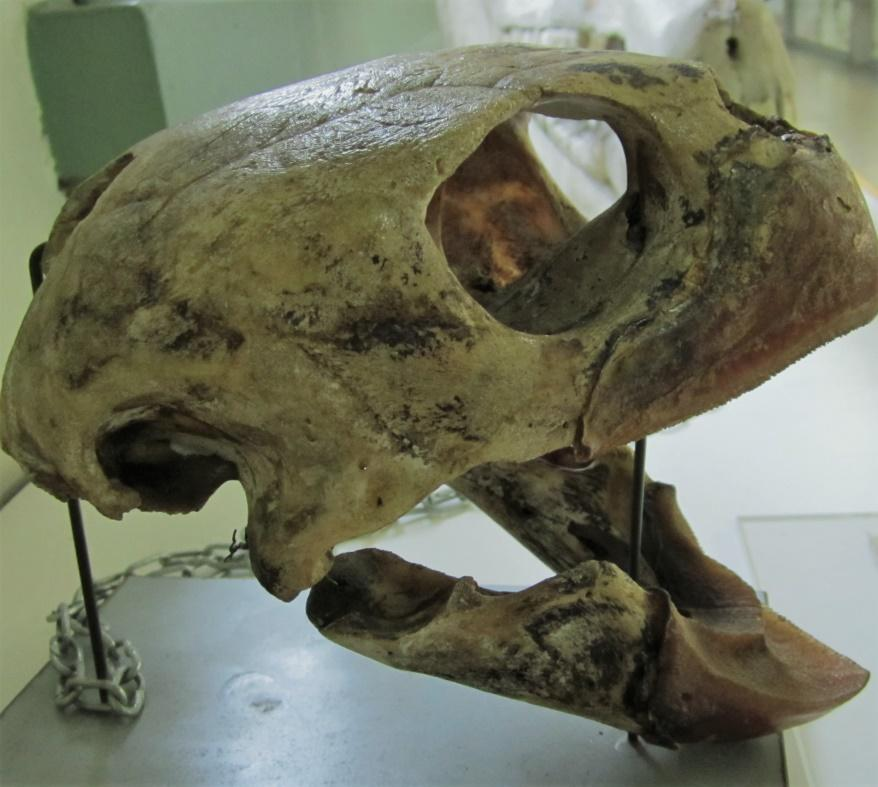
Chelonia- The anapsid reptiles have primitive skulls and are characterized by no temporal openings. Turtles are the only living creature of this clade and it belongs to one order which is referred to as Testudines, Chelonia, or Testudinata.
Squamata- These animals are diapsid like crocodiles. They are a group of reptiles that has two holes on each side of their skull.
Rhyncocephalia- These animals have a diapsid skull and lack a whole lower temporal bar, which separates from the other species and they also have a pair of incisor-like teeth.
Hence the correct answer is option B, Chelonia.
Below is the picture of a skull of Chelonia.
Additional Information:
Anapsida or anapsid reptiles were said to be a monophyletic group, it has been said that many groups of reptiles that have anapsid skulls might be distantly related. Researchers till now debate over the exact relationship between the reptiles which appeared in the late Carboniferous and the Testudines. Later it was said that the turtle anapsid skull was due to the reversion rather than being the descendant of the anapsid.
Note:
The anapsid type of skull is found in Chelonia( turtles and tortoises). An anapsid skull does not have openings near the temple areas. They have a solid bony top found in the primitive reptiles.
Complete step by step answer:
Crocodiles- Crocodiles have a diapsid type of skull and they are a group of amniote tetrapods which developed two holes at each side of their skull about three hundred million years ago during the Carboniferous period. These diapsids are very diverse and include all types of crocodiles, snakes, lizards, tuatara, birds, and turtles.
Chelonia- The anapsid reptiles have primitive skulls and are characterized by no temporal openings. Turtles are the only living creature of this clade and it belongs to one order which is referred to as Testudines, Chelonia, or Testudinata.
Squamata- These animals are diapsid like crocodiles. They are a group of reptiles that has two holes on each side of their skull.
Rhyncocephalia- These animals have a diapsid skull and lack a whole lower temporal bar, which separates from the other species and they also have a pair of incisor-like teeth.
Hence the correct answer is option B, Chelonia.
Below is the picture of a skull of Chelonia.
Additional Information:
Anapsida or anapsid reptiles were said to be a monophyletic group, it has been said that many groups of reptiles that have anapsid skulls might be distantly related. Researchers till now debate over the exact relationship between the reptiles which appeared in the late Carboniferous and the Testudines. Later it was said that the turtle anapsid skull was due to the reversion rather than being the descendant of the anapsid.
Note:
The anapsid type of skull is found in Chelonia( turtles and tortoises). An anapsid skull does not have openings near the temple areas. They have a solid bony top found in the primitive reptiles.
Recently Updated Pages
Master Class 11 Social Science: Engaging Questions & Answers for Success

Master Class 11 English: Engaging Questions & Answers for Success
Master Class 11 Maths: Engaging Questions & Answers for Success
Master Class 11 Chemistry: Engaging Questions & Answers for Success
Master Class 11 Biology: Engaging Questions & Answers for Success
Master Class 11 Physics: Engaging Questions & Answers for Success
Trending doubts
One Metric ton is equal to kg A 10000 B 1000 C 100 class 11 physics CBSE
Difference Between Prokaryotic Cells and Eukaryotic Cells
Draw a diagram of a plant cell and label at least eight class 11 biology CBSE
Two of the body parts which do not appear in MRI are class 11 biology CBSE
Which gas is abundant in air class 11 chemistry CBSE
10 examples of friction in our daily life