




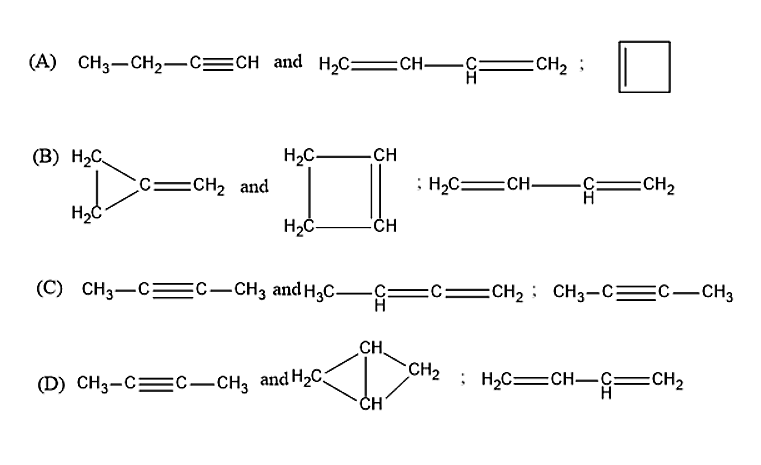
An organic compound of molecular formula \[{C_4}{H_6}\] (A), forms precipitate with ammoniacal silver nitrate and ammoniacal cuprous chloride. ‘A’ has an isomer ‘B’, one mole of which reacts with one mole of \[B{r_2}\] to form 1,4-dibromo-2-butene. Another isomer of ‘A’ is ‘C’, 1 mole of C reacts with only 1 mole of \[B{r_2}\]to give vicinal dibromide. A, B & C.
Answer
 Verified
579.3k+ views
Hint: First thing we have to do in this reaction is to find the compound A from the molecular formula given. Then only we will be able to carry out the further reaction and then find the compound B and C.
Complete answer:
An organic compound is given which has a molecular formula of \[{C_4}{H_6}\]. When the compound A reacts with the ammoniacal silver nitrate and ammoniacal cuprous chloride, it will form a precipitate. Hence, the compound A was found to be 1-Butyne.
1-Butyne is having an isomer, i.e., the compound B. One mole of the compound B will react with one mole of the bromine molecule to form 1,4-Dibromo-2-butene. Therefore, the compound B was found to be 1,4-Butadiene.
Butyne is also having another isomer other than 1,4-Butadiene, i.e., the compound C. One mole of the compound C will react with one mole of the Bromine molecule to give vicinal dibromide. Therefore, the compound C is found to be 1-Cyclobutene.
Therefore, the correct answer is option (A).
Note:
We should always be careful while finding the compound A, because by knowing it only we would be able to carry out the rest of the reaction. If we make a mistake in finding it, then there is a chance that the whole reaction can go wrong.
Complete answer:
An organic compound is given which has a molecular formula of \[{C_4}{H_6}\]. When the compound A reacts with the ammoniacal silver nitrate and ammoniacal cuprous chloride, it will form a precipitate. Hence, the compound A was found to be 1-Butyne.
1-Butyne is having an isomer, i.e., the compound B. One mole of the compound B will react with one mole of the bromine molecule to form 1,4-Dibromo-2-butene. Therefore, the compound B was found to be 1,4-Butadiene.
Butyne is also having another isomer other than 1,4-Butadiene, i.e., the compound C. One mole of the compound C will react with one mole of the Bromine molecule to give vicinal dibromide. Therefore, the compound C is found to be 1-Cyclobutene.
Therefore, the correct answer is option (A).
Note:
We should always be careful while finding the compound A, because by knowing it only we would be able to carry out the rest of the reaction. If we make a mistake in finding it, then there is a chance that the whole reaction can go wrong.
Recently Updated Pages
Master Class 11 English: Engaging Questions & Answers for Success

Master Class 11 Social Science: Engaging Questions & Answers for Success
Master Class 11 Maths: Engaging Questions & Answers for Success
Master Class 11 Biology: Engaging Questions & Answers for Success
Master Class 11 Physics: Engaging Questions & Answers for Success
Master Class 11 Chemistry: Engaging Questions & Answers for Success
Trending doubts
One Metric ton is equal to kg A 10000 B 1000 C 100 class 11 physics CBSE
Difference Between Prokaryotic Cells and Eukaryotic Cells
1 ton equals to A 100 kg B 1000 kg C 10 kg D 10000 class 11 physics CBSE
Find the value of the expression given below sin 30circ class 11 maths CBSE
Two of the body parts which do not appear in MRI are class 11 biology CBSE
What are hard magnetic materials class 11 physics CBSE