




An open glass tube is immersed in mercury in such a way that a length of $8cm$ tends about the molecular level. The open end of the tube is closed and sealed and the tube is raised vertically up by an additional $48cm$. What will be the length of the air column about mercury in the tube now? (Atmospheric pressure= $76cm$ of Hg)
(A). $38cm$
(B). $6cm$
(C). $16cm$
(D). $22cm$
Answer
 Verified
590.4k+ views
Hint: Give, the tube is first raised by $8cm$ and then raised by $48cm$. In the first condition, the pressure will be due to the air column only but in the second condition, the pressure will be due to mercury as well as air column. Using the ideal gas law equation and formula for pressure in a fluid and equating the pressures at equilibrium point, we can calculate the length of the air column.
Formulas used:
$PV=nRT$
$P=\rho gh$
Complete answer:
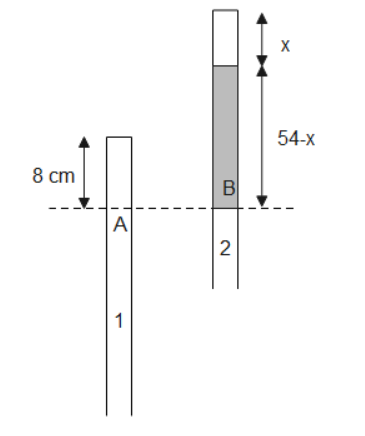
The ideal gas equation is given by-
$PV=nRT$ - (1)
Here, $P$ is the pressure
$V$ is the volume
$n$ is the number of moles
$R$ is the gas constant
$T$ is the temperature
By isothermal process condition, the temperature of both bodies at a given number of moles is same, therefore,
${{T}_{1}}={{T}_{2}}$
From eq (1), we have
$\dfrac{{{P}_{1}}{{V}_{1}}}{nR}=\dfrac{{{P}_{2}}{{V}_{2}}}{nR}$
$\Rightarrow {{P}_{1}}{{V}_{1}}={{P}_{2}}{{V}_{2}}$ - (2)
Let ${{P}_{0}}$ be the pressure of tube-1 and $P$ be the pressure of tube-2. We know that volume can be written as a product of area and length. Substituting given values in eq (2), we get,
${{P}_{0}}8A=PxA$
$\Rightarrow P=\dfrac{8{{P}_{0}}}{x}$ - (3)
We know that pressure in a fluid is given as-
$P=\rho gh$ - (4)
Here, $\rho $ is the density of the fluid
$g$ is acceleration due to gravity
$h$ is the height in the fluid
Using the above equation, we get,
${{P}_{0}}={{\rho }_{m}}g(76)$ - (5)
Using eq (3), eq (4), eq (5) equating pressures at point A and B, we get,
$\begin{align}
& {{\rho }_{m}}g(76)=\dfrac{8{{P}_{0}}}{x}+{{\rho }_{m}}g(54-x) \\
& \Rightarrow {{\rho }_{m}}g(76)=\dfrac{8{{\rho }_{m}}g(76)}{x}+{{\rho }_{m}}g(54-x) \\
& \Rightarrow 76=\dfrac{8\times 76}{x}+(54-x) \\
& \Rightarrow 22+x=\dfrac{608}{x} \\
& \Rightarrow {{x}^{2}}+22x-608=0 \\
& \Rightarrow {{x}^{2}}+38x-16x-608=0 \\
& \Rightarrow (x+38)(x-16)=0 \\
& \therefore x=16cm \\
\end{align}$
Therefore, the length of the air column about mercury in the tube is $16cm$.
Hence, the correct option is (C).
Note:
Using the thermodynamic equation is more efficient than using the ideal gas equation in this question. Isothermal process is the process in which temperature remains constant, since bodies are kept at room temperature, we can apply isothermal condition here. The pressures at point A and B are equal because in both tubes equilibrium is established at these points.
Formulas used:
$PV=nRT$
$P=\rho gh$
Complete answer:
The ideal gas equation is given by-
$PV=nRT$ - (1)
Here, $P$ is the pressure
$V$ is the volume
$n$ is the number of moles
$R$ is the gas constant
$T$ is the temperature
By isothermal process condition, the temperature of both bodies at a given number of moles is same, therefore,
${{T}_{1}}={{T}_{2}}$
From eq (1), we have
$\dfrac{{{P}_{1}}{{V}_{1}}}{nR}=\dfrac{{{P}_{2}}{{V}_{2}}}{nR}$
$\Rightarrow {{P}_{1}}{{V}_{1}}={{P}_{2}}{{V}_{2}}$ - (2)
Let ${{P}_{0}}$ be the pressure of tube-1 and $P$ be the pressure of tube-2. We know that volume can be written as a product of area and length. Substituting given values in eq (2), we get,
${{P}_{0}}8A=PxA$
$\Rightarrow P=\dfrac{8{{P}_{0}}}{x}$ - (3)
We know that pressure in a fluid is given as-
$P=\rho gh$ - (4)
Here, $\rho $ is the density of the fluid
$g$ is acceleration due to gravity
$h$ is the height in the fluid
Using the above equation, we get,
${{P}_{0}}={{\rho }_{m}}g(76)$ - (5)
Using eq (3), eq (4), eq (5) equating pressures at point A and B, we get,
$\begin{align}
& {{\rho }_{m}}g(76)=\dfrac{8{{P}_{0}}}{x}+{{\rho }_{m}}g(54-x) \\
& \Rightarrow {{\rho }_{m}}g(76)=\dfrac{8{{\rho }_{m}}g(76)}{x}+{{\rho }_{m}}g(54-x) \\
& \Rightarrow 76=\dfrac{8\times 76}{x}+(54-x) \\
& \Rightarrow 22+x=\dfrac{608}{x} \\
& \Rightarrow {{x}^{2}}+22x-608=0 \\
& \Rightarrow {{x}^{2}}+38x-16x-608=0 \\
& \Rightarrow (x+38)(x-16)=0 \\
& \therefore x=16cm \\
\end{align}$
Therefore, the length of the air column about mercury in the tube is $16cm$.
Hence, the correct option is (C).
Note:
Using the thermodynamic equation is more efficient than using the ideal gas equation in this question. Isothermal process is the process in which temperature remains constant, since bodies are kept at room temperature, we can apply isothermal condition here. The pressures at point A and B are equal because in both tubes equilibrium is established at these points.
Recently Updated Pages
Master Class 11 English: Engaging Questions & Answers for Success

Master Class 11 Social Science: Engaging Questions & Answers for Success
Master Class 11 Maths: Engaging Questions & Answers for Success
Master Class 11 Biology: Engaging Questions & Answers for Success
Master Class 11 Physics: Engaging Questions & Answers for Success
Master Class 11 Chemistry: Engaging Questions & Answers for Success
Trending doubts
One Metric ton is equal to kg A 10000 B 1000 C 100 class 11 physics CBSE
Difference Between Prokaryotic Cells and Eukaryotic Cells
Two of the body parts which do not appear in MRI are class 11 biology CBSE
Find the value of the expression given below sin 30circ class 11 maths CBSE
Draw a diagram of a plant cell and label at least eight class 11 biology CBSE
10 examples of friction in our daily life