




An old man cannot see objects closer than \[1\,{\text{m}}\] from the eye clearly. Name the defect of vision he is suffering from. How can it be corrected? Draw a ray diagram for the:
(i) Defect of vision and also
(ii) For its correction
Answer
 Verified
620.1k+ views
Hint: It is the defect in which the person can see distant objects clearly while he cannot see the nearby objects clearly. The image of the nearby object is formed behind the retina. We use the converging lens to correct this defect.
Complete step by step answer:
In the given question, we are supplied with the following data:
There is an old man who cannot see the objects which are closer than \[1\,{\text{m}}\] from the eye clearly.We are asked to find out the defect he is suffering from. We are also asked to draw a ray diagram each for the defect we are suffering from and the correction of the defect.
To begin with, let us discuss a bit about this defect. In this defect, he can see the distant objects clearly, however he cannot see the nearby objects clearly. This is due to the reason that there is insufficient converging capacity in the eye lens to converge light on the retina from surrounding objects. The term used to describe being long sighted is hypermetropia, also called hyperopia. If a person is suffering from hypermetropia, the image is created behind the retina of a surrounding object. This suggests that light is concentrated too far back towards the eye, allowing blurred objects that are close up to appear. It can be fixed with the use of an effective power convex lens.
Let us draw the ray diagrams on for the defect of vision and the other for the correction of the defect.
(i) Ray diagram for the defect of vision:
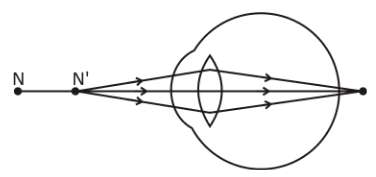
The image of the object is formed behind the retina for which the retina cannot read the image of the object.
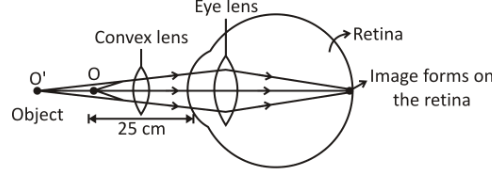
(ii) Correction of the defect:
Since a convex lens has the potential to blend incoming rays, it can be used to fix this vision flaw. In the given figure, the ray diagram for the correction action for a hypermetropic eye is presented.
Note:While answering this question many students seem to have a confusion regarding the myopia and the hypermetropia. Myopia is a defect in which a person can see the nearby objects clearly while cannot see the distant objects clearly. But hypermetropia is completely opposite of that.
Complete step by step answer:
In the given question, we are supplied with the following data:
There is an old man who cannot see the objects which are closer than \[1\,{\text{m}}\] from the eye clearly.We are asked to find out the defect he is suffering from. We are also asked to draw a ray diagram each for the defect we are suffering from and the correction of the defect.
To begin with, let us discuss a bit about this defect. In this defect, he can see the distant objects clearly, however he cannot see the nearby objects clearly. This is due to the reason that there is insufficient converging capacity in the eye lens to converge light on the retina from surrounding objects. The term used to describe being long sighted is hypermetropia, also called hyperopia. If a person is suffering from hypermetropia, the image is created behind the retina of a surrounding object. This suggests that light is concentrated too far back towards the eye, allowing blurred objects that are close up to appear. It can be fixed with the use of an effective power convex lens.
Let us draw the ray diagrams on for the defect of vision and the other for the correction of the defect.
(i) Ray diagram for the defect of vision:
The image of the object is formed behind the retina for which the retina cannot read the image of the object.
(ii) Correction of the defect:
Since a convex lens has the potential to blend incoming rays, it can be used to fix this vision flaw. In the given figure, the ray diagram for the correction action for a hypermetropic eye is presented.
Note:While answering this question many students seem to have a confusion regarding the myopia and the hypermetropia. Myopia is a defect in which a person can see the nearby objects clearly while cannot see the distant objects clearly. But hypermetropia is completely opposite of that.
Recently Updated Pages
Basicity of sulphurous acid and sulphuric acid are

Master Class 10 Computer Science: Engaging Questions & Answers for Success
Master Class 10 Social Science: Engaging Questions & Answers for Success
Master Class 10 Science: Engaging Questions & Answers for Success
Class 10 Question and Answer - Your Ultimate Solutions Guide
Master Class 10 Maths: Engaging Questions & Answers for Success
Trending doubts
What is the Total Duration of Football Match?
Explain the Treaty of Vienna of 1815 class 10 social science CBSE
In football, which nation is called "La Roja"?
Why is there a time difference of about 5 hours between class 10 social science CBSE
10 examples of evaporation in daily life with explanations
What is the full form of POSCO class 10 social science CBSE