




An object is placed at a distance of $12cm$ from a concave mirror. The image formed will be real and four times larger than the object. Find out the distance of the image from the mirror. An object is placed $24cm$ from a concave mirror. The image formed will be inverted and double the size of the object. Calculate the focal length of the mirror and the position where the image will be formed.
Answer
 Verified
584.7k+ views
Hint: The magnification of an object is found by taking the ratio of the image distance to the object distance. This can also be found by taking the ratio of the height of the image formed to the height of the object placed. For the mirror, the magnification formula will be having a negative sign. These all may help you to solve this question.
Complete answer:
The formula for the magnification can be written as,
$m=\dfrac{{{h}_{i}}}{{{h}_{o}}}=-\dfrac{v}{u}$
Where ${{h}_{i}}$ be the height of the image formed, ${{h}_{o}}$ be the height of the object placed, $v$ be the distance of the image formed and $u$be the distance of the object placed in front of the mirror.
Here it is mentioned that the image distance in the first case is,
$u=-12cm$
And the magnification produced will be,
$m=-4$
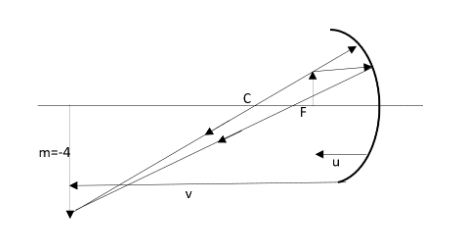
Therefore, let us substitute the values in it,
$\begin{align}
& m=-4=\dfrac{-v}{u} \\
& \Rightarrow -4=\dfrac{-v}{-12} \\
\end{align}$
From this, the image distance will be found as,
$v=-48cm$
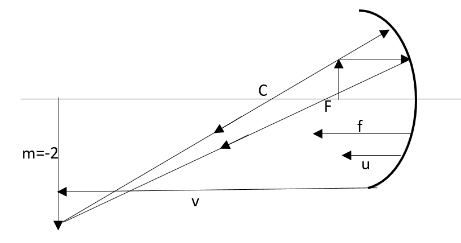
In the next case, the object is placed at a distance given as,
$u=-24cm$
The magnification of the image will be
$m=\dfrac{{{h}_{i}}}{{{h}_{o}}}=\dfrac{-2}{1}=\dfrac{-v}{u}$
Therefore let us substitute the value of object distance in it,
$m=-2=\dfrac{-v}{-24}$
From this equation we will get the final velocity as,
$v=-48cm$
Now let us find the focal length using the mirror equation given as,
$\dfrac{1}{f}=\dfrac{1}{v}+\dfrac{1}{u}$
Where $f$ be the focal length of the mirror. Let us substitute the values in it,
$\begin{align}
& \dfrac{1}{f}=\dfrac{1}{-48}+\dfrac{1}{-24} \\
& \dfrac{1}{f}=\dfrac{-3}{48}=\dfrac{-1}{16} \\
\end{align}$
By taking the reciprocal of the equation,
$f=-16cm$
Note:
The sign convention should be followed when we calculate the distances. The directions which are in the same direction of the incident light have been taken as positive and the directions which are in opposite directions of the incident light are mentioned as negative. In the same way, the direction above the principal axis is positive and the direction below the axis is taken as negative.
Complete answer:
The formula for the magnification can be written as,
$m=\dfrac{{{h}_{i}}}{{{h}_{o}}}=-\dfrac{v}{u}$
Where ${{h}_{i}}$ be the height of the image formed, ${{h}_{o}}$ be the height of the object placed, $v$ be the distance of the image formed and $u$be the distance of the object placed in front of the mirror.
Here it is mentioned that the image distance in the first case is,
$u=-12cm$
And the magnification produced will be,
$m=-4$
Therefore, let us substitute the values in it,
$\begin{align}
& m=-4=\dfrac{-v}{u} \\
& \Rightarrow -4=\dfrac{-v}{-12} \\
\end{align}$
From this, the image distance will be found as,
$v=-48cm$
In the next case, the object is placed at a distance given as,
$u=-24cm$
The magnification of the image will be
$m=\dfrac{{{h}_{i}}}{{{h}_{o}}}=\dfrac{-2}{1}=\dfrac{-v}{u}$
Therefore let us substitute the value of object distance in it,
$m=-2=\dfrac{-v}{-24}$
From this equation we will get the final velocity as,
$v=-48cm$
Now let us find the focal length using the mirror equation given as,
$\dfrac{1}{f}=\dfrac{1}{v}+\dfrac{1}{u}$
Where $f$ be the focal length of the mirror. Let us substitute the values in it,
$\begin{align}
& \dfrac{1}{f}=\dfrac{1}{-48}+\dfrac{1}{-24} \\
& \dfrac{1}{f}=\dfrac{-3}{48}=\dfrac{-1}{16} \\
\end{align}$
By taking the reciprocal of the equation,
$f=-16cm$
Note:
The sign convention should be followed when we calculate the distances. The directions which are in the same direction of the incident light have been taken as positive and the directions which are in opposite directions of the incident light are mentioned as negative. In the same way, the direction above the principal axis is positive and the direction below the axis is taken as negative.
Recently Updated Pages
Master Class 10 Computer Science: Engaging Questions & Answers for Success

Master Class 10 General Knowledge: Engaging Questions & Answers for Success
Master Class 10 English: Engaging Questions & Answers for Success
Master Class 10 Social Science: Engaging Questions & Answers for Success
Master Class 10 Maths: Engaging Questions & Answers for Success
Master Class 10 Science: Engaging Questions & Answers for Success
Trending doubts
What is the median of the first 10 natural numbers class 10 maths CBSE
Which women's tennis player has 24 Grand Slam singles titles?
Who is the Brand Ambassador of Incredible India?
Why is there a time difference of about 5 hours between class 10 social science CBSE
Write a letter to the principal requesting him to grant class 10 english CBSE
A moving boat is observed from the top of a 150 m high class 10 maths CBSE