




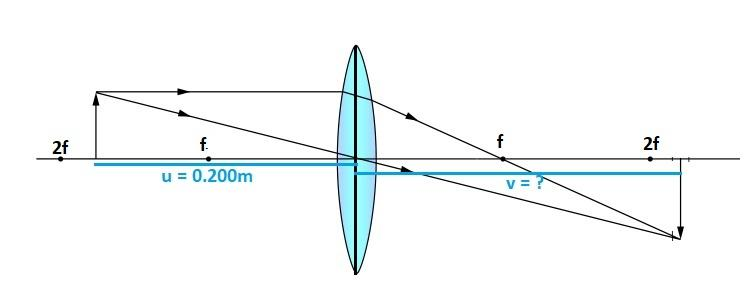
An object is kept at 0.200m from a double convex lens or biconvex lens of focal length 0.0150m. The position of the image is
A. 0.0162m
B. 0.600m
C. 8.00m
D. 11.6m
Answer
 Verified
596.7k+ views
Hint: The position of the object and the focal length of the lens is given. We can find the position of the image using the lens formula which is given below. The terms in lens formula should be plugged in with proper sign convention.
Formula used:
\[\dfrac{1}{v}-\dfrac{1}{u}=\dfrac{1}{f}\]
Complete step by step answer:
The image is formed in a lens when the rays of light coming off the object get refracted when passed through the lens and then intersect to form the image. The position of the image depends on the position of the object and the focal length of the lens. The relation is given as
\[\dfrac{1}{v}-\dfrac{1}{u}=\dfrac{1}{f}\]
In the question, the position of the object and the focal length is given. Let us start by listing the information given with proper sign convention.
\[\begin{align}
& u=-0.2 \\
& f=0.015 \\
\end{align}\]
Now we want the position of the image for that we use the lens formula
\[\dfrac{1}{v}-\dfrac{1}{u}=\dfrac{1}{f}\]
Plugging in the values we get
\[\begin{align}
& \dfrac{1}{v}-\dfrac{1}{u}=\dfrac{1}{f} \\
& \Rightarrow \dfrac{1}{v}-\dfrac{1}{\left( -0.2 \right)}=\dfrac{1}{f} \\
& \Rightarrow \dfrac{1}{v}+\dfrac{1}{0.2}=\dfrac{1}{0.015} \\
& \Rightarrow \dfrac{1}{v}+\dfrac{10}{2}=\dfrac{1000}{15} \\
& \Rightarrow \dfrac{1}{v}=\dfrac{1000}{15}-\dfrac{10}{2} \\
& \Rightarrow \dfrac{1}{v}=\dfrac{2000-150}{30} \\
& \Rightarrow \dfrac{1}{v}=\dfrac{1850}{30} \\
& \Rightarrow \dfrac{1}{v}=\dfrac{185}{3} \\
& \Rightarrow v=\dfrac{3}{185} \\
& \Rightarrow v=0.0162 \\
\end{align}\]
So, the position of the image is 0.0162m. Option A is correct.
Note:
The sign convention is used in solving ray optics questions. The formulas are developed with the sign convention in mind. The length is measured from the optical centre of the lens. The length on the left of the optical centre is taken as negative while the distance in the right is taken as positive.
Formula used:
\[\dfrac{1}{v}-\dfrac{1}{u}=\dfrac{1}{f}\]
Complete step by step answer:
The image is formed in a lens when the rays of light coming off the object get refracted when passed through the lens and then intersect to form the image. The position of the image depends on the position of the object and the focal length of the lens. The relation is given as
\[\dfrac{1}{v}-\dfrac{1}{u}=\dfrac{1}{f}\]
In the question, the position of the object and the focal length is given. Let us start by listing the information given with proper sign convention.
\[\begin{align}
& u=-0.2 \\
& f=0.015 \\
\end{align}\]
Now we want the position of the image for that we use the lens formula
\[\dfrac{1}{v}-\dfrac{1}{u}=\dfrac{1}{f}\]
Plugging in the values we get
\[\begin{align}
& \dfrac{1}{v}-\dfrac{1}{u}=\dfrac{1}{f} \\
& \Rightarrow \dfrac{1}{v}-\dfrac{1}{\left( -0.2 \right)}=\dfrac{1}{f} \\
& \Rightarrow \dfrac{1}{v}+\dfrac{1}{0.2}=\dfrac{1}{0.015} \\
& \Rightarrow \dfrac{1}{v}+\dfrac{10}{2}=\dfrac{1000}{15} \\
& \Rightarrow \dfrac{1}{v}=\dfrac{1000}{15}-\dfrac{10}{2} \\
& \Rightarrow \dfrac{1}{v}=\dfrac{2000-150}{30} \\
& \Rightarrow \dfrac{1}{v}=\dfrac{1850}{30} \\
& \Rightarrow \dfrac{1}{v}=\dfrac{185}{3} \\
& \Rightarrow v=\dfrac{3}{185} \\
& \Rightarrow v=0.0162 \\
\end{align}\]
So, the position of the image is 0.0162m. Option A is correct.
Note:
The sign convention is used in solving ray optics questions. The formulas are developed with the sign convention in mind. The length is measured from the optical centre of the lens. The length on the left of the optical centre is taken as negative while the distance in the right is taken as positive.
Recently Updated Pages
Master Class 12 Social Science: Engaging Questions & Answers for Success

Master Class 12 Physics: Engaging Questions & Answers for Success
Master Class 12 Maths: Engaging Questions & Answers for Success
Master Class 12 Economics: Engaging Questions & Answers for Success
Master Class 12 Chemistry: Engaging Questions & Answers for Success
Master Class 12 Business Studies: Engaging Questions & Answers for Success
Trending doubts
Which are the Top 10 Largest Countries of the World?
Draw a labelled sketch of the human eye class 12 physics CBSE
Explain the structure of megasporangium class 12 biology CBSE
What are the major means of transport Explain each class 12 social science CBSE
How many chromosomes are found in human ovum a 46 b class 12 biology CBSE
The diagram of the section of a maize grain is given class 12 biology CBSE