




An isosceles right angle triangle has area 112.5 sq. cm. The length of its hypotenuse (in cm) is?
(a) 15
(b) $15\sqrt{2}$
(c) 16
(d) $16\sqrt{2}$
Answer
 Verified
610.5k+ views
Hint: Assume the equal sides of the isosceles triangle as ‘x’. Apply the formula for the area of the triangle given by: $\text{A=}\dfrac{\text{1}}{\text{2}}\text{ }\!\!\times\!\!\text{ base }\!\!\times\!\!\text{ height}$, where ‘A’ is the area of the triangle. Once the side the triangle is determined, apply Pythagoras theorem given by: $hypotenuse=\sqrt{bas{{e}^{2}}+heigh{{t}^{2}}}$, to determine the hypotenuse of the right angle triangle.
Complete step by step answer:
We know that an isosceles triangle has its 2 sides equal. Now, we have been provided with an isosceles right angle triangle. That means its height and base are of the same length.
Let us assume that the height and base of the triangle is ‘x’.
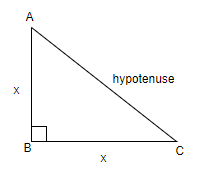
Now, it is given that area of the triangle is 112.5 sq. cm. Therefore, applying the formula of the area of the right angle triangle, we get,
$\begin{align}
& \text{Area=}\dfrac{\text{1}}{\text{2}}\text{ }\!\!\times\!\!\text{ base }\!\!\times\!\!\text{ height} \\
& \Rightarrow 112.5=\dfrac{1}{2}\times x\times x \\
& \Rightarrow {{x}^{2}}=2\times 112.5 \\
& \Rightarrow {{x}^{2}}=225 \\
\end{align}$
Taking square root both sides, we get,
$\begin{align}
& x=\sqrt{225} \\
& \Rightarrow x=15\text{ cm} \\
\end{align}$
Therefore, the length of the base and height of the triangle is 15 cm.
Now, using Pythagoras theorem in the triangle, we get,
$\begin{align}
& \text{hypotenuse}=\sqrt{\text{bas}{{\text{e}}^{\text{2}}}\text{+heigh}{{\text{t}}^{\text{2}}}} \\
& \Rightarrow \text{hypotenuse}=\sqrt{{{x}^{2}}+{{x}^{2}}}=\sqrt{{{15}^{2}}+{{15}^{2}}} \\
& \Rightarrow \text{hypotenuse}=\sqrt{2\times {{15}^{2}}}=15\sqrt{2} \\
\end{align}$
So, the correct answer is “Option b”.
Note: One may note that we do not have to use heron’s formula for the calculation of area in the above question. Although we will get the answer by using heron’s formula here but the process will be very lengthy and also calculation will be hard. So, whenever we have been provided with a right angle triangle then use the normal formula for the calculation of area.
Complete step by step answer:
We know that an isosceles triangle has its 2 sides equal. Now, we have been provided with an isosceles right angle triangle. That means its height and base are of the same length.
Let us assume that the height and base of the triangle is ‘x’.
Now, it is given that area of the triangle is 112.5 sq. cm. Therefore, applying the formula of the area of the right angle triangle, we get,
$\begin{align}
& \text{Area=}\dfrac{\text{1}}{\text{2}}\text{ }\!\!\times\!\!\text{ base }\!\!\times\!\!\text{ height} \\
& \Rightarrow 112.5=\dfrac{1}{2}\times x\times x \\
& \Rightarrow {{x}^{2}}=2\times 112.5 \\
& \Rightarrow {{x}^{2}}=225 \\
\end{align}$
Taking square root both sides, we get,
$\begin{align}
& x=\sqrt{225} \\
& \Rightarrow x=15\text{ cm} \\
\end{align}$
Therefore, the length of the base and height of the triangle is 15 cm.
Now, using Pythagoras theorem in the triangle, we get,
$\begin{align}
& \text{hypotenuse}=\sqrt{\text{bas}{{\text{e}}^{\text{2}}}\text{+heigh}{{\text{t}}^{\text{2}}}} \\
& \Rightarrow \text{hypotenuse}=\sqrt{{{x}^{2}}+{{x}^{2}}}=\sqrt{{{15}^{2}}+{{15}^{2}}} \\
& \Rightarrow \text{hypotenuse}=\sqrt{2\times {{15}^{2}}}=15\sqrt{2} \\
\end{align}$
So, the correct answer is “Option b”.
Note: One may note that we do not have to use heron’s formula for the calculation of area in the above question. Although we will get the answer by using heron’s formula here but the process will be very lengthy and also calculation will be hard. So, whenever we have been provided with a right angle triangle then use the normal formula for the calculation of area.
Recently Updated Pages
Master Class 10 Social Science: Engaging Questions & Answers for Success

Master Class 10 Science: Engaging Questions & Answers for Success
Master Class 10 Maths: Engaging Questions & Answers for Success
Master Class 10 General Knowledge: Engaging Questions & Answers for Success
Master Class 10 Computer Science: Engaging Questions & Answers for Success
Class 10 Question and Answer - Your Ultimate Solutions Guide
Trending doubts
What is the full form of PNG A Petrol Natural Gas B class 10 chemistry CBSE
The power of the lens is 2D What is its focal length class 10 physics CBSE
Metals which do not react with dilute acids beginarray20l class 10 chemistry CBSE
The uses of bleaching powder are A It is used bleaching class 10 chemistry CBSE
Write a letter to the principal requesting him to grant class 10 english CBSE
State and prove the Pythagoras theorem-class-10-maths-CBSE