




An iron pipe 20 cm long has exterior diameter equal to 25 cm. If the thickness of the pipe is 1 cm, find the whole surface area of the pipe.
Answer
 Verified
544.9k+ views
Hint: We will find the total surface area of the pipe as (surface area of the external pipe + surface area of the internal pipe + 2 $\times $ area of the corner rings of the pipe). The surface area of the pipe is given as $2\pi rl$, which $r$ is the radius of the pipe and $l$ is the length of the pipe. Also, the area of the ring will be $2\left( \pi {{R}^{2}}-\pi {{r}^{2}} \right)$.
Complete step-by-step solution -
It is given in the question that, an iron has length 20 cm and it has exterior diameter of 25 cm and it’s thickness is 1 cm, then we have to find the total surface area of the pipe. Total surface area of the pipe as (surface area of the external pipe + surface area of the internal pipe + 2 $\times $ area of the corner rings of the pipe). We know that the surface area of the pipe is given as $2\pi rl$, where $r$ is the radius of the pipe and $l$ is the length of the pipe. Also, the area of the ring will be $2\left( \pi {{R}^{2}}-\pi {{r}^{2}} \right)$, where $R$ is radius of the external ring and $r$ is the radius of the internal ring.
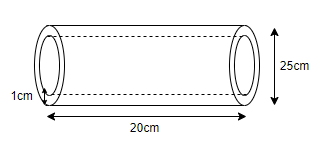
The external radius $\left( R \right)=\dfrac{diameter}{2}\Rightarrow \dfrac{25}{2}cm$
So, the external surface area of the pipe = $2\pi Rl\Rightarrow 2\times \dfrac{22}{7}\times \dfrac{25}{2}\times 20\Rightarrow \dfrac{22000}{14}\Rightarrow 1571.42c{{m}^{2}}$
Internal radius $\left( r \right)=\dfrac{diameter}{2}-1\Rightarrow \dfrac{25}{2}-1\Rightarrow \dfrac{23}{2}cm$
So, the internal surface area of the pipe = $2\pi rl\Rightarrow 2\times \dfrac{22}{7}\times \dfrac{23}{2}\times 20\Rightarrow \dfrac{20240}{14}\Rightarrow 1445.71c{{m}^{2}}$
Now, the surface area of 2 rings at the corner of the pipe = $2\left( \pi {{R}^{2}}-\pi {{r}^{2}} \right)$
$\begin{align}
& =2\times \left( \dfrac{22}{7}\times \dfrac{25}{2}\times \dfrac{25}{2}-\dfrac{22}{7}\times \dfrac{23}{2}\times \dfrac{23}{2} \right) \\
& =2\times \left( \dfrac{13750}{28}-\dfrac{11638}{28} \right) \\
& =2\times \left( 491.07-415.64 \right) \\
& =2\times 75.43 \\
& =150.86c{{m}^{2}} \\
\end{align}$
Total surface area of the pipe is = (total surface area of the external pipe + total surface area of the internal pipe + 2 $\times $ surface area of the corner ring).
$\begin{align}
& =\left( 1571.42+1445.71+150.86 \right)c{{m}^{2}} \\
& =3167.99c{{m}^{2}}\approx 3168c{{m}^{2}} \\
\end{align}$
Therefore, we get the total surface area of the pipe as $3168c{{m}^{2}}$.
Note: Generally, the students forget to multiply the surface area of the ring by 2, but as we have two rings, we have to multiply the surface area of the ring by 2. The students may also get confused with the formulas. So, it is better for the students to learn all the basic formulas, in order to solve questions like this.
Complete step-by-step solution -
It is given in the question that, an iron has length 20 cm and it has exterior diameter of 25 cm and it’s thickness is 1 cm, then we have to find the total surface area of the pipe. Total surface area of the pipe as (surface area of the external pipe + surface area of the internal pipe + 2 $\times $ area of the corner rings of the pipe). We know that the surface area of the pipe is given as $2\pi rl$, where $r$ is the radius of the pipe and $l$ is the length of the pipe. Also, the area of the ring will be $2\left( \pi {{R}^{2}}-\pi {{r}^{2}} \right)$, where $R$ is radius of the external ring and $r$ is the radius of the internal ring.
The external radius $\left( R \right)=\dfrac{diameter}{2}\Rightarrow \dfrac{25}{2}cm$
So, the external surface area of the pipe = $2\pi Rl\Rightarrow 2\times \dfrac{22}{7}\times \dfrac{25}{2}\times 20\Rightarrow \dfrac{22000}{14}\Rightarrow 1571.42c{{m}^{2}}$
Internal radius $\left( r \right)=\dfrac{diameter}{2}-1\Rightarrow \dfrac{25}{2}-1\Rightarrow \dfrac{23}{2}cm$
So, the internal surface area of the pipe = $2\pi rl\Rightarrow 2\times \dfrac{22}{7}\times \dfrac{23}{2}\times 20\Rightarrow \dfrac{20240}{14}\Rightarrow 1445.71c{{m}^{2}}$
Now, the surface area of 2 rings at the corner of the pipe = $2\left( \pi {{R}^{2}}-\pi {{r}^{2}} \right)$
$\begin{align}
& =2\times \left( \dfrac{22}{7}\times \dfrac{25}{2}\times \dfrac{25}{2}-\dfrac{22}{7}\times \dfrac{23}{2}\times \dfrac{23}{2} \right) \\
& =2\times \left( \dfrac{13750}{28}-\dfrac{11638}{28} \right) \\
& =2\times \left( 491.07-415.64 \right) \\
& =2\times 75.43 \\
& =150.86c{{m}^{2}} \\
\end{align}$
Total surface area of the pipe is = (total surface area of the external pipe + total surface area of the internal pipe + 2 $\times $ surface area of the corner ring).
$\begin{align}
& =\left( 1571.42+1445.71+150.86 \right)c{{m}^{2}} \\
& =3167.99c{{m}^{2}}\approx 3168c{{m}^{2}} \\
\end{align}$
Therefore, we get the total surface area of the pipe as $3168c{{m}^{2}}$.
Note: Generally, the students forget to multiply the surface area of the ring by 2, but as we have two rings, we have to multiply the surface area of the ring by 2. The students may also get confused with the formulas. So, it is better for the students to learn all the basic formulas, in order to solve questions like this.
Recently Updated Pages
Master Class 10 Social Science: Engaging Questions & Answers for Success

Master Class 10 Science: Engaging Questions & Answers for Success
Master Class 10 Maths: Engaging Questions & Answers for Success
Master Class 10 General Knowledge: Engaging Questions & Answers for Success
Master Class 10 Computer Science: Engaging Questions & Answers for Success
Class 10 Question and Answer - Your Ultimate Solutions Guide
Trending doubts
What is the full form of PNG A Petrol Natural Gas B class 10 chemistry CBSE
Explain the Treaty of Vienna of 1815 class 10 social science CBSE
In cricket, how many legal balls are there in a standard over?
Why is there a time difference of about 5 hours between class 10 social science CBSE
Who Won 36 Oscar Awards? Record Holder Revealed
What is the median of the first 10 natural numbers class 10 maths CBSE