




An Insectivorous plant is
A. Opuntia
B. Crotalaria
C. Eichornia
D. Utricularia
Answer
 Verified
625.2k+ views
Hint: Insectivorous plants are those plants that obtain their food or nutrition by feeding on insects and other organisms. Utricularia, commonly called as bladderworts are insectivorous plants. Utricularia in its bladders mouth has sensitive bristles or hairs to catch the prey.
Complete answer: Plants which are specialized in trapping insects are popularly known as insectivorous plants. They are very different from normal plants in their mode of nutrition.
They, however, never prey upon humans or large animals.
These are colorful, shiny, possess sweet nectar, and pleasant odor to attract insects. Insectivorous plants of India belong mainly to three families: Droseraceae, Nepenthaceae, and Lentibulariaceae.
Some plants capture and digest insects passively as a sin pitcher plant (nepenthes) or by the movement of certain organs, like closing the leaf traps the moment insects land on them (Venus flytrap).
Additional information: Utricularia, commonly called as bladderworts are the insectivorous plants among the following options, and they belong to the family, Lentibulariaceae.
Utricularia in its bladders mouth has sensitive bristles or hairs. When an insect happens to contact these hairs the door opens, carrying the insect into the bladder along with a little current of water.
The door is shut when water fills the bladder; the enzymes produced by the inner wall of the bladder digest the insect.
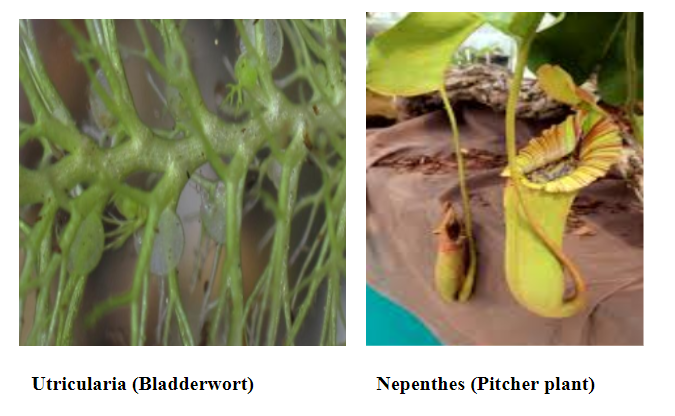
Thus, the correct answer is Utricularia
Note: Utricularia or bladderwort has medicinal property.
They are useful against cough, for the dressing of wounds, and as a remedy for urinary diseases. Other insectivorous plants include pitcher plant, venus fly trap, drosera, butterworts, sundew, etc.
Opuntia is a species of cactus belongs to the family Cactaceae, crotalaria, known as rattlepods belongs to Fabaceae, Eicchornia, known as water cyanth or terror of Bengal, belongs to the family pondeteriaceae that spreads all over the water body fast in a short time.
Complete answer: Plants which are specialized in trapping insects are popularly known as insectivorous plants. They are very different from normal plants in their mode of nutrition.
They, however, never prey upon humans or large animals.
These are colorful, shiny, possess sweet nectar, and pleasant odor to attract insects. Insectivorous plants of India belong mainly to three families: Droseraceae, Nepenthaceae, and Lentibulariaceae.
Some plants capture and digest insects passively as a sin pitcher plant (nepenthes) or by the movement of certain organs, like closing the leaf traps the moment insects land on them (Venus flytrap).
Additional information: Utricularia, commonly called as bladderworts are the insectivorous plants among the following options, and they belong to the family, Lentibulariaceae.
Utricularia in its bladders mouth has sensitive bristles or hairs. When an insect happens to contact these hairs the door opens, carrying the insect into the bladder along with a little current of water.
The door is shut when water fills the bladder; the enzymes produced by the inner wall of the bladder digest the insect.
Thus, the correct answer is Utricularia
Note: Utricularia or bladderwort has medicinal property.
They are useful against cough, for the dressing of wounds, and as a remedy for urinary diseases. Other insectivorous plants include pitcher plant, venus fly trap, drosera, butterworts, sundew, etc.
Opuntia is a species of cactus belongs to the family Cactaceae, crotalaria, known as rattlepods belongs to Fabaceae, Eicchornia, known as water cyanth or terror of Bengal, belongs to the family pondeteriaceae that spreads all over the water body fast in a short time.
Recently Updated Pages
Master Class 12 Economics: Engaging Questions & Answers for Success

Master Class 12 English: Engaging Questions & Answers for Success
Master Class 12 Social Science: Engaging Questions & Answers for Success
Master Class 12 Maths: Engaging Questions & Answers for Success
Master Class 12 Physics: Engaging Questions & Answers for Success
Master Class 12 Business Studies: Engaging Questions & Answers for Success
Trending doubts
Draw ray diagrams each showing i myopic eye and ii class 12 physics CBSE
The ratio of E to B in electromagnetic waves is equal class 12 physics CBSE
Sulphuric acid is known as the king of acids State class 12 chemistry CBSE
The atomic mass of potassium is 391 What is the mass class 12 chemistry CBSE
Drive an expression for the electric field due to an class 12 physics CBSE
Short note Soil Erosion class 12 biology CBSE