




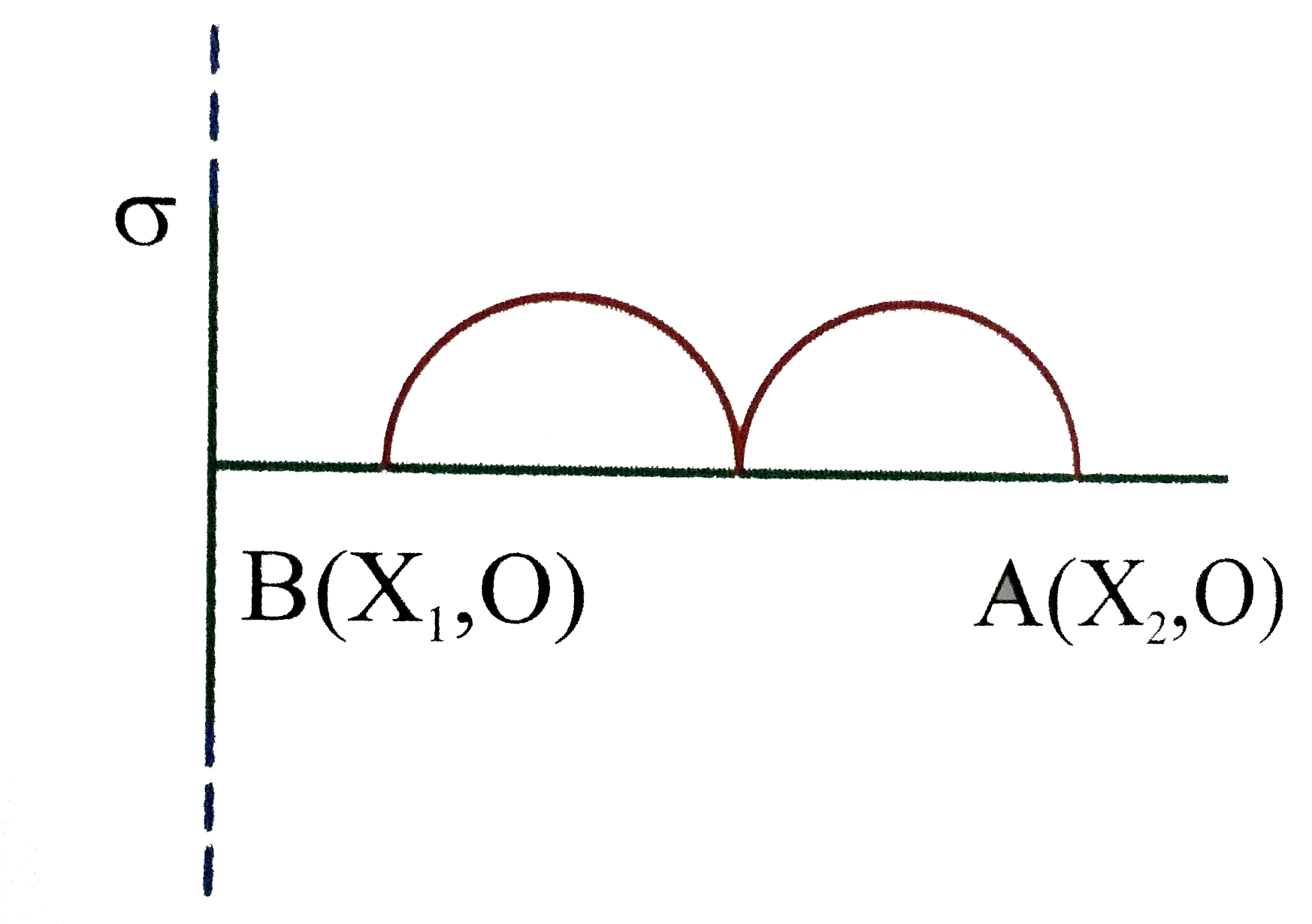
An infinite long plate has surface charge density sigma. As shown in the figure, a point charge q is moved from A to B. Net work done by electric field is:
Answer
 Verified
584.1k+ views
Hint: First use the expression for work done on a charge. Then, substitute potential difference due to the charge on the electric field. Then, use the equation for the electric field for a uniformly charged infinite plane. Substitute this value in the equation for work done. Then finally substitute the value for change in distance of the charge.
Complete step by step answer:
Work done on a charge is given by,
$W= Vd$ ...(1)
Where, V is the potential difference
d is the distance covered by the charge
We know, potential difference due to the charge q is given by,
$V= qE$ ...(2)
Substituting equation. (2) in equation. (1) we get,
$W= qEd$ ...(3)
Now, electric field for an uniformly charged infinite plane having a surface charge density as $\sigma$ is given by,
$E= \dfrac {\sigma}{2{\epsilon}_{0}}$ ...(4)
Substituting equation. (4) in equation. (3) we get,
$W= qd \dfrac {\sigma}{2{\epsilon}_{0}}$
When the point charge is moved from point A to point B above equation becomes,
$W= q({x}_{1} –{x}_{2})\dfrac {\sigma}{2{\epsilon}_{0}}$
Therefore, the net work done by electric force is $ ({x}_{1} –{x}_{2})\dfrac {q\sigma}{2{\epsilon}_{0}}$
Note:
Electric field for an uniformly charged infinite sheet is given by,
$E= \dfrac {\sigma}{{\epsilon}_{0}}$
Electric field for an infinite sheet is twice the electric field of an infinite plate. Electric field is independent of the distance of the point from the sheet. An infinite plane sheet of charge creates a constant electric field. Electric field due to conducting sheet of same surface density $\sigma$ is given by, ${E}_{1}= \dfrac {\sigma}{2{\epsilon}_{0}}$
$\therefore {E}_{1}= \dfrac {E}{2}$
Complete step by step answer:
Work done on a charge is given by,
$W= Vd$ ...(1)
Where, V is the potential difference
d is the distance covered by the charge
We know, potential difference due to the charge q is given by,
$V= qE$ ...(2)
Substituting equation. (2) in equation. (1) we get,
$W= qEd$ ...(3)
Now, electric field for an uniformly charged infinite plane having a surface charge density as $\sigma$ is given by,
$E= \dfrac {\sigma}{2{\epsilon}_{0}}$ ...(4)
Substituting equation. (4) in equation. (3) we get,
$W= qd \dfrac {\sigma}{2{\epsilon}_{0}}$
When the point charge is moved from point A to point B above equation becomes,
$W= q({x}_{1} –{x}_{2})\dfrac {\sigma}{2{\epsilon}_{0}}$
Therefore, the net work done by electric force is $ ({x}_{1} –{x}_{2})\dfrac {q\sigma}{2{\epsilon}_{0}}$
Note:
Electric field for an uniformly charged infinite sheet is given by,
$E= \dfrac {\sigma}{{\epsilon}_{0}}$
Electric field for an infinite sheet is twice the electric field of an infinite plate. Electric field is independent of the distance of the point from the sheet. An infinite plane sheet of charge creates a constant electric field. Electric field due to conducting sheet of same surface density $\sigma$ is given by, ${E}_{1}= \dfrac {\sigma}{2{\epsilon}_{0}}$
$\therefore {E}_{1}= \dfrac {E}{2}$
Recently Updated Pages
Master Class 11 Computer Science: Engaging Questions & Answers for Success

Master Class 11 Business Studies: Engaging Questions & Answers for Success
Master Class 11 Economics: Engaging Questions & Answers for Success
Master Class 11 English: Engaging Questions & Answers for Success
Master Class 11 Maths: Engaging Questions & Answers for Success
Master Class 11 Biology: Engaging Questions & Answers for Success
Trending doubts
One Metric ton is equal to kg A 10000 B 1000 C 100 class 11 physics CBSE
There are 720 permutations of the digits 1 2 3 4 5 class 11 maths CBSE
Discuss the various forms of bacteria class 11 biology CBSE
Draw a diagram of a plant cell and label at least eight class 11 biology CBSE
State the laws of reflection of light
Explain zero factorial class 11 maths CBSE