




An inductor L = 100mH, a resistor R = 100(Ohms) and a battery E = 100V are initially connected in series as shown in the figure. After a long time the battery is disconnected after short circuiting the points A and B. The current in the circuit after 1ms is.
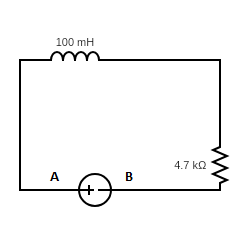
1) 1 A
2) $\dfrac{1}{e}$A
3) e A
4) 0.1 A
Answer
 Verified
544.5k+ views
Hint: Here there will be two equations formed one when the battery is connected and another when there is no battery and the circuit is short circuited. Here we use ohm's law and the formula for inductive resistance.
Formula used:
Energy in the circuit =$\dfrac{1}{2}L{(\dfrac{E}{R})^2}$;
Where:
L = Inductance;
E = Source battery.
R = Resistance.
Ohm’s law
$I = \dfrac{E}{R}$;
I = Current.
E = Voltage source.
R = Resistance.
Inductive Resistance
$i = {I_o}{e^{\dfrac{{ - tR}}{L}}}$;
Where:
i = Current;
${I_o}$= I = Initial current.
t = time.
R = Resistance.
L = Inductance.
Complete answer:
The formation of an electrical circuit happens when a path that is of a conductive nature is created. The conductive path allows a number of charges to move continuously and this continuous movement is called current. There is a law which relates current “I”, voltage “V” and Resistance “R”. The law is known as Ohm’s Law. It states that the amount of electric current flowing in the circuit is proportional to the voltage across it and is inversely proportional to the resistance.
Write Ohm’s Law:
${I_o} = \dfrac{E}{R}$;
Apply the formula and find out the initial current;
Equation for inductive resistance is:
$i = {I_o}{e^{\dfrac{{ - tR}}{L}}}$;
Now, put the value ${I_o} = \dfrac{E}{R}$(Ohm’s Law) in the above equation and solve,
$i = \dfrac{E}{R}{e^{\dfrac{{ - tR}}{L}}}$;
Put the given value in the above equation:
$i = \dfrac{{100}}{{100}} \times {e^{\dfrac{{ - {{10}^{ - 3}} \times {{10}^2}}}{{100 \times {{10}^{ - 3}}}}}}$;
Do the mathematical calculation in the above equation by dividing the numerator with denominator:
$i = {e^{ - 1}}Ampere$ ….(The unit of current is Amperes)
Option”2” is correct. The current in the circuit after 1ms is $i = eA$.
Note:
Here we have to apply the relation between ohm's law and formula for inductive resistance. Put the value of current which is found out by using ohm's law in the formula for inductive resistance. Make sure to do the mathematical calculations carefully.
Formula used:
Energy in the circuit =$\dfrac{1}{2}L{(\dfrac{E}{R})^2}$;
Where:
L = Inductance;
E = Source battery.
R = Resistance.
Ohm’s law
$I = \dfrac{E}{R}$;
I = Current.
E = Voltage source.
R = Resistance.
Inductive Resistance
$i = {I_o}{e^{\dfrac{{ - tR}}{L}}}$;
Where:
i = Current;
${I_o}$= I = Initial current.
t = time.
R = Resistance.
L = Inductance.
Complete answer:
The formation of an electrical circuit happens when a path that is of a conductive nature is created. The conductive path allows a number of charges to move continuously and this continuous movement is called current. There is a law which relates current “I”, voltage “V” and Resistance “R”. The law is known as Ohm’s Law. It states that the amount of electric current flowing in the circuit is proportional to the voltage across it and is inversely proportional to the resistance.
Write Ohm’s Law:
${I_o} = \dfrac{E}{R}$;
Apply the formula and find out the initial current;
Equation for inductive resistance is:
$i = {I_o}{e^{\dfrac{{ - tR}}{L}}}$;
Now, put the value ${I_o} = \dfrac{E}{R}$(Ohm’s Law) in the above equation and solve,
$i = \dfrac{E}{R}{e^{\dfrac{{ - tR}}{L}}}$;
Put the given value in the above equation:
$i = \dfrac{{100}}{{100}} \times {e^{\dfrac{{ - {{10}^{ - 3}} \times {{10}^2}}}{{100 \times {{10}^{ - 3}}}}}}$;
Do the mathematical calculation in the above equation by dividing the numerator with denominator:
$i = {e^{ - 1}}Ampere$ ….(The unit of current is Amperes)
Option”2” is correct. The current in the circuit after 1ms is $i = eA$.
Note:
Here we have to apply the relation between ohm's law and formula for inductive resistance. Put the value of current which is found out by using ohm's law in the formula for inductive resistance. Make sure to do the mathematical calculations carefully.
Recently Updated Pages
Master Class 11 Computer Science: Engaging Questions & Answers for Success

Master Class 11 Business Studies: Engaging Questions & Answers for Success
Master Class 11 Economics: Engaging Questions & Answers for Success
Master Class 11 English: Engaging Questions & Answers for Success
Master Class 11 Maths: Engaging Questions & Answers for Success
Master Class 11 Biology: Engaging Questions & Answers for Success
Trending doubts
One Metric ton is equal to kg A 10000 B 1000 C 100 class 11 physics CBSE
There are 720 permutations of the digits 1 2 3 4 5 class 11 maths CBSE
Discuss the various forms of bacteria class 11 biology CBSE
Draw a diagram of a plant cell and label at least eight class 11 biology CBSE
State the laws of reflection of light
Explain zero factorial class 11 maths CBSE