




An ideal massless spring $S$ can be compressed $1{\text{ m}}$ by a Force of $100{\text{ N}}$in equilibrium. The same spring is placed at the bottom of a frictionless inclined plane inclined at ${30^ \circ }$ to the horizontal. A $10{\text{ kg}}$block $M$ is released from rest at the top of the incline and is brought to rest momentarily after compressing the spring by $2{\text{ m}}$. If $g = 10{\text{ m}}{{\text{s}}^{ - 2}}$, what is the speed of mass just before it touches the spring?
A. $\sqrt {20} {\text{ m}}{{\text{s}}^{ - 1}}$
B. $\sqrt {30} {\text{ m}}{{\text{s}}^{ - 1}}$
C. $\sqrt {10} {\text{ m}}{{\text{s}}^{ - 1}}$
D. $\sqrt {40} {\text{ m}}{{\text{s}}^{ - 1}}$
Answer
 Verified
513k+ views
Hint:Apply law of conservation of energy – Energy can neither be created nor be destroyed it can only be transformed from one form to another. The energy of an isolated system remains constant. Energy is never lost from the system, it just gets converted into some other form.
Complete step by step answer:
According to Hooke’s law, change in length of the spring is directly proportional to the force applied.Let us find out the spring constant.
$F = kx$
where $F$ is the force applied, $x$ is the change in the length of the spring and $k$ is the
spring constant.
$k = \dfrac{F}{x} \\
\Rightarrow k= \dfrac{{100}}{1} \\
\Rightarrow k= 100{\text{ N/m}}$
From the diagram,
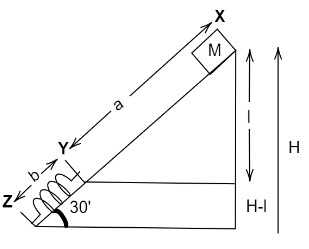
$\sin \theta = \dfrac{H}{{(a + b)}}$…(i)
Applying Energy Conservation Principle,
The sum of Kinetic energy and potential energy of block at X is equal to the sum of the kinetic energy and potential energy of block at Z.
\[{K_X} + {U_X} = {K_Z} + {U_Z}\]
${K_X}$ and ${K_Z}$ are zero because the block starts from rest and momentarily stops at the bottom.
${U_X} = {U_Z}$
${U_Z}$ is the result of compression of the spring due to the block.
$MgH = \dfrac{1}{2}k{\left[ {\Delta x} \right]^2}$
$\Rightarrow H = \dfrac{{k{{\left[ {\Delta x} \right]}^2}}}{{2Mg}} \\
\Rightarrow H = \dfrac{{100 \times 4}}{{2 \times 10 \times 10}} \\
\Rightarrow H = 2{\text{ m}}$
Now,
$\dfrac{H}{{\sin {{30}^ \circ }}} = (a + b)$
Putting the values,
$a = 4 - b$ ($b$ is the change in length of spring)
$\Rightarrow a = 2{\text{ m}}$
From the above diagram,
$l = a\sin {30^ \circ }$
$\Rightarrow l = 1{\text{ m}}$
Applying the law of conservation of energy at points $X$ and $Y$.
\[{K_X} + {U_X} = {K_Y} + {U_Y}\]
${K_X}$ is zero because the block starts from rest.
${U_X} = {K_Y} + {U_Y}$
$\Rightarrow MgH = \dfrac{1}{2}M{V_Y}^2 + Mg(H - l)$
$\Rightarrow {V_Y} = \sqrt {2gl} \\
\Rightarrow {V_Y}= \sqrt {20} \\
\therefore {V_Y}\approx 4.47{\text{ m/s}}$
Therefore, the correct option is A.
Note:The potential energy of the block $M$ at point $Y$ is $Mg(H - l)$. When the block is at rest kinetic energy becomes zero since the velocity of the body is zero. Also remember before touching the spring the block possesses both kinetic and potential energy since its motion does not cease on touching the spring.
Complete step by step answer:
According to Hooke’s law, change in length of the spring is directly proportional to the force applied.Let us find out the spring constant.
$F = kx$
where $F$ is the force applied, $x$ is the change in the length of the spring and $k$ is the
spring constant.
$k = \dfrac{F}{x} \\
\Rightarrow k= \dfrac{{100}}{1} \\
\Rightarrow k= 100{\text{ N/m}}$
From the diagram,
$\sin \theta = \dfrac{H}{{(a + b)}}$…(i)
Applying Energy Conservation Principle,
The sum of Kinetic energy and potential energy of block at X is equal to the sum of the kinetic energy and potential energy of block at Z.
\[{K_X} + {U_X} = {K_Z} + {U_Z}\]
${K_X}$ and ${K_Z}$ are zero because the block starts from rest and momentarily stops at the bottom.
${U_X} = {U_Z}$
${U_Z}$ is the result of compression of the spring due to the block.
$MgH = \dfrac{1}{2}k{\left[ {\Delta x} \right]^2}$
$\Rightarrow H = \dfrac{{k{{\left[ {\Delta x} \right]}^2}}}{{2Mg}} \\
\Rightarrow H = \dfrac{{100 \times 4}}{{2 \times 10 \times 10}} \\
\Rightarrow H = 2{\text{ m}}$
Now,
$\dfrac{H}{{\sin {{30}^ \circ }}} = (a + b)$
Putting the values,
$a = 4 - b$ ($b$ is the change in length of spring)
$\Rightarrow a = 2{\text{ m}}$
From the above diagram,
$l = a\sin {30^ \circ }$
$\Rightarrow l = 1{\text{ m}}$
Applying the law of conservation of energy at points $X$ and $Y$.
\[{K_X} + {U_X} = {K_Y} + {U_Y}\]
${K_X}$ is zero because the block starts from rest.
${U_X} = {K_Y} + {U_Y}$
$\Rightarrow MgH = \dfrac{1}{2}M{V_Y}^2 + Mg(H - l)$
$\Rightarrow {V_Y} = \sqrt {2gl} \\
\Rightarrow {V_Y}= \sqrt {20} \\
\therefore {V_Y}\approx 4.47{\text{ m/s}}$
Therefore, the correct option is A.
Note:The potential energy of the block $M$ at point $Y$ is $Mg(H - l)$. When the block is at rest kinetic energy becomes zero since the velocity of the body is zero. Also remember before touching the spring the block possesses both kinetic and potential energy since its motion does not cease on touching the spring.
Recently Updated Pages
Master Class 11 Social Science: Engaging Questions & Answers for Success

Master Class 11 Physics: Engaging Questions & Answers for Success
Master Class 11 Maths: Engaging Questions & Answers for Success
Master Class 11 Economics: Engaging Questions & Answers for Success
Master Class 11 Computer Science: Engaging Questions & Answers for Success
Master Class 11 Chemistry: Engaging Questions & Answers for Success
Trending doubts
One Metric ton is equal to kg A 10000 B 1000 C 100 class 11 physics CBSE
There are 720 permutations of the digits 1 2 3 4 5 class 11 maths CBSE
1 Quintal is equal to a 110 kg b 10 kg c 100kg d 1000 class 11 physics CBSE
State and prove Bernoullis theorem class 11 physics CBSE
Difference Between Prokaryotic Cells and Eukaryotic Cells
Discuss the various forms of bacteria class 11 biology CBSE