




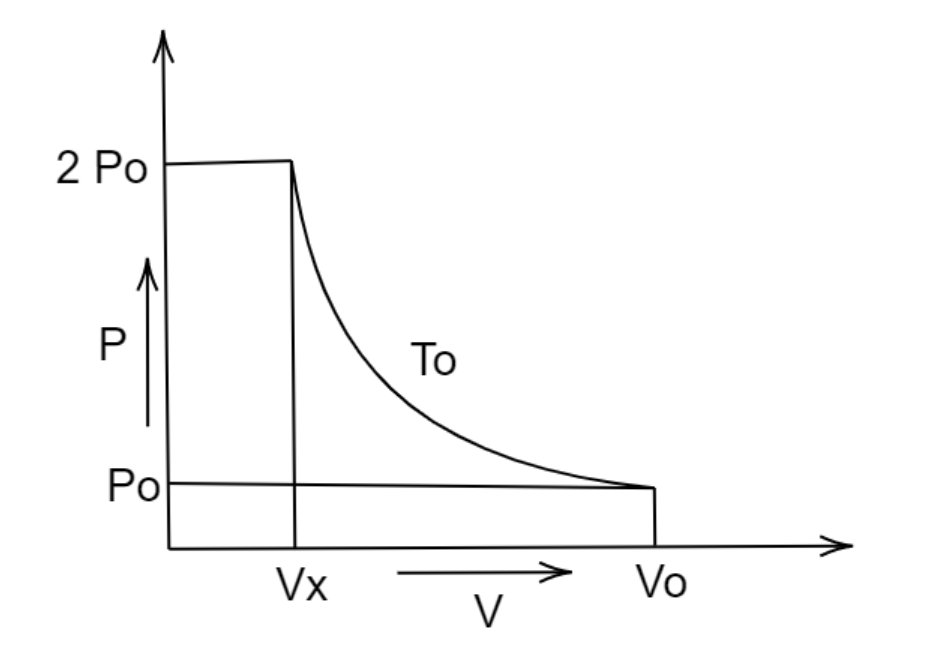
An ideal gas undergoes a state change according to a PV diagram. What is the value of \[Vx\]?
A. \[\dfrac{{V_o}}{2}\]
B. \[V_o\]
C. \[2V_o\]
D. \[\dfrac{{V_o}}{4}\]
Answer
 Verified
565.2k+ views
Hint: In this question, a PV graph is given. A relation between pressure and the volume of an ideal gas is given. An ideal gas is a hypothetical gas and its behavior is described by kinetic molecular theory of gases.
Complete answer:
An ideal gas law is simply the combination of simple gas law such as Boyle’s law, Charles law and Avogadro’s law. The ideal gas equation is \[PV = nRT\]
Let’s first understand each gas law:
1. Boyle’s law- This law describes the inverse relation between the pressure and volume at a constant temperature and a fixed volume of a gas.
\[P \propto \dfrac{1}{V}\]
2. Charles’s law- This law describes the directly proportional relation between the volume and temperature of a gas where pressure and amount of a gas is kept constant.
\[V \propto T\]
3. Avogadro’s law- This law describes that volume of a gas is directly proportional to the amount of a gas at a constant pressure and temperature.
\[V \propto n\]
By combining all the above law, we get ideal gas equation i.e. \[PV = nRT\]
According to this question, the relation between pressure and volume of a gas is given, so we use Boyle’s law which states that the pressure exerted by a given mass of a gas is inversely proportional to the volume if the temperature and amount of a gas is kept constant.
\[P \propto \dfrac{1}{V}\]
We can also write it as: \[{P_1}{V_1} = {P_2}{V_2}\]
In this question, it is given:
Initial pressure and volume,
\[{P_1}\, = {P_o}\]
\[{V_1} = \,{V_o}\]
Final pressure and volume,
\[{P_2}\, = 2{P_o}\]
\[{V_2}\, = \,{V_x}\]
Put all the values in this equation \[{P_1}{V_1} = {P_2}{V_2}\]
We get,
\[{P_o}\,{V_o}\, = 2{P_o}\,{V_x}\]
\[{V_x} = \dfrac{{{V_o}}}{2}\]
Hence, the correct answer is option (A).
Note:
There is another law which makes the ideal gas equation i.e. Amonton’s law which state that pressure of a gas is directly proportional to temperature at a constant volume and amount of a gas i.e. \[P \propto T\]. It must be noted that no such ideal gas exists in reality. It is just a hypothetical gas which is used to study real gases.
Complete answer:
An ideal gas law is simply the combination of simple gas law such as Boyle’s law, Charles law and Avogadro’s law. The ideal gas equation is \[PV = nRT\]
Let’s first understand each gas law:
1. Boyle’s law- This law describes the inverse relation between the pressure and volume at a constant temperature and a fixed volume of a gas.
\[P \propto \dfrac{1}{V}\]
2. Charles’s law- This law describes the directly proportional relation between the volume and temperature of a gas where pressure and amount of a gas is kept constant.
\[V \propto T\]
3. Avogadro’s law- This law describes that volume of a gas is directly proportional to the amount of a gas at a constant pressure and temperature.
\[V \propto n\]
By combining all the above law, we get ideal gas equation i.e. \[PV = nRT\]
According to this question, the relation between pressure and volume of a gas is given, so we use Boyle’s law which states that the pressure exerted by a given mass of a gas is inversely proportional to the volume if the temperature and amount of a gas is kept constant.
\[P \propto \dfrac{1}{V}\]
We can also write it as: \[{P_1}{V_1} = {P_2}{V_2}\]
In this question, it is given:
Initial pressure and volume,
\[{P_1}\, = {P_o}\]
\[{V_1} = \,{V_o}\]
Final pressure and volume,
\[{P_2}\, = 2{P_o}\]
\[{V_2}\, = \,{V_x}\]
Put all the values in this equation \[{P_1}{V_1} = {P_2}{V_2}\]
We get,
\[{P_o}\,{V_o}\, = 2{P_o}\,{V_x}\]
\[{V_x} = \dfrac{{{V_o}}}{2}\]
Hence, the correct answer is option (A).
Note:
There is another law which makes the ideal gas equation i.e. Amonton’s law which state that pressure of a gas is directly proportional to temperature at a constant volume and amount of a gas i.e. \[P \propto T\]. It must be noted that no such ideal gas exists in reality. It is just a hypothetical gas which is used to study real gases.
Recently Updated Pages
If x a + bt + ct2 where x is in meters and t is in class 11 physics CBSE

A car covers the first half distance between two places class 11 physics CBSE
The resultant of two vectors overrightarrow P and overrightarrow class 11 physics CBSE
Find the value of cos 135 class 11 maths CBSE
A mass M is held in place by an applied force F and class 11 physics CBSE
A solution of glucose in water is labelled as 10 dfracwv class 11 chemistry CBSE
Trending doubts
One Metric ton is equal to kg A 10000 B 1000 C 100 class 11 physics CBSE
Find the value of the expression given below sin 30circ class 11 maths CBSE
What do you mean by retardation What is its SI uni class 11 physics CBSE
Draw a diagram of nephron and explain its structur class 11 biology CBSE
10 examples of friction in our daily life
Difference between physical and chemical change class 11 chemistry CBSE