




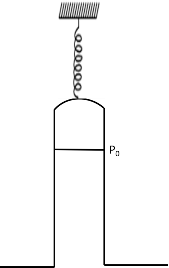
An ideal barometer tube of negligible mass is suspended from a spring balance as shown. The mass of mercury in the tube is m and atmospheric pressure is $ P_0 $ . The cross-section area of the tube is A. The reading of spring balance is:
A. \[mg\]
B. \[{P_0}A\]
C. \[{P_0}A{\text{ }} - {\text{ }}mg\]
D. $\dfrac{{{P_0}A{\text{ + }}mg}}{2}$
Answer
 Verified
586.5k+ views
Hint: In the question, we have been asked about the reading of the spring balance of the given figure. So, to solve this question we will start with taking restoring force, kx of spring it will be equal to weight, i.e., mg. Now the fluid will also exert some force, hence on getting all the required value, we will get the required answer.
Complete step by step answer:
We have been given an ideal barometer tube of negligible mass which is suspended from a spring balance. It is given that the mass of mercury in the tube is ‘m’ and atmospheric pressure is and the cross-section area of the tube is A. We need to find the reading of spring balance.
The given mass of mercury in the barometer tube \[ = {\text{ }}m\]
The given atmospheric pressure \[ = {\text{ }}{P_0}\]
And, cross-section area of the given tube \[ = {\text{ }}A\]
Barometer tube of negligible mass is suspended from a spring balance, and we know that the spring always measures contraction of expansion depending on the nature of force acting on it.
So, when the weight is attached to the spring, the weight gets displaced from its equilibrium position and the restoring force acts on the weight. At equilibrium the only force acting will be mg.
Hence, the restoring force kx, \[kx{\text{ }} = {\text{ }}mg.\]
where, k \[ = \] spring constant
And there is a fluid inside the barometer, i.e., mercury will exert pressure inside the tube and it will raise to some height h.
So, atmospheric pressure, \[{P_0} = \rho gh\]\[ \ldots eq.\left( 1 \right)\]
\[\rho gh = \dfrac{F}{A}\]\[ \ldots .eq.\left( 2 \right)\]
where, F \[ = \] force
So, from \[eq.\left( 1 \right)\] and \[eq.\left( 2 \right),\] we get
\[F = {P_0}A\]
So, the reading of spring balance is \[{P_0}A.\]
So, the correct answer is “Option B”.
Note:
In the solution, we have mentioned, that \[kx{\text{ }} = {\text{ }}mg.\]To understand this, we will take an example, suppose on vertically hanging a mass m from a spring with spring constant k. Initially the spring will expand due to the weight attached but afterwards it will come to rest. That’s why, then kx will be equal to mg. Basically, the weight of mass will be balanced by spring force.
Complete step by step answer:
We have been given an ideal barometer tube of negligible mass which is suspended from a spring balance. It is given that the mass of mercury in the tube is ‘m’ and atmospheric pressure is and the cross-section area of the tube is A. We need to find the reading of spring balance.
The given mass of mercury in the barometer tube \[ = {\text{ }}m\]
The given atmospheric pressure \[ = {\text{ }}{P_0}\]
And, cross-section area of the given tube \[ = {\text{ }}A\]
Barometer tube of negligible mass is suspended from a spring balance, and we know that the spring always measures contraction of expansion depending on the nature of force acting on it.
So, when the weight is attached to the spring, the weight gets displaced from its equilibrium position and the restoring force acts on the weight. At equilibrium the only force acting will be mg.
Hence, the restoring force kx, \[kx{\text{ }} = {\text{ }}mg.\]
where, k \[ = \] spring constant
And there is a fluid inside the barometer, i.e., mercury will exert pressure inside the tube and it will raise to some height h.
So, atmospheric pressure, \[{P_0} = \rho gh\]\[ \ldots eq.\left( 1 \right)\]
\[\rho gh = \dfrac{F}{A}\]\[ \ldots .eq.\left( 2 \right)\]
where, F \[ = \] force
So, from \[eq.\left( 1 \right)\] and \[eq.\left( 2 \right),\] we get
\[F = {P_0}A\]
So, the reading of spring balance is \[{P_0}A.\]
So, the correct answer is “Option B”.
Note:
In the solution, we have mentioned, that \[kx{\text{ }} = {\text{ }}mg.\]To understand this, we will take an example, suppose on vertically hanging a mass m from a spring with spring constant k. Initially the spring will expand due to the weight attached but afterwards it will come to rest. That’s why, then kx will be equal to mg. Basically, the weight of mass will be balanced by spring force.
Recently Updated Pages
Master Class 11 Computer Science: Engaging Questions & Answers for Success

Master Class 11 Business Studies: Engaging Questions & Answers for Success
Master Class 11 Economics: Engaging Questions & Answers for Success
Master Class 11 English: Engaging Questions & Answers for Success
Master Class 11 Maths: Engaging Questions & Answers for Success
Master Class 11 Biology: Engaging Questions & Answers for Success
Trending doubts
One Metric ton is equal to kg A 10000 B 1000 C 100 class 11 physics CBSE
There are 720 permutations of the digits 1 2 3 4 5 class 11 maths CBSE
Discuss the various forms of bacteria class 11 biology CBSE
Draw a diagram of a plant cell and label at least eight class 11 biology CBSE
State the laws of reflection of light
10 examples of friction in our daily life