




An example of symbiotic bacteria is
A)Erwinia amylovora
B)Rhizobium leguminosarum
C)Xanthomonas campestris
D)Agrobacterium tumefaciens
Answer
 Verified
601.5k+ views
Hint: It is a bacteria that lives in a mutual symbiotic relationship with the legumes. It also has the ability to fix free nitrogen from the air. This species is also the main concepts in biology because it helps in describing the fundamentals and understanding of the biological diversity in relation to both ecology and genetics.
Complete answer:
-The bacteria which live in a symbiotic relationship with other organisms are called symbiotic bacteria.
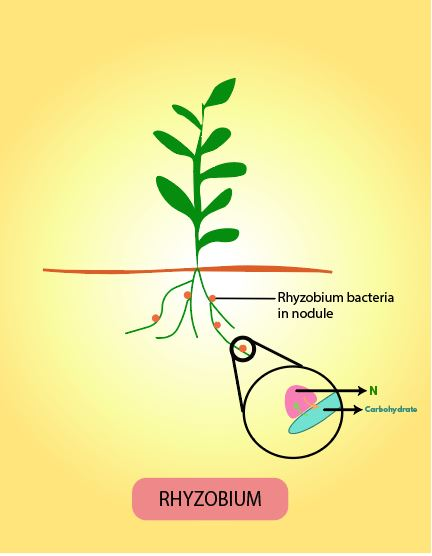
-In the symbiotic relationship both the host and the pathogen are benefited like rhizobium bacteria associated with root nodules. Here plants provide shelter to the rhizobium bacteria and the bacteria helps plants in nitrogen fixation.
-The rhizobium bacteria live on the roots of the legumes in the soil or in nodules. They form the symbiotic association with the legume in the root nodule and receive nutrients from the plant. Hence, producing nitrogen for the process known as nitrogen fixation or biological nitrogen fixation.
-Rhizobium is also classified as slow-growing or fast-growing bacteria based on the growth in the laboratory medium.
Additional Information:
Many of the soil microorganisms play a very important role like rhizobia form a symbiotic relationship with the legumes resulting in biological nitrogen fixation.
-Erwinia amylovora - it is a bacteria that is first proved to be a pathogen of plants. It causes fire blight. Fire blight is a disease of apples and pears and can be seen in many parts of the world.
Xanthomonas campestris-it causes black rot in crucifers by darkening their blood vascular tissue. It is in an aerobic, gram-negative, and rod-shaped bacteria. About 20 different species have been identified pause distinctive pathogenicity in plants including crops and wild plants.
Agrobacterium tumefaciens- it causes the crown gall disease in over 140 species of eudicots. It is also a gram-negative and rod-shaped soil bacteria.
So, the correct answer is, “Rhizobium leguminosarum”.
Note: -According to the legume species rhizobia classified and this concept is known as cross inoculation groups.
-For the effective biological nitrogen fixation legume should be properly inaugurated with the correct rhizobium.
-The plant species and the environmental factors mostly affect the introduced rhizobium in the soil. Thus, rhizobium affects the result of inoculation.
Complete answer:
-The bacteria which live in a symbiotic relationship with other organisms are called symbiotic bacteria.
-In the symbiotic relationship both the host and the pathogen are benefited like rhizobium bacteria associated with root nodules. Here plants provide shelter to the rhizobium bacteria and the bacteria helps plants in nitrogen fixation.
-The rhizobium bacteria live on the roots of the legumes in the soil or in nodules. They form the symbiotic association with the legume in the root nodule and receive nutrients from the plant. Hence, producing nitrogen for the process known as nitrogen fixation or biological nitrogen fixation.
-Rhizobium is also classified as slow-growing or fast-growing bacteria based on the growth in the laboratory medium.
Additional Information:
Many of the soil microorganisms play a very important role like rhizobia form a symbiotic relationship with the legumes resulting in biological nitrogen fixation.
-Erwinia amylovora - it is a bacteria that is first proved to be a pathogen of plants. It causes fire blight. Fire blight is a disease of apples and pears and can be seen in many parts of the world.
Xanthomonas campestris-it causes black rot in crucifers by darkening their blood vascular tissue. It is in an aerobic, gram-negative, and rod-shaped bacteria. About 20 different species have been identified pause distinctive pathogenicity in plants including crops and wild plants.
Agrobacterium tumefaciens- it causes the crown gall disease in over 140 species of eudicots. It is also a gram-negative and rod-shaped soil bacteria.
So, the correct answer is, “Rhizobium leguminosarum”.
Note: -According to the legume species rhizobia classified and this concept is known as cross inoculation groups.
-For the effective biological nitrogen fixation legume should be properly inaugurated with the correct rhizobium.
-The plant species and the environmental factors mostly affect the introduced rhizobium in the soil. Thus, rhizobium affects the result of inoculation.
Recently Updated Pages
Master Class 11 Social Science: Engaging Questions & Answers for Success

Master Class 11 English: Engaging Questions & Answers for Success
Master Class 11 Maths: Engaging Questions & Answers for Success
Master Class 11 Chemistry: Engaging Questions & Answers for Success
Master Class 11 Biology: Engaging Questions & Answers for Success
Master Class 11 Physics: Engaging Questions & Answers for Success
Trending doubts
One Metric ton is equal to kg A 10000 B 1000 C 100 class 11 physics CBSE
Difference Between Prokaryotic Cells and Eukaryotic Cells
How many of the following diseases can be studied with class 11 biology CBSE
Which of the following enzymes is used for carboxylation class 11 biology CBSE
Draw a diagram of a plant cell and label at least eight class 11 biology CBSE
Two of the body parts which do not appear in MRI are class 11 biology CBSE