




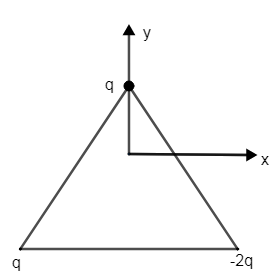
An equilateral triangle wire frame of side L having 3 point charges at its vertices is kept in x-y plane as shown. Components of the electric field due to the configuration in z-direction at (0, 0, L) is (origin is centroid of triangle).
\[\begin{align}
& A.\text{ }\dfrac{9\sqrt{3}Kq}{8{{L}^{2}}} \\
& B.\text{ zero} \\
& C.\text{ }\dfrac{9Kq}{8{{L}^{2}}} \\
& D.\text{ none} \\
\end{align}\]
Answer
 Verified
600.3k+ views
Hint: An equilateral triangle is the one in which all sides are equal. Firstly, calculate the distance of vertices of triangle from the centroid of the equilateral triangle then, find the components of the electric field in the z-direction at (0, 0, L) point.
Complete answer:
We know that an equilateral triangle is a triangle whose all three sides are of the same length. The sides of an equilateral triangle are congruent. The three angles are also congruent.to each other and are each ${{60}^{o}}$.
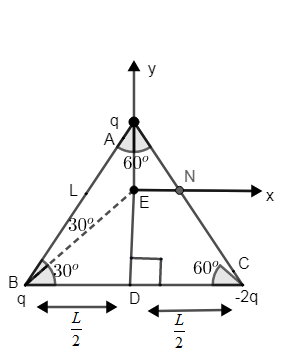
Now form the above figure, in $\Delta BED$
\[\begin{align}
& \cos {{30}^{o}}=\dfrac{BE}{BD} \\
& \cos {{30}^{o}}=\dfrac{BE}{\dfrac{L}{2}} \\
& \Rightarrow BE=\dfrac{L}{2}\times \cos {{30}^{o}} \\
& \Rightarrow BE=\dfrac{L}{2}\times \dfrac{\sqrt{3}}{2} \\
& \Rightarrow BE=\dfrac{\sqrt{3}}{4}L \\
\end{align}\]
Now to calculate distance d we have,
$\eqalign{
& d = \sqrt {{{\left( {\dfrac{{\sqrt 3 }}{4}L} \right)}^2} + {L^2}} \cr
& \Rightarrow d = \dfrac{{\sqrt {19L} }}{4}m \cr} $
Let’s find the z- component of the electric field.
$\eqalign{
& {E_z} = K\left( {\dfrac{q}{{L{'^2}}} + \dfrac{q}{{L{'^2}}} - \dfrac{{2q}}{{L{'^2}}}} \right) \cr
& \Rightarrow {E_z} = K\left( {\dfrac{{2q}}{{L{'^2}}} - \dfrac{{2q}}{{{L^{'2}}}}} \right) \cr
& \therefore {E_z} = 0 \cr} $
Therefore the component of electric field in z-direction is zero. It is only x-y direction.
Hence the correct option is (B).
Additional Information:
The electric field takes finite time to propagate. Thus, if a charge is displaced from its position, the field at a distance r will change after a time t = r/c, where c is the speed of light. Additionally, the electric field in a region can be graphically represented by drawing certain curves known as the lines of electric force or electric field lines. These lines of forces are drawn in such a way that the tangent to a line of force gives the direction of the resultant electric field there. Thus, the electric field due to a positive point charge is represented by straight lines originating from the charge. And the electric field due to a negative point charge is represented by straight lines terminating at the charge.
Note:
Electric field is an electric property associated with each point in space when charge is present in any form. The magnitude and direction of electric field are expressed by electric field strength or electric field intensity.
Complete answer:
We know that an equilateral triangle is a triangle whose all three sides are of the same length. The sides of an equilateral triangle are congruent. The three angles are also congruent.to each other and are each ${{60}^{o}}$.
Now form the above figure, in $\Delta BED$
\[\begin{align}
& \cos {{30}^{o}}=\dfrac{BE}{BD} \\
& \cos {{30}^{o}}=\dfrac{BE}{\dfrac{L}{2}} \\
& \Rightarrow BE=\dfrac{L}{2}\times \cos {{30}^{o}} \\
& \Rightarrow BE=\dfrac{L}{2}\times \dfrac{\sqrt{3}}{2} \\
& \Rightarrow BE=\dfrac{\sqrt{3}}{4}L \\
\end{align}\]
Now to calculate distance d we have,
$\eqalign{
& d = \sqrt {{{\left( {\dfrac{{\sqrt 3 }}{4}L} \right)}^2} + {L^2}} \cr
& \Rightarrow d = \dfrac{{\sqrt {19L} }}{4}m \cr} $
Let’s find the z- component of the electric field.
$\eqalign{
& {E_z} = K\left( {\dfrac{q}{{L{'^2}}} + \dfrac{q}{{L{'^2}}} - \dfrac{{2q}}{{L{'^2}}}} \right) \cr
& \Rightarrow {E_z} = K\left( {\dfrac{{2q}}{{L{'^2}}} - \dfrac{{2q}}{{{L^{'2}}}}} \right) \cr
& \therefore {E_z} = 0 \cr} $
Therefore the component of electric field in z-direction is zero. It is only x-y direction.
Hence the correct option is (B).
Additional Information:
The electric field takes finite time to propagate. Thus, if a charge is displaced from its position, the field at a distance r will change after a time t = r/c, where c is the speed of light. Additionally, the electric field in a region can be graphically represented by drawing certain curves known as the lines of electric force or electric field lines. These lines of forces are drawn in such a way that the tangent to a line of force gives the direction of the resultant electric field there. Thus, the electric field due to a positive point charge is represented by straight lines originating from the charge. And the electric field due to a negative point charge is represented by straight lines terminating at the charge.
Note:
Electric field is an electric property associated with each point in space when charge is present in any form. The magnitude and direction of electric field are expressed by electric field strength or electric field intensity.
Recently Updated Pages
Master Class 11 Social Science: Engaging Questions & Answers for Success

Master Class 11 English: Engaging Questions & Answers for Success
Master Class 11 Maths: Engaging Questions & Answers for Success
Master Class 11 Chemistry: Engaging Questions & Answers for Success
Master Class 11 Biology: Engaging Questions & Answers for Success
Master Class 11 Physics: Engaging Questions & Answers for Success
Trending doubts
One Metric ton is equal to kg A 10000 B 1000 C 100 class 11 physics CBSE
Difference Between Prokaryotic Cells and Eukaryotic Cells
Draw a diagram of a plant cell and label at least eight class 11 biology CBSE
Two of the body parts which do not appear in MRI are class 11 biology CBSE
Which gas is abundant in air class 11 chemistry CBSE
10 examples of friction in our daily life