




An equilateral triangle of side 9cm is inscribed in a circle. Find the radius of the circle.
Answer
 Verified
612k+ views
Hint: In this question, we will start by making the diagram according to the information given in the question. The centre of the circle is the point of intersection of the perpendicular bisectors of the sides of the inscribed equilateral triangle. We will find the radius by using trigonometric ratio.
Complete step by step answer:
First we will make the diagram for the question:
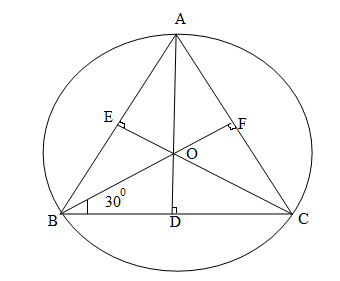
Triangle ABC is an equilateral triangle such that AB = BC = CA = 9cm.
Construction:- We have drawn perpendicular bisectors AD , BF and CE of the corresponding three sides of the triangle. ‘O’ is the point of intersection of these perpendicular bisectors.
We know that in an equilateral triangle, all sides and all angles are equal.
Measure of each angle = ${60^0}$
$\because $ AD is the perpendicular bisector of the side BC. So, we can say that:
BD = DC = 4.5cm.
We know that the perpendicular bisector divides the triangle into two congruent triangles.
$\therefore \angle EBO = \angle DBO = \dfrac{{{{60}^0}}}{2} = {30^0}$
We have point ‘O’ which is the intersection of these perpendicular bisectors and also the centre of the circumcircle.
So, we will now find the radius of this circle using trigonometry.
$\vartriangle OBD$ is a right triangle and $\angle OBD = {30^0}$.
On applying trigonometry ratio, we get:
$\cos {30^0} = \dfrac{{BD}}{{OB}}$
$ \Rightarrow OB = \dfrac{{BD}}{{\cos {{30}^0}}}$ .
Putting the value in above equation, we get:
$ \Rightarrow OB = \dfrac{{4.5}}{{\sqrt 3 /2}} = \dfrac{9}{{1.732}}$=5.196.
Therefore, the radius of the circle = OB = 5.196cm.
Note: In this question, you should know about the circumcircle of the triangle. It is a triangle whose centre is the point of intersection of the perpendicular bisectors of the sides of the triangle and touches the vertices of the triangle. The property of the perpendicular bisectors is that it divides the side into two parts and also, it is perpendicular to it.
Complete step by step answer:
First we will make the diagram for the question:
Triangle ABC is an equilateral triangle such that AB = BC = CA = 9cm.
Construction:- We have drawn perpendicular bisectors AD , BF and CE of the corresponding three sides of the triangle. ‘O’ is the point of intersection of these perpendicular bisectors.
We know that in an equilateral triangle, all sides and all angles are equal.
Measure of each angle = ${60^0}$
$\because $ AD is the perpendicular bisector of the side BC. So, we can say that:
BD = DC = 4.5cm.
We know that the perpendicular bisector divides the triangle into two congruent triangles.
$\therefore \angle EBO = \angle DBO = \dfrac{{{{60}^0}}}{2} = {30^0}$
We have point ‘O’ which is the intersection of these perpendicular bisectors and also the centre of the circumcircle.
So, we will now find the radius of this circle using trigonometry.
$\vartriangle OBD$ is a right triangle and $\angle OBD = {30^0}$.
On applying trigonometry ratio, we get:
$\cos {30^0} = \dfrac{{BD}}{{OB}}$
$ \Rightarrow OB = \dfrac{{BD}}{{\cos {{30}^0}}}$ .
Putting the value in above equation, we get:
$ \Rightarrow OB = \dfrac{{4.5}}{{\sqrt 3 /2}} = \dfrac{9}{{1.732}}$=5.196.
Therefore, the radius of the circle = OB = 5.196cm.
Note: In this question, you should know about the circumcircle of the triangle. It is a triangle whose centre is the point of intersection of the perpendicular bisectors of the sides of the triangle and touches the vertices of the triangle. The property of the perpendicular bisectors is that it divides the side into two parts and also, it is perpendicular to it.
Recently Updated Pages
Master Class 11 Social Science: Engaging Questions & Answers for Success

Master Class 11 Physics: Engaging Questions & Answers for Success
Master Class 11 Maths: Engaging Questions & Answers for Success
Master Class 11 Economics: Engaging Questions & Answers for Success
Master Class 11 Computer Science: Engaging Questions & Answers for Success
Master Class 11 Chemistry: Engaging Questions & Answers for Success
Trending doubts
One Metric ton is equal to kg A 10000 B 1000 C 100 class 11 physics CBSE
There are 720 permutations of the digits 1 2 3 4 5 class 11 maths CBSE
1 Quintal is equal to a 110 kg b 10 kg c 100kg d 1000 class 11 physics CBSE
State and prove Bernoullis theorem class 11 physics CBSE
Difference Between Prokaryotic Cells and Eukaryotic Cells
Which among the following are examples of coming together class 11 social science CBSE