




An equilateral triangle of side 9cm inscribed in a circle, the radius of the circle is
\[
(a){\text{ 3cm}} \\
(b){\text{ }}\sqrt 3 {\text{cm}} \\
(c){\text{ 3}}\sqrt 3 {\text{cm}} \\
(d){\text{ }}\dfrac{{3\sqrt 3 }}{2}{\text{cm}} \\
\]
Answer
 Verified
630k+ views
Hint – In this question join the center O with the vertices of the triangle and draw a perpendicular from vertex A onto the side BC. This perpendicular will bisect the side BC. Also OB, OC and OA will be the angle bisector of angle A, B and C. Use this concept to get the value of sides OB, OC or OA as they depict the radius of the circle.
Complete step-by-step solution -
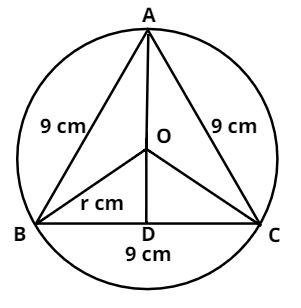
Let ABC be the equilateral triangle inscribed in a circle with center O.
The side of the equilateral triangle is 9 cm (given).
Now join point OA, OB and OC which is the radius of the circle.
Let the radius of the circle be r cm.
Therefore OA = OB = OC = r cm.
Now draw the perpendicular from point A on side BC which cuts the line BC at point D as shown in figure.
Therefore, $BD = \dfrac{{BC}}{2} = \dfrac{9}{2} = 4.5$ cm
Now as we know that all the angles in the equilateral triangle are equal = 60 degree.
$ \Rightarrow \angle A = \angle B = \angle C = {60^0}$
Now OB is the bisector of angle B.
$ \Rightarrow \angle OBD = \dfrac{{\angle B}}{2} = {30^0}$
Now in the triangle OBD cos is the ratio of base to hypotenuse.
$ \Rightarrow \cos {30^0} = \dfrac{{4.5}}{r} = \dfrac{{\sqrt 3 }}{2}$, $\left[ {\because \cos {{30}^0} = \dfrac{{\sqrt 3 }}{2}} \right]$
Now simplify the above equation we have,
$ \Rightarrow r = \dfrac{9}{{\sqrt 3 }}$
Now multiply and divide by $\sqrt 3 $ we have,
$ \Rightarrow r = \dfrac{9}{{\sqrt 3 }} \times \dfrac{{\sqrt 3 }}{{\sqrt 3 }} = \dfrac{{9\sqrt 3 }}{3} = 3\sqrt 3 $ cm.
So the radius of the circle is $3\sqrt 3 $ cm.
Hence option (C) is correct.
Note – An equilateral triangle is one in which all the sides are equal, the interior angles of an equilateral triangle are all equal and in magnitude is of ${60^0}$, this happens as the angles opposite to equal sides are equal and the angle sum property of a triangle is ${180^0}$. Diagrammatic representation of the information provided is helpful as it helps figuring out the geometry and the triangles involved.
Complete step-by-step solution -
Let ABC be the equilateral triangle inscribed in a circle with center O.
The side of the equilateral triangle is 9 cm (given).
Now join point OA, OB and OC which is the radius of the circle.
Let the radius of the circle be r cm.
Therefore OA = OB = OC = r cm.
Now draw the perpendicular from point A on side BC which cuts the line BC at point D as shown in figure.
Therefore, $BD = \dfrac{{BC}}{2} = \dfrac{9}{2} = 4.5$ cm
Now as we know that all the angles in the equilateral triangle are equal = 60 degree.
$ \Rightarrow \angle A = \angle B = \angle C = {60^0}$
Now OB is the bisector of angle B.
$ \Rightarrow \angle OBD = \dfrac{{\angle B}}{2} = {30^0}$
Now in the triangle OBD cos is the ratio of base to hypotenuse.
$ \Rightarrow \cos {30^0} = \dfrac{{4.5}}{r} = \dfrac{{\sqrt 3 }}{2}$, $\left[ {\because \cos {{30}^0} = \dfrac{{\sqrt 3 }}{2}} \right]$
Now simplify the above equation we have,
$ \Rightarrow r = \dfrac{9}{{\sqrt 3 }}$
Now multiply and divide by $\sqrt 3 $ we have,
$ \Rightarrow r = \dfrac{9}{{\sqrt 3 }} \times \dfrac{{\sqrt 3 }}{{\sqrt 3 }} = \dfrac{{9\sqrt 3 }}{3} = 3\sqrt 3 $ cm.
So the radius of the circle is $3\sqrt 3 $ cm.
Hence option (C) is correct.
Note – An equilateral triangle is one in which all the sides are equal, the interior angles of an equilateral triangle are all equal and in magnitude is of ${60^0}$, this happens as the angles opposite to equal sides are equal and the angle sum property of a triangle is ${180^0}$. Diagrammatic representation of the information provided is helpful as it helps figuring out the geometry and the triangles involved.
Recently Updated Pages
Master Class 10 Social Science: Engaging Questions & Answers for Success

Master Class 10 Science: Engaging Questions & Answers for Success
Master Class 10 Maths: Engaging Questions & Answers for Success
Master Class 10 General Knowledge: Engaging Questions & Answers for Success
Master Class 10 Computer Science: Engaging Questions & Answers for Success
Class 10 Question and Answer - Your Ultimate Solutions Guide
Trending doubts
What is the full form of PNG A Petrol Natural Gas B class 10 chemistry CBSE
Why is there a time difference of about 5 hours between class 10 social science CBSE
Distinguish between the reserved forests and protected class 10 biology CBSE
Metals which do not react with dilute acids beginarray20l class 10 chemistry CBSE
If a trait A exists in 10 of a population of an asexually class 10 biology CBSE
Find the value of log sqrt 2 64 class 10 maths CBSE