



An equilateral triangle is cut along its line of symmetry. How many isosceles triangles are formed?
A) 0
B) 1
C) 2
D) 3
Answer
 Verified
634.5k+ views
Hint: Here first we will draw an equilateral triangle with the line of symmetry and then observe the triangles so formed whether they are isosceles triangles or not.
Complete step-by-step answer:
It is given that an equilateral triangle is cut along its line of symmetry.
Let us assume the sides AB=BC=CA=a
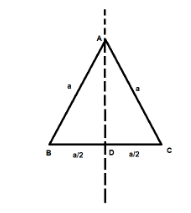
When we draw the line of symmetry which is the perpendicular bisector of the base of the equilateral triangle i.e. BC, we get two triangles as the result.
Therefore, \[\Delta ABD\] and \[\Delta ADC\] are formed as the result.
Now since AD is the perpendicular bisector of BC, therefore it divides BC into two equal parts
Hence we get:-
\[BD = DC = \dfrac{1}{2}BC\]
Hence the length of BD and CD is equal to \[\dfrac{a}{2}\]
Therefore, \[BD = DC = \dfrac{a}{2}\]
Now in \[\Delta ABD\]
\[A{B^2} = A{D^2} + B{D^2}\]
Putting in the values we get:-
\[{a^2} = A{D^2} + \dfrac{{{a^2}}}{4}\]
Solving it further we get:-
\[A{D^2} = {a^2} - \dfrac{{{a^2}}}{4}\]
Taking the LCM we get:-
\[A{D^2} = \dfrac{{4{a^2} - {a^2}}}{4}\]
\[ \Rightarrow A{D^2} = \dfrac{{3{a^2}}}{4}\]
Taking the square root we get:-
\[AD = \dfrac{{\sqrt 3 a}}{2}\]
This implies \[AB \ne BD \ne AD\]
Therefore no isosceles triangle is formed as it has two equal sides.
Hence, option A is correct.
Note: Students should note that an isosceles triangle has two sides and the two corresponding angles are equal.
Also, an equilateral triangle has three lines of symmetry.
The line of symmetry is an imaginary line on any plane which divides it into equal halves.
Complete step-by-step answer:
It is given that an equilateral triangle is cut along its line of symmetry.
Let us assume the sides AB=BC=CA=a
When we draw the line of symmetry which is the perpendicular bisector of the base of the equilateral triangle i.e. BC, we get two triangles as the result.
Therefore, \[\Delta ABD\] and \[\Delta ADC\] are formed as the result.
Now since AD is the perpendicular bisector of BC, therefore it divides BC into two equal parts
Hence we get:-
\[BD = DC = \dfrac{1}{2}BC\]
Hence the length of BD and CD is equal to \[\dfrac{a}{2}\]
Therefore, \[BD = DC = \dfrac{a}{2}\]
Now in \[\Delta ABD\]
\[A{B^2} = A{D^2} + B{D^2}\]
Putting in the values we get:-
\[{a^2} = A{D^2} + \dfrac{{{a^2}}}{4}\]
Solving it further we get:-
\[A{D^2} = {a^2} - \dfrac{{{a^2}}}{4}\]
Taking the LCM we get:-
\[A{D^2} = \dfrac{{4{a^2} - {a^2}}}{4}\]
\[ \Rightarrow A{D^2} = \dfrac{{3{a^2}}}{4}\]
Taking the square root we get:-
\[AD = \dfrac{{\sqrt 3 a}}{2}\]
This implies \[AB \ne BD \ne AD\]
Therefore no isosceles triangle is formed as it has two equal sides.
Hence, option A is correct.
Note: Students should note that an isosceles triangle has two sides and the two corresponding angles are equal.
Also, an equilateral triangle has three lines of symmetry.
The line of symmetry is an imaginary line on any plane which divides it into equal halves.
Recently Updated Pages
Basicity of sulphurous acid and sulphuric acid are

Master Class 12 Economics: Engaging Questions & Answers for Success
Master Class 12 Biology: Engaging Questions & Answers for Success
Master Class 11 English: Engaging Questions & Answers for Success
Master Class 11 Physics: Engaging Questions & Answers for Success
Master Class 11 Computer Science: Engaging Questions & Answers for Success
Trending doubts
Difference Between Plant Cell and Animal Cell
Fill the blanks with the suitable prepositions 1 The class 9 english CBSE
What is pollution? How many types of pollution? Define it
What is the full form of pH?
What is the Full Form of ICSE, CBSE and SSC
Name 10 Living and Non living things class 9 biology CBSE