




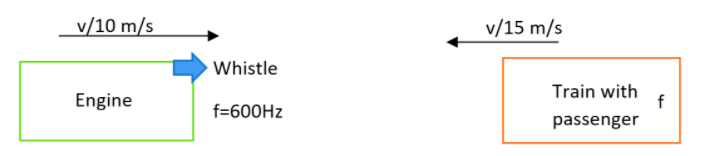
An engine running at speed $\dfrac{v}{10}$ sounds a whistle of frequency $600Hz$. A passenger in a train coming from the opposite side at speed $\dfrac{v}{15}$ experiences this whistle to be of frequency$f$. If $v$ is speed of sound in air and there is no wind, $f$ will be near to :
$\begin{align}
& A.711Hz \\
& B.630Hz \\
& C.580Hz \\
& D.510Hz \\
\end{align}$
Answer
 Verified
584.4k+ views
Hint: Doppler’s effect is taking place here. The equation of Doppler’s effect is to be used. The apparent frequency will be the product of the ratio of the sum of velocity of sound and the velocity of the receiver to the resultant of the velocity of sound and the velocity of the observer and the frequency of the source. Substitute the values in this equation and find out the answer.
Formula used:
$f=\left( \dfrac{v\pm {{u}_{r}}}{v\pm {{u}_{s}}} \right){{f}_{0}}$
Where $f$ be the apparent frequency, ${{f}_{0}}$ be the frequency of the whistle, $v$ be the velocity of the sound in air, ${{u}_{r}}$be the velocity of the receiver of the sound and ${{u}_{s}}$be the velocity of the source of the sound.
Complete answer:
Here it is mentioned that the velocity of sound in air is $v$
The frequency of the whistle used can be taken as,
\[{{f}_{0}}=600Hz\]
The receiver’s velocity, that is the velocity with which the train passes where the passenger sits is given as,
\[{{u}_{r}}=\dfrac{v}{15}\]
The velocity of the source, that is the velocity of the engine passing is given by the equation,
\[{{u}_{s}}=\dfrac{-v}{10}\]
Therefore, as per the equation of Doppler Effect, we can write that,
$f=\left( \dfrac{v\pm {{u}_{r}}}{v\pm {{u}_{s}}} \right){{f}_{0}}$
Where $f$ be the apparent frequency.
Substituting the values in it will give,
$f=\left( \dfrac{v+\dfrac{v}{15}}{v+\left( -\dfrac{v}{10} \right)} \right)\times 600$
Therefore, calculating the value will give,
$f=711Hz$
Hence the correct answer is obtained.
It is mentioned as option A.
Note:
An acoustic Doppler current profiler (ADCP) is a hydro acoustic current meter. This is similar to the sonar. This works on the basis of the principle of Doppler Effect of sound waves to measure the water current velocities over a range of depth. In robotics also, this phenomenon is used to aid the movement of robots. The Doppler Effect is used in some types of radar also.
Formula used:
$f=\left( \dfrac{v\pm {{u}_{r}}}{v\pm {{u}_{s}}} \right){{f}_{0}}$
Where $f$ be the apparent frequency, ${{f}_{0}}$ be the frequency of the whistle, $v$ be the velocity of the sound in air, ${{u}_{r}}$be the velocity of the receiver of the sound and ${{u}_{s}}$be the velocity of the source of the sound.
Complete answer:
Here it is mentioned that the velocity of sound in air is $v$
The frequency of the whistle used can be taken as,
\[{{f}_{0}}=600Hz\]
The receiver’s velocity, that is the velocity with which the train passes where the passenger sits is given as,
\[{{u}_{r}}=\dfrac{v}{15}\]
The velocity of the source, that is the velocity of the engine passing is given by the equation,
\[{{u}_{s}}=\dfrac{-v}{10}\]
Therefore, as per the equation of Doppler Effect, we can write that,
$f=\left( \dfrac{v\pm {{u}_{r}}}{v\pm {{u}_{s}}} \right){{f}_{0}}$
Where $f$ be the apparent frequency.
Substituting the values in it will give,
$f=\left( \dfrac{v+\dfrac{v}{15}}{v+\left( -\dfrac{v}{10} \right)} \right)\times 600$
Therefore, calculating the value will give,
$f=711Hz$
Hence the correct answer is obtained.
It is mentioned as option A.
Note:
An acoustic Doppler current profiler (ADCP) is a hydro acoustic current meter. This is similar to the sonar. This works on the basis of the principle of Doppler Effect of sound waves to measure the water current velocities over a range of depth. In robotics also, this phenomenon is used to aid the movement of robots. The Doppler Effect is used in some types of radar also.
Recently Updated Pages
Master Class 11 Computer Science: Engaging Questions & Answers for Success

Master Class 11 Business Studies: Engaging Questions & Answers for Success
Master Class 11 Economics: Engaging Questions & Answers for Success
Master Class 11 English: Engaging Questions & Answers for Success
Master Class 11 Maths: Engaging Questions & Answers for Success
Master Class 11 Biology: Engaging Questions & Answers for Success
Trending doubts
One Metric ton is equal to kg A 10000 B 1000 C 100 class 11 physics CBSE
There are 720 permutations of the digits 1 2 3 4 5 class 11 maths CBSE
Discuss the various forms of bacteria class 11 biology CBSE
Draw a diagram of a plant cell and label at least eight class 11 biology CBSE
State the laws of reflection of light
Explain zero factorial class 11 maths CBSE