




An engine of 150 kW power is drawing a train of total mass 150,000 kg up an inclination of 1 in 5. The frictional resistance is 4 kg wt/1000 kg. Find its maximum speed. Given: \[g = 10\,{\text{m/}}{{\text{s}}^2}\].
Answer
 Verified
634.5k+ views
Hint: Determine the frictional force on the total mass of the train in units of newton. Draw the free body diagram and determine the net resistance force in the backward direction. The power is the product of force and velocity.
Formula used:
Power, \[P = Fv\],
where, F is the force and v is the velocity.
Complete step by step answer:
We have given the power of the engine drawing the train \[P = 150\,{\text{kW}} = 1.5 \times {10^5}\,{\text{W}}\], the mass of the train \[m = 150,000\,{\text{kg}} = 1.5 \times {10^4}\,{\text{kg}}\] and the inclination of the plane is \[\sin \theta = \dfrac{1}{5}\].
The given resistance force due to the friction is 4 kg-wt per 1000 kg. Therefore, the total resistance force on the total mass of the train will be,
\[{f_r} = \dfrac{{4 \times 150000}}{{1000}}\]
\[ \Rightarrow {f_r} = 600\,{\text{kg - wt}}\]
\[ \Rightarrow {f_r} = 600 \times 10\,{\text{N}}\]
\[ \Rightarrow {f_r} = 6000\,{\text{N}}\]
Let us draw the free body diagram of the forces acting on the train as follows,
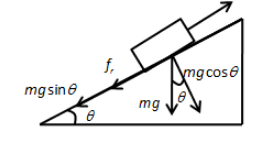
From the above figure, the total resistance force in the backward direction is,
\[F = mg\sin \theta + {f_r}\]
Substituting \[m = 1.5 \times {10^4}\,{\text{kg}}\], \[g = 10\,{\text{m/}}{{\text{s}}^2}\] , \[\sin \theta = \dfrac{1}{5}\] and \[{f_r} = 6000\,{\text{N}}\] in the above equation, we get,
\[F = \left( {1.5 \times {{10}^5}} \right)\left( {10} \right)\left( {\dfrac{1}{5}} \right) + 6000\]
\[ \Rightarrow F = 3.06 \times {10^5}\,{\text{N}}\]
The power of the engine to draw the train with this backward resistance force is,
\[P = Fv\]
\[ \Rightarrow v = \dfrac{P}{F}\]
Here, v is the velocity of the train.
Substituting \[P = 1.5 \times {10^5}\,{\text{W}}\] and \[F = 3.06 \times {10^5}\,{\text{N}}\] in the above equation, we get,
\[v = \dfrac{{1.5 \times {{10}^5}\,{\text{W}}}}{{3.06 \times {{10}^5}\,{\text{N}}}}\]
\[ \Rightarrow v = 0.49\,{\text{m/s}}\]
\[ \therefore {\text{v}} \approx {\text{0}}{\text{.5}}\,{\text{m/s}}\]
Thus, the maximum speed of the train is 0.50 m/s.
Note: The crucial step in this solution is to determine the frictional resistance since it is given in kg-wt. You may wonder what kg-wt is. 1 kg-wt is the force equivalent to a weight of 1 kg body that is 9.8 N or 10 N as given in the question. If the inclination is given as 1 in 5, it is always the sine angle of ratio of 1 and 5, and not the cosine angle. Students must always draw the free body diagram to determine the direction of forces.
Formula used:
Power, \[P = Fv\],
where, F is the force and v is the velocity.
Complete step by step answer:
We have given the power of the engine drawing the train \[P = 150\,{\text{kW}} = 1.5 \times {10^5}\,{\text{W}}\], the mass of the train \[m = 150,000\,{\text{kg}} = 1.5 \times {10^4}\,{\text{kg}}\] and the inclination of the plane is \[\sin \theta = \dfrac{1}{5}\].
The given resistance force due to the friction is 4 kg-wt per 1000 kg. Therefore, the total resistance force on the total mass of the train will be,
\[{f_r} = \dfrac{{4 \times 150000}}{{1000}}\]
\[ \Rightarrow {f_r} = 600\,{\text{kg - wt}}\]
\[ \Rightarrow {f_r} = 600 \times 10\,{\text{N}}\]
\[ \Rightarrow {f_r} = 6000\,{\text{N}}\]
Let us draw the free body diagram of the forces acting on the train as follows,
From the above figure, the total resistance force in the backward direction is,
\[F = mg\sin \theta + {f_r}\]
Substituting \[m = 1.5 \times {10^4}\,{\text{kg}}\], \[g = 10\,{\text{m/}}{{\text{s}}^2}\] , \[\sin \theta = \dfrac{1}{5}\] and \[{f_r} = 6000\,{\text{N}}\] in the above equation, we get,
\[F = \left( {1.5 \times {{10}^5}} \right)\left( {10} \right)\left( {\dfrac{1}{5}} \right) + 6000\]
\[ \Rightarrow F = 3.06 \times {10^5}\,{\text{N}}\]
The power of the engine to draw the train with this backward resistance force is,
\[P = Fv\]
\[ \Rightarrow v = \dfrac{P}{F}\]
Here, v is the velocity of the train.
Substituting \[P = 1.5 \times {10^5}\,{\text{W}}\] and \[F = 3.06 \times {10^5}\,{\text{N}}\] in the above equation, we get,
\[v = \dfrac{{1.5 \times {{10}^5}\,{\text{W}}}}{{3.06 \times {{10}^5}\,{\text{N}}}}\]
\[ \Rightarrow v = 0.49\,{\text{m/s}}\]
\[ \therefore {\text{v}} \approx {\text{0}}{\text{.5}}\,{\text{m/s}}\]
Thus, the maximum speed of the train is 0.50 m/s.
Note: The crucial step in this solution is to determine the frictional resistance since it is given in kg-wt. You may wonder what kg-wt is. 1 kg-wt is the force equivalent to a weight of 1 kg body that is 9.8 N or 10 N as given in the question. If the inclination is given as 1 in 5, it is always the sine angle of ratio of 1 and 5, and not the cosine angle. Students must always draw the free body diagram to determine the direction of forces.
Recently Updated Pages
Which will be the least stable resonating structure class 11 chemistry CBSE

How many 5 digit telephone numbers can be construc-class-11-maths-CBSE
How do you find the angle of the resultant vector class 11 physics CBSE
Draw labelled diagram of the following i Gram seed class 11 biology CBSE
1 Quintal is equal to a 110 kg b 10 kg c 100kg d 1000 class 11 physics CBSE
What is the need and importance of classification class 11 biology CBSE
Trending doubts
Find the value of the expression given below sin 30circ class 11 maths CBSE
One Metric ton is equal to kg A 10000 B 1000 C 100 class 11 physics CBSE
10 examples of friction in our daily life
Draw a diagram of a plant cell and label at least eight class 11 biology CBSE
Proton was discovered by A Thomson B Rutherford C Chadwick class 11 chemistry CBSE
10 examples of diffusion in everyday life