




An ellipse is drawn by taking a diameter of the circle \[{{(x-1)}^{2}}+{{y}^{2}}=1\] as its semi-minor axis and a diameter of the circle \[{{x}^{2}}+{{(y-2)}^{2}}=4\] is semi-major axis. If the Centre of the ellipse is at the origin and its axes are the coordinate axes, then the equation of the ellipse is
A) \[4{{x}^{2}}+{{y}^{2}}=4\]
B) \[{{x}^{2}}+4{{y}^{2}}=8\]
C) \[4{{x}^{2}}+{{y}^{2}}=8\]
D) \[{{x}^{2}}+4{{y}^{2}}=16\]
Answer
 Verified
491.7k+ views
Hint: In this particular problem there are two equations in which we have to find the radius and diameter of each equation. The standard equation of a circle is $(x-h)^2 + (y-k)^2= r^2$, where $(h,k)$ is the center of the circle and $r$ is the radius of the circle.
The diameter of each equation is our a and b so that we can substitute this value in the general equation of the ellipse. General equation of ellipse is \[\dfrac{{{x}^{2}}}{{{a}^{2}}}+\dfrac{{{y}^{2}}}{{{b}^{2}}}=1\].
Where the length of the semi major axis of the ellipse is $a$ and the length of the semi minor axis of the ellipse is $b$.
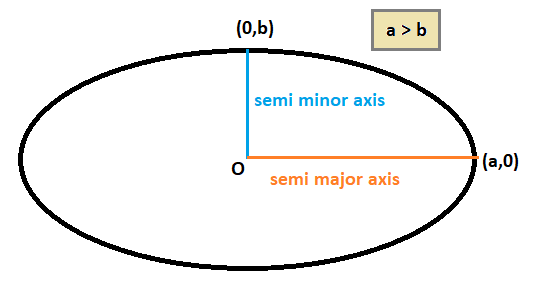
Image: Image showing an ellipse with the semi minor and semi major axis.
Complete step by step solution:
The equation which is given\[{{(x-1)}^{2}}+{{y}^{2}}=1\] that means we have to draw a circle with center \[(1,0)\] and radius $1$.
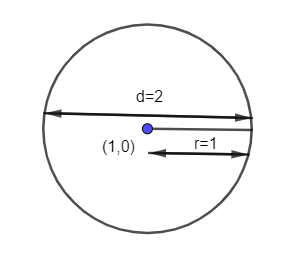
The diameter of this circle is $2 \times $ Radius = $2 \times 1 =2$
Given that, this diameter length is equal to the semi minor axis length of ellipse $(b)$= 2
Another circle equation which is given \[{{x}^{2}}+{{(y-2)}^{2}}=4\]. This circle has center \[(0,2)\] and radius $2$.
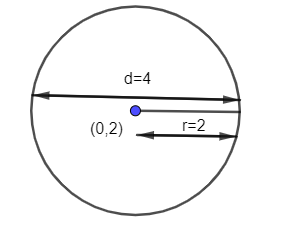
The diameter of this circle is $2 \times $ Radius = $2 \times 2 =4$
Given that, this diameter length is equal to the semi major axis length of ellipse $(a)$= 4
We were asked to find the equation of the ellipse.
So, we have to find the equation of ellipse in the form of \[\dfrac{{{x}^{2}}}{{{a}^{2}}}+\dfrac{{{y}^{2}}}{{{b}^{2}}}=1\].
After substituting the value of \[a=4\] and \[b=2\] in the above equation
\[\dfrac{{{x}^{2}}}{{{4}^{2}}}+\dfrac{{{y}^{2}}}{{{2}^{2}}}=1\]
After simplifying further we get:
\[\dfrac{{{x}^{2}}}{16}+\dfrac{{{y}^{2}}}{4}=1\]
Take LCM and simplify it we get:
\[\dfrac{{{x}^{2}}+4{{y}^{2}}}{16}=1\]
Multiply 16 on both side we get the final equation of an ellipse
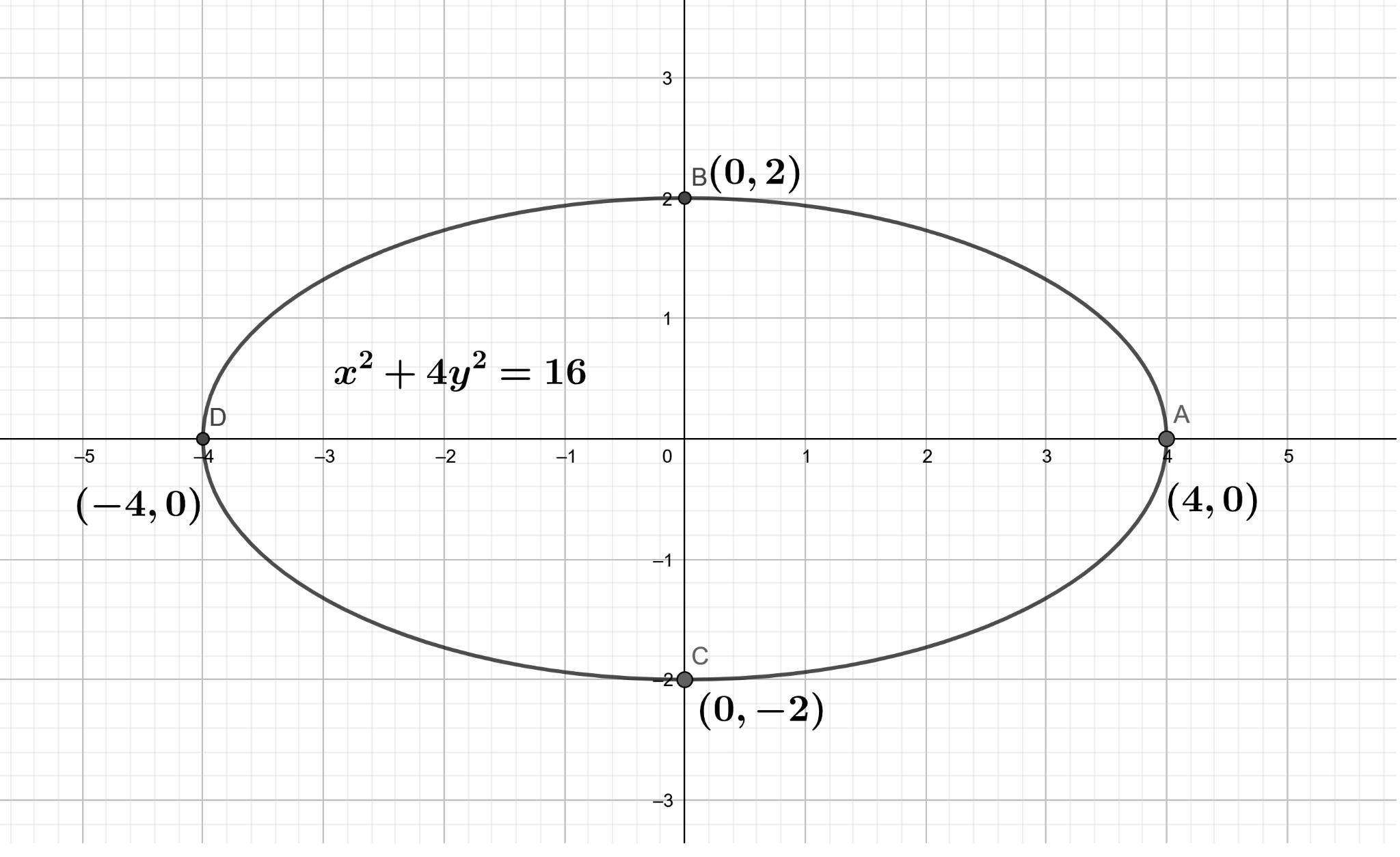
\[\therefore {{x}^{2}}+4{{y}^{2}}=16\]
Therefore, the correct option is “option D”.
The graph of the ellipse \[{{x}^{2}}+4{{y}^{2}}=16\] is shown below.
Note:
In this particular problem there are two equations given and to find the radius we have to see the RHS of the given two which is \[{{r}^{2}}\] from which we find the value of radius. Always remember the general equation because we need to remember such a general equation to find the equation of an ellipse. In general, the value of \[a\] and \[b\] which is nothing but the value of diameter.
The diameter of each equation is our a and b so that we can substitute this value in the general equation of the ellipse. General equation of ellipse is \[\dfrac{{{x}^{2}}}{{{a}^{2}}}+\dfrac{{{y}^{2}}}{{{b}^{2}}}=1\].
Where the length of the semi major axis of the ellipse is $a$ and the length of the semi minor axis of the ellipse is $b$.
Image: Image showing an ellipse with the semi minor and semi major axis.
Complete step by step solution:
The equation which is given\[{{(x-1)}^{2}}+{{y}^{2}}=1\] that means we have to draw a circle with center \[(1,0)\] and radius $1$.
The diameter of this circle is $2 \times $ Radius = $2 \times 1 =2$
Given that, this diameter length is equal to the semi minor axis length of ellipse $(b)$= 2
Another circle equation which is given \[{{x}^{2}}+{{(y-2)}^{2}}=4\]. This circle has center \[(0,2)\] and radius $2$.
The diameter of this circle is $2 \times $ Radius = $2 \times 2 =4$
Given that, this diameter length is equal to the semi major axis length of ellipse $(a)$= 4
We were asked to find the equation of the ellipse.
So, we have to find the equation of ellipse in the form of \[\dfrac{{{x}^{2}}}{{{a}^{2}}}+\dfrac{{{y}^{2}}}{{{b}^{2}}}=1\].
After substituting the value of \[a=4\] and \[b=2\] in the above equation
\[\dfrac{{{x}^{2}}}{{{4}^{2}}}+\dfrac{{{y}^{2}}}{{{2}^{2}}}=1\]
After simplifying further we get:
\[\dfrac{{{x}^{2}}}{16}+\dfrac{{{y}^{2}}}{4}=1\]
Take LCM and simplify it we get:
\[\dfrac{{{x}^{2}}+4{{y}^{2}}}{16}=1\]
Multiply 16 on both side we get the final equation of an ellipse
\[\therefore {{x}^{2}}+4{{y}^{2}}=16\]
Therefore, the correct option is “option D”.
The graph of the ellipse \[{{x}^{2}}+4{{y}^{2}}=16\] is shown below.
Note:
In this particular problem there are two equations given and to find the radius we have to see the RHS of the given two which is \[{{r}^{2}}\] from which we find the value of radius. Always remember the general equation because we need to remember such a general equation to find the equation of an ellipse. In general, the value of \[a\] and \[b\] which is nothing but the value of diameter.
Recently Updated Pages
Master Class 9 General Knowledge: Engaging Questions & Answers for Success

Master Class 9 Maths: Engaging Questions & Answers for Success
Master Class 9 Science: Engaging Questions & Answers for Success
Master Class 9 English: Engaging Questions & Answers for Success
Master Class 9 Social Science: Engaging Questions & Answers for Success
Class 9 Question and Answer - Your Ultimate Solutions Guide
Trending doubts
One Metric ton is equal to kg A 10000 B 1000 C 100 class 11 physics CBSE
Difference Between Prokaryotic Cells and Eukaryotic Cells
Two of the body parts which do not appear in MRI are class 11 biology CBSE
1 ton equals to A 100 kg B 1000 kg C 10 kg D 10000 class 11 physics CBSE
10 examples of friction in our daily life
Name the Largest and the Smallest Cell in the Human Body ?