




An ellipse has OB as semi-minor axis, F and F’ are its foci and the angle FBF’ is a right angle then, the eccentricity of the ellipse is
$
a.\dfrac{1}{{\sqrt 3 }} \\
b.\dfrac{1}{4} \\
c.\dfrac{1}{2} \\
d.\dfrac{1}{{\sqrt 2 }} \\
$
Answer
 Verified
642.3k+ views
Hint: In order to solve this problem we need to know that the Product of slopes of two perpendicular lines is -1. Drawing the diagram will help you a lot. You need to use the formula of eccentricity $e = \sqrt {1 - \dfrac{{{b^2}}}{{{a^2}}}} $. Doing this will solve this problem.
Complete step-by-step answer:
The figure to this problem can be drawn as,
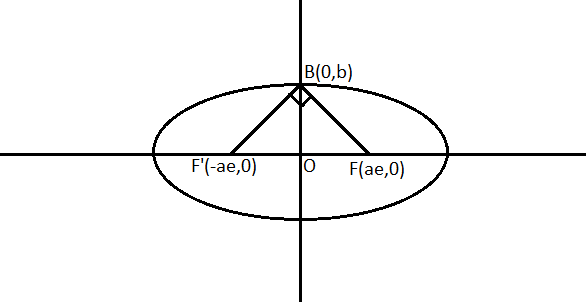
Let equation of ellipse is $\dfrac{{{x^2}}}{{{a^2}}} + \dfrac{{{y^2}}}{{{b^2}}} = 1$
We can easily see in figure coordinates of B(0, b), F (ae, 0) and F’(-ae, 0).
We know, F’B perpendicular to FB.
Thus, Product of slopes of two perpendicular lines is -1.
So, slope of F’B x slope of FB = -1
Slope of F’B = $\dfrac{{b - 0}}{{0 + ae}} = \dfrac{b}{{ae}}$
Slope of FB = $\dfrac{{b - 0}}{{0 - ae}} = \dfrac{{ - b}}{{ae}}$
$ \Rightarrow \dfrac{b}{{ae}} \times \dfrac{{ - b}}{{ae}} = - 1$ (When we multiply the slopes of two perpendicular lines)
$ \Rightarrow \dfrac{{ - {b^2}}}{{{a^2}{e^2}}} = - 1$
On solving we get,
${b^2} = {a^2}{e^2}$…..(1)
We know that $e = \sqrt {1 - \dfrac{{{b^2}}}{{{a^2}}}} $
Now, put the value of ${b^2}$ from (1) equation in (2) equation.
We get the new equation as,
$
\Rightarrow e = \sqrt {1 - \dfrac{{{a^2}{e^2}}}{{{a^2}}}} \\
\Rightarrow e = \sqrt {1 - {e^2}} \\
$
On squaring both sides we get,
$ \Rightarrow {e^2} = 1 - {e^2}$
On further solving the equations we get,
$
\Rightarrow 2{e^2} = 1 \\
\Rightarrow e = \dfrac{1}{{\sqrt 2 }} \\
$
So, the correct answer is “Option d”.
Note: Whenever we face such types of problems we use some important points. Like first of all draw a figure and mark coordinates then find the value of slope of lines using coordinates and as we know the product of slopes of two perpendicular lines always be -1. Knowing this will solve our problem and will give you the right answer.
Complete step-by-step answer:
The figure to this problem can be drawn as,
Let equation of ellipse is $\dfrac{{{x^2}}}{{{a^2}}} + \dfrac{{{y^2}}}{{{b^2}}} = 1$
We can easily see in figure coordinates of B(0, b), F (ae, 0) and F’(-ae, 0).
We know, F’B perpendicular to FB.
Thus, Product of slopes of two perpendicular lines is -1.
So, slope of F’B x slope of FB = -1
Slope of F’B = $\dfrac{{b - 0}}{{0 + ae}} = \dfrac{b}{{ae}}$
Slope of FB = $\dfrac{{b - 0}}{{0 - ae}} = \dfrac{{ - b}}{{ae}}$
$ \Rightarrow \dfrac{b}{{ae}} \times \dfrac{{ - b}}{{ae}} = - 1$ (When we multiply the slopes of two perpendicular lines)
$ \Rightarrow \dfrac{{ - {b^2}}}{{{a^2}{e^2}}} = - 1$
On solving we get,
${b^2} = {a^2}{e^2}$…..(1)
We know that $e = \sqrt {1 - \dfrac{{{b^2}}}{{{a^2}}}} $
Now, put the value of ${b^2}$ from (1) equation in (2) equation.
We get the new equation as,
$
\Rightarrow e = \sqrt {1 - \dfrac{{{a^2}{e^2}}}{{{a^2}}}} \\
\Rightarrow e = \sqrt {1 - {e^2}} \\
$
On squaring both sides we get,
$ \Rightarrow {e^2} = 1 - {e^2}$
On further solving the equations we get,
$
\Rightarrow 2{e^2} = 1 \\
\Rightarrow e = \dfrac{1}{{\sqrt 2 }} \\
$
So, the correct answer is “Option d”.
Note: Whenever we face such types of problems we use some important points. Like first of all draw a figure and mark coordinates then find the value of slope of lines using coordinates and as we know the product of slopes of two perpendicular lines always be -1. Knowing this will solve our problem and will give you the right answer.
Recently Updated Pages
Lysosomes are known as suicidal bags of cell why class 11 biology CBSE

Father s age is three times the sum of the ages of-class-11-maths-CBSE
Give a comparative account of the classes of kingdom class 11 biology CBSE
The ceiling of a long hall is 25m high What is the class 11 physics CBSE
Name the Largest and the Smallest Cell in the Human Body ?
Draw a welllabelled diagram of a plant cell class 11 biology CBSE
Trending doubts
Find the value of the expression given below sin 30circ class 11 maths CBSE
One Metric ton is equal to kg A 10000 B 1000 C 100 class 11 physics CBSE
Two of the body parts which do not appear in MRI are class 11 biology CBSE
10 examples of friction in our daily life
Proton was discovered by A Thomson B Rutherford C Chadwick class 11 chemistry CBSE
10 examples of diffusion in everyday life