




An elevator car has a mass of 1600 kg and is carrying passengers having a combined mass of 200 kg. A constant friction force of 4000 N retards its motion. How much power must a motor deliver to lift the elevator car and its passengers at a constant speed of 3.00 m/s?
Answer
 Verified
610.8k+ views
Hint:
We are given an elevator known as lift. The total mass of the lift and the elevator can be calculated. The elevator intends to move upward at some constant speed but a resistive force is hampering its motion. We can use Newton’s second law to solve this problem.
Complete Step by Step Solution:
We have drawn free body diagram of the problem
Mass of elevator= 1600 kg
Mass of passengers = 200 kg
The total mass of the lift and passengers= 1800 kg
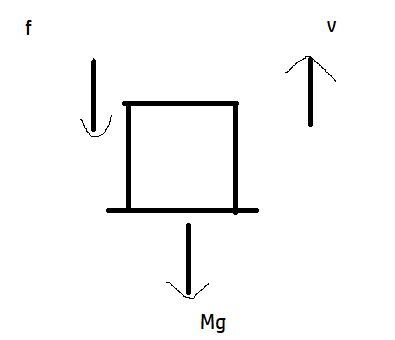
Force acting downwards= Mg
= \[1800\times 9.8=17640N\]
Frictional force acting downwards = f= 4000 N
Total downward force= 17640+4000= 21640 N
Now for a lift to move upwards tension force acts upward and since it needs to move with constant velocity, as per Newton’s second law its acceleration must be zero.
So $ T= 21640 N $
We need to calculate power and it is given by the formula P=Fv where F is the force which here is the tension.
\[
P=Fv \\
\Rightarrow P = 21640\times 3 \\
\Rightarrow P = 64920W \\
\]
$ \therefore $ Power needed to be delivered = $64920 W $
Note:
Here we have calculated the power using the formula P=FV, this is instantaneous power calculated by using force and velocity. This kind of problem is calculated by drawing a free body diagram and showing all the forces acting on the body.
We are given an elevator known as lift. The total mass of the lift and the elevator can be calculated. The elevator intends to move upward at some constant speed but a resistive force is hampering its motion. We can use Newton’s second law to solve this problem.
Complete Step by Step Solution:
We have drawn free body diagram of the problem
Mass of elevator= 1600 kg
Mass of passengers = 200 kg
The total mass of the lift and passengers= 1800 kg
Force acting downwards= Mg
= \[1800\times 9.8=17640N\]
Frictional force acting downwards = f= 4000 N
Total downward force= 17640+4000= 21640 N
Now for a lift to move upwards tension force acts upward and since it needs to move with constant velocity, as per Newton’s second law its acceleration must be zero.
So $ T= 21640 N $
We need to calculate power and it is given by the formula P=Fv where F is the force which here is the tension.
\[
P=Fv \\
\Rightarrow P = 21640\times 3 \\
\Rightarrow P = 64920W \\
\]
$ \therefore $ Power needed to be delivered = $64920 W $
Note:
Here we have calculated the power using the formula P=FV, this is instantaneous power calculated by using force and velocity. This kind of problem is calculated by drawing a free body diagram and showing all the forces acting on the body.
Recently Updated Pages
Master Class 11 Social Science: Engaging Questions & Answers for Success

Master Class 11 English: Engaging Questions & Answers for Success
Master Class 11 Maths: Engaging Questions & Answers for Success
Master Class 11 Chemistry: Engaging Questions & Answers for Success
Master Class 11 Biology: Engaging Questions & Answers for Success
Master Class 11 Physics: Engaging Questions & Answers for Success
Trending doubts
One Metric ton is equal to kg A 10000 B 1000 C 100 class 11 physics CBSE
Difference Between Prokaryotic Cells and Eukaryotic Cells
How many of the following diseases can be studied with class 11 biology CBSE
Which of the following enzymes is used for carboxylation class 11 biology CBSE
Draw a diagram of a plant cell and label at least eight class 11 biology CBSE
Two of the body parts which do not appear in MRI are class 11 biology CBSE