




An electron projected with a velocity $v={{v}_{0}}\hat{i}$ in the electric field $E={{\bar{E}}_{0}}j$ . Trace the path followed by the electron ${{E}_{0.}}$.
A. Parabola
B. Circle
C. Straight line in + y-direction
D. Straight line in- y-direction
Answer
 Verified
589.2k+ views
Hint: when a particle is accelerated with a certain velocity in the direction perpendicular to the external electric field certain charge is gained by the particle. This charge is due to the developed magnetic field perpendicular to the direction of the applied electric field. Hypothetically, the electric and the magnetic fields can never stand alone.
Complete step by step answer:
When we see the condition mentioned in the question it says that a particle is projected in an electric field (${{V}_{0}}$) in the $j$ direction which is along the y-axis in such a way that it is moving with a velocity ${{V}_{0}}$ in vector $i$ direction which is along. This can be described graphically from the following representation.
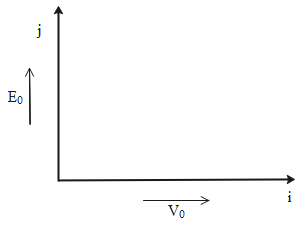
From the graph, we can say that the particle is moving in the direction perpendicular to a perpendicular external electric field.
The acceleration of the particle will depend on the mass of the particle projected on the external electric field and the charge produced on the particle due to the externally applied field.
The acceleration of the electron will be $-\dfrac{eE}{m}\hat{j}$
The motion of such a particle is analogous to the mass on the particle which is projected with a velocity ${{V}_{0}}$ with the gravity acting on the particle which is in the vertical direction.
So, the particle will trace along a parabolic path in the x-y plane.
So, the correct answer is “Option A”.
Note: The electric and the magnetic field cannot stand alone; they recreate the other component perpendicular to them. The motion of a partial perpendicular to the electric field and along the direction of the virtual magnetic field which is developed by the electric field is always influenced by the electric field, the mass of the particle and the vertically applied acceleration due to gravity.
Complete step by step answer:
When we see the condition mentioned in the question it says that a particle is projected in an electric field (${{V}_{0}}$) in the $j$ direction which is along the y-axis in such a way that it is moving with a velocity ${{V}_{0}}$ in vector $i$ direction which is along. This can be described graphically from the following representation.
From the graph, we can say that the particle is moving in the direction perpendicular to a perpendicular external electric field.
The acceleration of the particle will depend on the mass of the particle projected on the external electric field and the charge produced on the particle due to the externally applied field.
The acceleration of the electron will be $-\dfrac{eE}{m}\hat{j}$
The motion of such a particle is analogous to the mass on the particle which is projected with a velocity ${{V}_{0}}$ with the gravity acting on the particle which is in the vertical direction.
So, the particle will trace along a parabolic path in the x-y plane.
So, the correct answer is “Option A”.
Note: The electric and the magnetic field cannot stand alone; they recreate the other component perpendicular to them. The motion of a partial perpendicular to the electric field and along the direction of the virtual magnetic field which is developed by the electric field is always influenced by the electric field, the mass of the particle and the vertically applied acceleration due to gravity.
Recently Updated Pages
Basicity of sulphurous acid and sulphuric acid are

Master Class 12 English: Engaging Questions & Answers for Success
Master Class 12 Social Science: Engaging Questions & Answers for Success
Master Class 12 Maths: Engaging Questions & Answers for Success
Master Class 12 Economics: Engaging Questions & Answers for Success
Master Class 12 Physics: Engaging Questions & Answers for Success
Trending doubts
Which are the Top 10 Largest Countries of the World?
Draw a labelled sketch of the human eye class 12 physics CBSE
Draw ray diagrams each showing i myopic eye and ii class 12 physics CBSE
Give 10 examples of unisexual and bisexual flowers
Coming together federation is practiced in A India class 12 social science CBSE
Write the formula to find the shortest distance between class 12 maths CBSE