




An electron having momentum $2.4 \times 10^{-23}$ kg m$s^{-1}$ enters a region of uniform magnetic field of 0.15 T. The field vector makes an angle of $30^{\circ}$ with the initial velocity vector of the electron. The radius of the helical path of the electron in the field shall be :
A. 2 mm
B. 1 mm
C. $\dfrac{\sqrt{3}}{2}$ mm
D. 0.5 mm
Answer
 Verified
587.1k+ views
Hint: When a charged particle enters a magnetic field region (uniform), making some angle with the magnetic field direction, it is the perpendicular component of the velocity that provides circular motion to the charged particle.
Formula used:
Radius r of a particle (mass m, charge q) undergoing circular motion in a magnetic field B is given as:
$r = \dfrac{mv \sin \theta}{qB}$;
where $\theta$ is the angle that the particle velocity makes initially with the magnetic field direction.
Complete answer:
We know that when a charged particle enters a magnetic field region, with its direction of velocity being parallel to the magnetic field direction, it goes and is deflected by the magnetic field. If the particle enters making an angle of 90$^{\circ}$ with the magnetic field direction then it describes a circle.
From this we can conclude that it is the perpendicular component of the velocity that is responsible for circular motion.
We break our velocity into 2 following components:
1. $v \cos \theta$ along the magnetic field, and
2. $v \sin \theta$ perpendicular to the magnetic field.
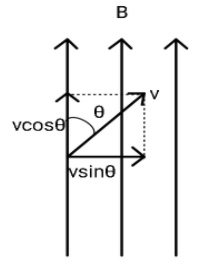
For circular motion, the centripetal force of the circular motion is equated with the Lorentz force.
$\dfrac{m(v \sin \theta)^2}{r} = q vB \sin \theta $ .
This expression will give us the radius as:
$r = \dfrac{mv \sin \theta}{qB}$
We are given the value of mv already, so upon substituting the given values, we get:
$r = \dfrac{2.4 \times 10^{-23} kg ms^{-1}}{1.6 \times 10^{-19} C \times 0.15 T \times 2 }$
$r = 5 \times 10^{-4} $m
Therefore the correct answer is option (D). The electron describes a radius of 0.5 m.
Note:
While taking the cross product, we know that for two vectors making an angle $\theta$, the magnitude of cross product is $ab \sin \theta$. Since a cross product of velocity and magnetic field is required in writing the Lorentz Force, we wrote $qvB \sin \theta$ as the magnitude of the force on the RHS side while deriving the formula.
Formula used:
Radius r of a particle (mass m, charge q) undergoing circular motion in a magnetic field B is given as:
$r = \dfrac{mv \sin \theta}{qB}$;
where $\theta$ is the angle that the particle velocity makes initially with the magnetic field direction.
Complete answer:
We know that when a charged particle enters a magnetic field region, with its direction of velocity being parallel to the magnetic field direction, it goes and is deflected by the magnetic field. If the particle enters making an angle of 90$^{\circ}$ with the magnetic field direction then it describes a circle.
From this we can conclude that it is the perpendicular component of the velocity that is responsible for circular motion.
We break our velocity into 2 following components:
1. $v \cos \theta$ along the magnetic field, and
2. $v \sin \theta$ perpendicular to the magnetic field.
For circular motion, the centripetal force of the circular motion is equated with the Lorentz force.
$\dfrac{m(v \sin \theta)^2}{r} = q vB \sin \theta $ .
This expression will give us the radius as:
$r = \dfrac{mv \sin \theta}{qB}$
We are given the value of mv already, so upon substituting the given values, we get:
$r = \dfrac{2.4 \times 10^{-23} kg ms^{-1}}{1.6 \times 10^{-19} C \times 0.15 T \times 2 }$
$r = 5 \times 10^{-4} $m
Therefore the correct answer is option (D). The electron describes a radius of 0.5 m.
Note:
While taking the cross product, we know that for two vectors making an angle $\theta$, the magnitude of cross product is $ab \sin \theta$. Since a cross product of velocity and magnetic field is required in writing the Lorentz Force, we wrote $qvB \sin \theta$ as the magnitude of the force on the RHS side while deriving the formula.
Recently Updated Pages
Master Class 11 Computer Science: Engaging Questions & Answers for Success

Master Class 11 Business Studies: Engaging Questions & Answers for Success
Master Class 11 Economics: Engaging Questions & Answers for Success
Master Class 11 English: Engaging Questions & Answers for Success
Master Class 11 Maths: Engaging Questions & Answers for Success
Master Class 11 Biology: Engaging Questions & Answers for Success
Trending doubts
One Metric ton is equal to kg A 10000 B 1000 C 100 class 11 physics CBSE
There are 720 permutations of the digits 1 2 3 4 5 class 11 maths CBSE
Discuss the various forms of bacteria class 11 biology CBSE
Draw a diagram of a plant cell and label at least eight class 11 biology CBSE
State the laws of reflection of light
Explain zero factorial class 11 maths CBSE