




An electric lamp of resistance \[20\;\Omega \] and a resistor of resistance \[4\;\Omega \] are connected to a 6 V battery as shown in the circuit diagram.
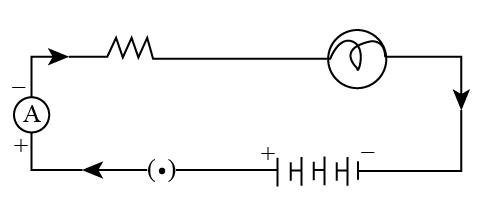
Calculate:
A. The total resistance of the circuit.
B. The current through the circuit.
C. The potential difference across the
1. electric lamp
2. Resistor
D. Power of the lamp.
Answer
 Verified
655.8k+ views
Hint: The above solution can be resolved with the help of various mathematical relations of electrical circuits like , total resistance, which is the sum of resistances of individual components, voltage supply, that is the calculated by taking the fraction of current flow across the component and the magnitude of resistance of the component.
Complete step by step solution
Given:
The resistance of the electric lamp is, \[{R_1} = 20\;\Omega \].
The resistance of the resistor is, \[{R_2} = 4\;\Omega \].
The voltage supply is, V = 6 V.
A. The total resistance of the circuit is,
\[{R_T} = {R_1} + {R_2}\]
Substituting the values as,
\[\begin{array}{l}
{R_T} = 20\;\Omega + 4\;\Omega \\
{R_T} = 24\;\Omega
\end{array}\]
Therefore, the magnitude of total resistance is \[24\;\Omega \].
B. The current through the circuit is,
\[{I_C} = \dfrac{V}{{{R_T}}}\]
Substituting the values as,
\[\begin{array}{l}
{I_C} = \dfrac{{6\;{\rm{V}}}}{{24\;\Omega }}\\
{I_C} = 0.25\;{\rm{A}}
\end{array}\]
Therefore, the magnitude of current through the circuit is 0.25 A.
C. 1. The Potential across the electric lamp is,
\[{V_1} = {I_C} \times {R_1}\]
Substituting the values as,
\[\begin{array}{l}
{V_1} = 0.25\;{\rm{A}} \times 20\;\Omega \\
{V_1} = 5\;{\rm{V}}
\end{array}\]
Therefore, the magnitude voltage across the electric lamp is 5 V.
C.2 The Potential across the conductor is,
\[{V_2} = {I_C} \times {R_2}\]
Substituting the values as,
\[\begin{array}{l}
{V_2} = 0.25\;{\rm{A}} \times 4\;\Omega \\
{V_2} = 1\;{\rm{V}}
\end{array}\]
Therefore, the magnitude voltage across the conductor is 1 V.
D. The power of the lamp can be calculated as,
\[P = {V_1} \times {I_C}\]
Substituting the values as,
\[\begin{array}{l}
P = 5\;{\rm{V}} \times {\rm{0}}{\rm{.25}}\;{\rm{A}}\\
P = 1.25\;{\rm{W}}
\end{array}\]
Therefore, the magnitude power through the electric lamp is \[1.25\;{\rm{W}}\].
Note: To resolve the given condition, one must remember the key formulas of electrical fundamentals like power supply, voltage supply, equivalent resistances and many more. The appropriate values of the current and resistances are to be used for a specific component to achieve the desired result.
Complete step by step solution
Given:
The resistance of the electric lamp is, \[{R_1} = 20\;\Omega \].
The resistance of the resistor is, \[{R_2} = 4\;\Omega \].
The voltage supply is, V = 6 V.
A. The total resistance of the circuit is,
\[{R_T} = {R_1} + {R_2}\]
Substituting the values as,
\[\begin{array}{l}
{R_T} = 20\;\Omega + 4\;\Omega \\
{R_T} = 24\;\Omega
\end{array}\]
Therefore, the magnitude of total resistance is \[24\;\Omega \].
B. The current through the circuit is,
\[{I_C} = \dfrac{V}{{{R_T}}}\]
Substituting the values as,
\[\begin{array}{l}
{I_C} = \dfrac{{6\;{\rm{V}}}}{{24\;\Omega }}\\
{I_C} = 0.25\;{\rm{A}}
\end{array}\]
Therefore, the magnitude of current through the circuit is 0.25 A.
C. 1. The Potential across the electric lamp is,
\[{V_1} = {I_C} \times {R_1}\]
Substituting the values as,
\[\begin{array}{l}
{V_1} = 0.25\;{\rm{A}} \times 20\;\Omega \\
{V_1} = 5\;{\rm{V}}
\end{array}\]
Therefore, the magnitude voltage across the electric lamp is 5 V.
C.2 The Potential across the conductor is,
\[{V_2} = {I_C} \times {R_2}\]
Substituting the values as,
\[\begin{array}{l}
{V_2} = 0.25\;{\rm{A}} \times 4\;\Omega \\
{V_2} = 1\;{\rm{V}}
\end{array}\]
Therefore, the magnitude voltage across the conductor is 1 V.
D. The power of the lamp can be calculated as,
\[P = {V_1} \times {I_C}\]
Substituting the values as,
\[\begin{array}{l}
P = 5\;{\rm{V}} \times {\rm{0}}{\rm{.25}}\;{\rm{A}}\\
P = 1.25\;{\rm{W}}
\end{array}\]
Therefore, the magnitude power through the electric lamp is \[1.25\;{\rm{W}}\].
Note: To resolve the given condition, one must remember the key formulas of electrical fundamentals like power supply, voltage supply, equivalent resistances and many more. The appropriate values of the current and resistances are to be used for a specific component to achieve the desired result.
Recently Updated Pages
Write any three differences between metals and nonmetals class 10 social science CBSE

Amit standing on a horizontal plane finds a bird flying class 10 maths CBSE
Two circles of radii 5 cm and 3 cm intersect at two class 10 maths CBSE
Solve the following i John and Jivanti together have class 10 maths CBSE
What is the relation between orthocenter circumcentre class 10 maths CBSE
Two plane mirrors are inclined at 70circ A ray incident class 10 physics CBSE
Trending doubts
Explain the Treaty of Vienna of 1815 class 10 social science CBSE
Which country is known as "The land of Fire and Ice"?
1 GB equals how many MB?
10 examples of evaporation in daily life with explanations
What is the full form of POSCO class 10 social science CBSE
Which is the hottest planet in the Solar system A Earth class 10 social science CBSE