




An electric heater which is connected to a 220 V supply line has two resistance coils. A and B of 240Ω resistance each, these coils can be used separately (one at a time), in series or in parallel. Calculate the current drawn when:
i) only one coil A is used
ii) coils A and B are used in series.
Answer
 Verified
638.1k+ views
Hint: The resistance of the resistance coils and the given voltage can be used in Ohm’s law to find the current drawn. While finding the current drawn when the coils A and B are connected in series, we must first find the equivalent resistance of the coils. Then, we can use Ohm’s law to find the current drawn.
Formula used:
$\eqalign{
& V = IR \cr
& {R_{series}} = {R_1} + {R_2} \cr} $
Complete answer:
Firstly, we are going to draw the electric circuit, for better understanding. The circuit when only one coil A is used is drawn below.
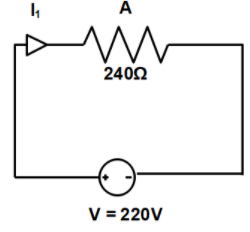
Now, let the resistance of A be ‘${R_A}$’, then in the circuit drawn above the current ‘${I_1}$' can be found by applying Ohm’s law as follows,
$\eqalign{
& V = {I_1}{R_A} \Rightarrow {I_1} = \dfrac{V}{{{R_A}}} \cr
& \Rightarrow {I_1} = \dfrac{{220V}}{{240\Omega }} \cr
& \Rightarrow {I_1} = 0.917A \cr} $
Therefore, the current drawn by the electric heater when only coil A is used is $0.917A$.
Next, we’ll draw the circuit diagram when the coils A and B are connected in series.
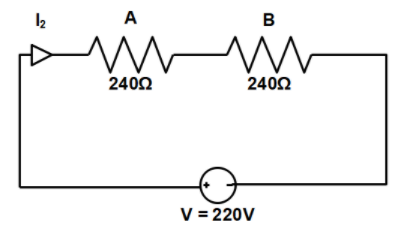
As the resistance coils are connected in series, the equivalent resistance of the circuit coils will be
$\eqalign{
& {R_{eq}} = {R_A} + {R_B} \cr
& \Rightarrow {R_{eq}} = 240\Omega + 240\Omega \cr
& \Rightarrow {R_{eq}} = 480\Omega \cr} $
If we assume that ‘${I_2}$’ is the current drawn when the coils are connected in series, by Ohm’s law we have
$\eqalign{
& V = {I_2}{R_{eq}} \cr
& \Rightarrow {I_2} = \dfrac{V}{{{R_{eq}}}} \cr
& \Rightarrow {I_2} = \dfrac{{220V}}{{480\Omega }} = 0.458A \cr
& \therefore {I_2} = 0.458A \cr} $
Therefore, the current drawn when the coils A and B are connected in series is $0.458A$.
Note:
The resistance coils are used in the electric heaters due to the property of their heat dissipation.
Here, we’re representing the electric heater as a resistor, instead of using the standard symbol for an electric heater, as we’re only concerned with the resistor properties of the electric heater. This also applies to all the problems in which heating coils are used, like an electric kettle.
Formula used:
$\eqalign{
& V = IR \cr
& {R_{series}} = {R_1} + {R_2} \cr} $
Complete answer:
Firstly, we are going to draw the electric circuit, for better understanding. The circuit when only one coil A is used is drawn below.
Now, let the resistance of A be ‘${R_A}$’, then in the circuit drawn above the current ‘${I_1}$' can be found by applying Ohm’s law as follows,
$\eqalign{
& V = {I_1}{R_A} \Rightarrow {I_1} = \dfrac{V}{{{R_A}}} \cr
& \Rightarrow {I_1} = \dfrac{{220V}}{{240\Omega }} \cr
& \Rightarrow {I_1} = 0.917A \cr} $
Therefore, the current drawn by the electric heater when only coil A is used is $0.917A$.
Next, we’ll draw the circuit diagram when the coils A and B are connected in series.
As the resistance coils are connected in series, the equivalent resistance of the circuit coils will be
$\eqalign{
& {R_{eq}} = {R_A} + {R_B} \cr
& \Rightarrow {R_{eq}} = 240\Omega + 240\Omega \cr
& \Rightarrow {R_{eq}} = 480\Omega \cr} $
If we assume that ‘${I_2}$’ is the current drawn when the coils are connected in series, by Ohm’s law we have
$\eqalign{
& V = {I_2}{R_{eq}} \cr
& \Rightarrow {I_2} = \dfrac{V}{{{R_{eq}}}} \cr
& \Rightarrow {I_2} = \dfrac{{220V}}{{480\Omega }} = 0.458A \cr
& \therefore {I_2} = 0.458A \cr} $
Therefore, the current drawn when the coils A and B are connected in series is $0.458A$.
Note:
The resistance coils are used in the electric heaters due to the property of their heat dissipation.
Here, we’re representing the electric heater as a resistor, instead of using the standard symbol for an electric heater, as we’re only concerned with the resistor properties of the electric heater. This also applies to all the problems in which heating coils are used, like an electric kettle.
Recently Updated Pages
Basicity of sulphurous acid and sulphuric acid are

Master Class 11 English: Engaging Questions & Answers for Success
Master Class 11 Physics: Engaging Questions & Answers for Success
Master Class 11 Computer Science: Engaging Questions & Answers for Success
Master Class 11 Chemistry: Engaging Questions & Answers for Success
Master Class 11 Social Science: Engaging Questions & Answers for Success
Trending doubts
Difference Between Prokaryotic Cells and Eukaryotic Cells
Two of the body parts which do not appear in MRI are class 11 biology CBSE
One Metric ton is equal to kg A 10000 B 1000 C 100 class 11 physics CBSE
10 examples of friction in our daily life
Draw a diagram of nephron and explain its structur class 11 biology CBSE
What will happen if the mucus is not secreted by the class 11 biology CBSE