




An athlete diving off a high springboard can perform a variety of physical moments in the air before entering the water below. Which one of the following parameters will remain constant during the fall? The athlete's :
A) Linear velocity
B) Linear momentum
C) Moment of inertia
D) Angular momentum
Answer
 Verified
577.5k+ views
Hint: We can observe the diver’s fall into the water, analyse which of the given parameters remain constant and which changes. As the ball falls downwards, the force of gravity will be acting on its every point of motion.
Formula to be used:
$\tau = \dfrac{{dL}}{{dt}}$ where $\tau $ is torque acting on the body and $\dfrac{{dL}}{{dt}}$ is the rate of change of linear momentum.
Complete step by step answer:
The motion of the diver can be shown as:
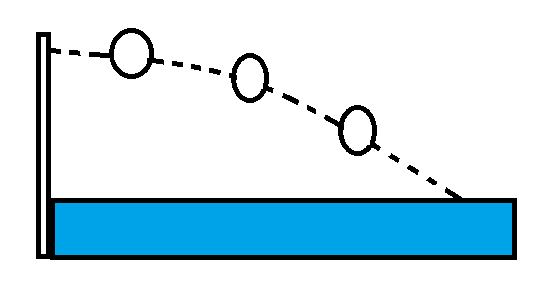
From the diagram it can be seen that, the body is falling downwards, the force of gravity will be acting on all the points.
Linear velocity and linear momentum refers to the change in these physical quantities along the line. Linear velocity depends on the distance covered per unit time. And some linear distance will be covered while diving, so the linear velocity of the diver changes. Linear momentum is the product of mass and velocity, so if the velocity of the diver changes, its linear momentum will also change (as it is dependent on velocity).
The moment of inertia is the product of the centre of mass and the square of the distance from the axis of rotation. As the athlete tries different physical moments, the position of the center of mass changes, thus there will be a change in moment of inertia.
Now, the angular momentum depends upon the angular force called torque acting upon the body, but here there is no external force acting. So, the torque will be zero which inturn means that the angular momentum is conserved. Also, the gravitational force passes through the center of the earth , its Torque along the center of earth will be 0. As:
$
\tau = \dfrac{{dL}}{{dt}} \\
\implies 0 = \dfrac{{dL}}{{dt}} \\
\Rightarrow L = constant \\
$
So, the correct answer is “Option D”.
Note:
When we use the word ‘linear’, we always mean that the physical quantity is along a straight line.
When a physical quantity remains constant, the rest of the changes do not reflect any change on that quantity, this means that the particular quantity is conserved.
The expression $\dfrac{{dL}}{{dt}}$ , shows a change in rate of linear momentum as its differentiation is taken with respect to time. When this change becomes zero, it means the physical quantity, linear momentum is constant and thus conserved.
Formula to be used:
$\tau = \dfrac{{dL}}{{dt}}$ where $\tau $ is torque acting on the body and $\dfrac{{dL}}{{dt}}$ is the rate of change of linear momentum.
Complete step by step answer:
The motion of the diver can be shown as:
From the diagram it can be seen that, the body is falling downwards, the force of gravity will be acting on all the points.
Linear velocity and linear momentum refers to the change in these physical quantities along the line. Linear velocity depends on the distance covered per unit time. And some linear distance will be covered while diving, so the linear velocity of the diver changes. Linear momentum is the product of mass and velocity, so if the velocity of the diver changes, its linear momentum will also change (as it is dependent on velocity).
The moment of inertia is the product of the centre of mass and the square of the distance from the axis of rotation. As the athlete tries different physical moments, the position of the center of mass changes, thus there will be a change in moment of inertia.
Now, the angular momentum depends upon the angular force called torque acting upon the body, but here there is no external force acting. So, the torque will be zero which inturn means that the angular momentum is conserved. Also, the gravitational force passes through the center of the earth , its Torque along the center of earth will be 0. As:
$
\tau = \dfrac{{dL}}{{dt}} \\
\implies 0 = \dfrac{{dL}}{{dt}} \\
\Rightarrow L = constant \\
$
So, the correct answer is “Option D”.
Note:
When we use the word ‘linear’, we always mean that the physical quantity is along a straight line.
When a physical quantity remains constant, the rest of the changes do not reflect any change on that quantity, this means that the particular quantity is conserved.
The expression $\dfrac{{dL}}{{dt}}$ , shows a change in rate of linear momentum as its differentiation is taken with respect to time. When this change becomes zero, it means the physical quantity, linear momentum is constant and thus conserved.
Recently Updated Pages
Master Class 11 Computer Science: Engaging Questions & Answers for Success

Master Class 11 Business Studies: Engaging Questions & Answers for Success
Master Class 11 Economics: Engaging Questions & Answers for Success
Master Class 11 English: Engaging Questions & Answers for Success
Master Class 11 Maths: Engaging Questions & Answers for Success
Master Class 11 Biology: Engaging Questions & Answers for Success
Trending doubts
One Metric ton is equal to kg A 10000 B 1000 C 100 class 11 physics CBSE
There are 720 permutations of the digits 1 2 3 4 5 class 11 maths CBSE
Discuss the various forms of bacteria class 11 biology CBSE
Draw a diagram of a plant cell and label at least eight class 11 biology CBSE
State the laws of reflection of light
Explain zero factorial class 11 maths CBSE