




An asteroid is moving directly towards the centre of the earth. When at a distance of $10$R (R is the radius of the earth) from the earth centre, it has a speed of $12$km/s. Neglecting the effect on the earth's atmosphere, what will be the speed of the asteroid when it hits the surface of the earth (escape velocity from the earth is $11.2$km/s)? Give your answer to the nearest integer in Kilometre/s_ _ _ _ _ _
Answer
 Verified
618.6k+ views
Hint: As the asteroid is moving towards earth, then by conservation by mechanical energy, the total energy at a distance $10R$ from the centre of earth will be the same as the total energy at distance R from the centre of earth.
Formula used:
1. Initial Mechanical Energy $ = $ Final Mechanical Energy
2. $K.E = \dfrac{1}{2}m{v^2}$
3. Potential Energy $ = \dfrac{{ - GMm}}{R}$
Complete step by step answer:
Let the velocity of asteroid at distance $10R$ from centre of Earth by, $u = 12km/s$ and the final velocity of asteroid at a distance R from the centre of earth be v km/s as shown in figure below:
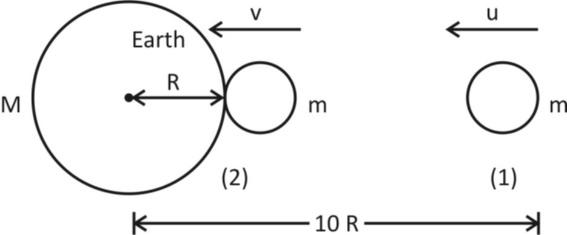
Now, initial Mechanical Energy $ = $ Initial kinetic energy $ + $ initial potential energy
$ = \dfrac{1}{2}m{u^2} + \left( {\dfrac{{ - GMm}}{{10R}}} \right)$
And Final Mechanical energy $ = $ Final kinetic energy $ + $ initial potential energy
$ = \dfrac{1}{2}m{u^2} + \left( {\dfrac{{ - GMm}}{{10R}}} \right)$
Where M is mass of Earth
m is mass of asteroid
R is radius of earth and
G is universal Gravitational constant
So, by conservation of mechanical energy, initial mechanical energy $ = $ final mechanical energy
$ \Rightarrow \dfrac{1}{2}m{u^2} + \left( {\dfrac{{ - GMm}}{{10R}}} \right) = \dfrac{1}{2}m{v^2} + \left( {\dfrac{{ - GMm}}{R}} \right)$
$ \Rightarrow \dfrac{1}{2}m{v^2} - \dfrac{1}{2}m{u^2} = \dfrac{{ - GMm}}{{10R}} + \dfrac{{ - GMm}}{R}$
$ \Rightarrow \dfrac{1}{2}\left( {{v^2} - {u^2}} \right) = \dfrac{{ - GMm}}{R}\left( {\dfrac{1}{{10}} - 1} \right)$
$ \Rightarrow \dfrac{1}{2}\left( {{v^2} - {u^2}} \right) = \dfrac{{ - GM}}{R} \times \dfrac{{ - 9}}{{10}}$
$ \Rightarrow {v^2} - {u^2} = \dfrac{{9GM}}{{10R}} \times 2$
$ \Rightarrow {v^2} = {u^2} + \dfrac{{9GM}}{{5R}}........\left( 1 \right)$
Now, here $u = 12km/s = 12000m/s$
M$ = $ mass of earth
As $\dfrac{{GM}}{{{R^2}}} = g \Rightarrow \dfrac{{GM}}{R} = gR$
So, \[{v^2} = {u^2} + \dfrac{9}{5}gR\]
\[\Rightarrow {v^2} = {\left( {12000} \right)^2} + \dfrac{9}{5} \times 9.8 \times 6400000\]
\[\Rightarrow {v^2} = 14000000 + 112896000\]
\[\Rightarrow {v^2} = 256,896,000\]
\[\Rightarrow v = 16,027.97m/s\]
$\Rightarrow v \simeq 16km/s$
Note:
The relation between acceleration due to gravity, g and universal gravitational constant, G is
$g = \dfrac{{GM}}{{{R^2}}} \Rightarrow \dfrac{{GM}}{R} = gR$
So, we have replaced $\dfrac{{GM}}{R}$ with gR in equation ....(1).
Formula used:
1. Initial Mechanical Energy $ = $ Final Mechanical Energy
2. $K.E = \dfrac{1}{2}m{v^2}$
3. Potential Energy $ = \dfrac{{ - GMm}}{R}$
Complete step by step answer:
Let the velocity of asteroid at distance $10R$ from centre of Earth by, $u = 12km/s$ and the final velocity of asteroid at a distance R from the centre of earth be v km/s as shown in figure below:
Now, initial Mechanical Energy $ = $ Initial kinetic energy $ + $ initial potential energy
$ = \dfrac{1}{2}m{u^2} + \left( {\dfrac{{ - GMm}}{{10R}}} \right)$
And Final Mechanical energy $ = $ Final kinetic energy $ + $ initial potential energy
$ = \dfrac{1}{2}m{u^2} + \left( {\dfrac{{ - GMm}}{{10R}}} \right)$
Where M is mass of Earth
m is mass of asteroid
R is radius of earth and
G is universal Gravitational constant
So, by conservation of mechanical energy, initial mechanical energy $ = $ final mechanical energy
$ \Rightarrow \dfrac{1}{2}m{u^2} + \left( {\dfrac{{ - GMm}}{{10R}}} \right) = \dfrac{1}{2}m{v^2} + \left( {\dfrac{{ - GMm}}{R}} \right)$
$ \Rightarrow \dfrac{1}{2}m{v^2} - \dfrac{1}{2}m{u^2} = \dfrac{{ - GMm}}{{10R}} + \dfrac{{ - GMm}}{R}$
$ \Rightarrow \dfrac{1}{2}\left( {{v^2} - {u^2}} \right) = \dfrac{{ - GMm}}{R}\left( {\dfrac{1}{{10}} - 1} \right)$
$ \Rightarrow \dfrac{1}{2}\left( {{v^2} - {u^2}} \right) = \dfrac{{ - GM}}{R} \times \dfrac{{ - 9}}{{10}}$
$ \Rightarrow {v^2} - {u^2} = \dfrac{{9GM}}{{10R}} \times 2$
$ \Rightarrow {v^2} = {u^2} + \dfrac{{9GM}}{{5R}}........\left( 1 \right)$
Now, here $u = 12km/s = 12000m/s$
M$ = $ mass of earth
As $\dfrac{{GM}}{{{R^2}}} = g \Rightarrow \dfrac{{GM}}{R} = gR$
So, \[{v^2} = {u^2} + \dfrac{9}{5}gR\]
\[\Rightarrow {v^2} = {\left( {12000} \right)^2} + \dfrac{9}{5} \times 9.8 \times 6400000\]
\[\Rightarrow {v^2} = 14000000 + 112896000\]
\[\Rightarrow {v^2} = 256,896,000\]
\[\Rightarrow v = 16,027.97m/s\]
$\Rightarrow v \simeq 16km/s$
Note:
The relation between acceleration due to gravity, g and universal gravitational constant, G is
$g = \dfrac{{GM}}{{{R^2}}} \Rightarrow \dfrac{{GM}}{R} = gR$
So, we have replaced $\dfrac{{GM}}{R}$ with gR in equation ....(1).
Recently Updated Pages
Master Class 11 English: Engaging Questions & Answers for Success

Master Class 11 Social Science: Engaging Questions & Answers for Success
Master Class 11 Maths: Engaging Questions & Answers for Success
Master Class 11 Biology: Engaging Questions & Answers for Success
Master Class 11 Physics: Engaging Questions & Answers for Success
Master Class 11 Chemistry: Engaging Questions & Answers for Success
Trending doubts
One Metric ton is equal to kg A 10000 B 1000 C 100 class 11 physics CBSE
Difference Between Prokaryotic Cells and Eukaryotic Cells
Two of the body parts which do not appear in MRI are class 11 biology CBSE
Find the value of the expression given below sin 30circ class 11 maths CBSE
Draw a diagram of a plant cell and label at least eight class 11 biology CBSE
10 examples of friction in our daily life