




An arrow is launched ${30.0^\circ }$ above the horizontal with an initial speed of $20.0m/s$ from the top of a water tower. After $3.00$ seconds, what will be the arrow's speed?
Take air resistance to be negligible and gravity to be the only source of acceleration.
(A) $19.4m/s$
(B) $20.0m/s$
(C) $26.0m/s$
(D) $29.4m/s$
(E) $34.1m/s$
Answer
 Verified
645.6k+ views
Hint: Resolve the components of initial velocity along horizontal and vertical axes. Then find the horizontal and vertical components of final velocity. Then use the vector properties to find the magnitude of the final velocity.
Complete step by step answer:
Observe the diagram
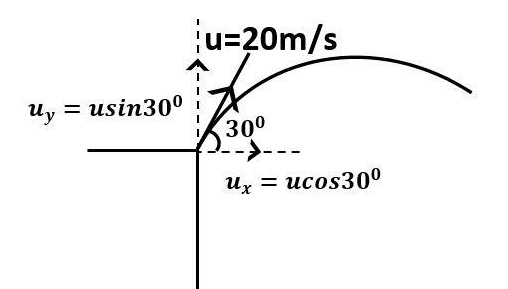
It is given in the question that,
Initial velocity of the arrow is $u = 20m/s$
The angle of projectile is $\theta = {30^0}$
We will first resolve the components of initial velocity, along the X and Y axis, respectively.
The component of initial velocity along positive X- axis will be
${u_x} = u\cos {30^0}$
$ \Rightarrow {u_x} = 20 \times \dfrac{{\sqrt 3 }}{2}$
$ \Rightarrow {u_x} = 10\sqrt 3 m/s$
The component of initial velocity along positive Y- axis will be
${u_y} = u\sin {30^0}$
$ \Rightarrow {u_y} = 20 \times \dfrac{1}{2}$
$ \Rightarrow {u_y} = 10m/s$
We have to calculate velocity after $t = 3s$
Let $v$ be the final velocity at time $t = 3s$
In projectile motion, horizontal motion occurs with constant velocity. Therefore, the horizontal component of initial and final velocity will be the same. i.e.
${v_x} = {u_x} = 10\sqrt 3 m/s$
And, the vertical component of final velocity will be affected by the constant acceleration due to gravity.
We have,
$v = u - gt$
Where,
$v$ is final velocity
$u$ is initial velocity
$g$ is acceleration due to gravity
$t$ is time period
Therefore, the vertical component of velocity can be written as
${v_y} = {u_y} - gt$
Substitute the given values in the above equation. We get
${v_y} = 10 - 10 \times 3$ $\left( {\because g = 10m/{s^2}} \right)$
$ \Rightarrow {v_y} = - 20m/s$
Now, by using the vector properties for magnitude, we can write the final velocity as
$v = \sqrt {v_x^2 + v_y^2} $
\[ \Rightarrow v = \sqrt {{{\left( {10\sqrt 3 } \right)}^2} + {{\left( { - 20} \right)}^2}} \]
$ \Rightarrow v = \sqrt {300 + 400} = \sqrt {700} $
$ \Rightarrow v = 26.45m/s$
Therefore, final velocity after $3s$ will be $v = 26.45m/s$ (approximately)
Therefore, from the above explanation, the correct answer is, option (B) $26.0m/s$
Note:You have to be very careful while applying signs to a vector quantity. You might find different ways of applying signs to such questions. In this question, we have considered the vectors along upward direction as positive and vectors along downward direction to be negative. In some other references, you might find that they have considered the vectors along upward direction to be negative and downward direction to be positive. Using any rule does not change the final answer, if you know the interpretation of the final sign that you will get.
Complete step by step answer:
Observe the diagram
It is given in the question that,
Initial velocity of the arrow is $u = 20m/s$
The angle of projectile is $\theta = {30^0}$
We will first resolve the components of initial velocity, along the X and Y axis, respectively.
The component of initial velocity along positive X- axis will be
${u_x} = u\cos {30^0}$
$ \Rightarrow {u_x} = 20 \times \dfrac{{\sqrt 3 }}{2}$
$ \Rightarrow {u_x} = 10\sqrt 3 m/s$
The component of initial velocity along positive Y- axis will be
${u_y} = u\sin {30^0}$
$ \Rightarrow {u_y} = 20 \times \dfrac{1}{2}$
$ \Rightarrow {u_y} = 10m/s$
We have to calculate velocity after $t = 3s$
Let $v$ be the final velocity at time $t = 3s$
In projectile motion, horizontal motion occurs with constant velocity. Therefore, the horizontal component of initial and final velocity will be the same. i.e.
${v_x} = {u_x} = 10\sqrt 3 m/s$
And, the vertical component of final velocity will be affected by the constant acceleration due to gravity.
We have,
$v = u - gt$
Where,
$v$ is final velocity
$u$ is initial velocity
$g$ is acceleration due to gravity
$t$ is time period
Therefore, the vertical component of velocity can be written as
${v_y} = {u_y} - gt$
Substitute the given values in the above equation. We get
${v_y} = 10 - 10 \times 3$ $\left( {\because g = 10m/{s^2}} \right)$
$ \Rightarrow {v_y} = - 20m/s$
Now, by using the vector properties for magnitude, we can write the final velocity as
$v = \sqrt {v_x^2 + v_y^2} $
\[ \Rightarrow v = \sqrt {{{\left( {10\sqrt 3 } \right)}^2} + {{\left( { - 20} \right)}^2}} \]
$ \Rightarrow v = \sqrt {300 + 400} = \sqrt {700} $
$ \Rightarrow v = 26.45m/s$
Therefore, final velocity after $3s$ will be $v = 26.45m/s$ (approximately)
Therefore, from the above explanation, the correct answer is, option (B) $26.0m/s$
Note:You have to be very careful while applying signs to a vector quantity. You might find different ways of applying signs to such questions. In this question, we have considered the vectors along upward direction as positive and vectors along downward direction to be negative. In some other references, you might find that they have considered the vectors along upward direction to be negative and downward direction to be positive. Using any rule does not change the final answer, if you know the interpretation of the final sign that you will get.
Recently Updated Pages
Which will be the least stable resonating structure class 11 chemistry CBSE

How many 5 digit telephone numbers can be construc-class-11-maths-CBSE
How do you find the angle of the resultant vector class 11 physics CBSE
Draw labelled diagram of the following i Gram seed class 11 biology CBSE
1 Quintal is equal to a 110 kg b 10 kg c 100kg d 1000 class 11 physics CBSE
What is the need and importance of classification class 11 biology CBSE
Trending doubts
Find the value of the expression given below sin 30circ class 11 maths CBSE
One Metric ton is equal to kg A 10000 B 1000 C 100 class 11 physics CBSE
10 examples of friction in our daily life
Draw a diagram of a plant cell and label at least eight class 11 biology CBSE
Difference between physical and chemical change class 11 chemistry CBSE
Proton was discovered by A Thomson B Rutherford C Chadwick class 11 chemistry CBSE