




An arch is in the form of semi-eclipse. It is 8 m wide and 2 m high at the center. Find the height of the arch at a point 1.5 m from one end.
Answer
 Verified
612k+ views
Hint:
In mathematics, an ellipse is a plane curve surrounding two focal points, such that for all points on the curve, the sum of the two distances to the focal points is a constant. As such, it generalizes a circle, which is the special type of ellipse in which the two focal points are the same.
Complete step by step solution:
According to the question, the above can be represented as the following diagram.
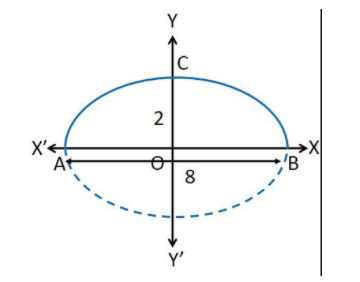
Let the length of the major axis or the width of the half ellipse be AB
And the height of the semi ellipse be CO
Thus, AB = 8 m
And CO = 2 m
And since we know that length of the major axis is
$
= 2a = 8m \\
\Rightarrow a = 4m \\
$
And $b = 2m$
The equation of the semi ellipse will be of the form
$\dfrac{{{x^2}}}{{{a^2}}} + \dfrac{{{y^2}}}{{{b^2}}} = 1$where a is semi major axis and b will be the semi minor axis
Thus accordingly a = 4m and b = 2m
Thus the equation becomes,
$
\dfrac{{{x^2}}}{{{4^2}}} + \dfrac{{{y^2}}}{{{2^2}}} = 1 \\
\Rightarrow \dfrac{{{x^2}}}{{16}} + \dfrac{{{y^2}}}{4} = 1 \\
$
Now,
Let P be a point on major axis such that AP = 1.5m
And, draw $PQ \bot AO$
Thus OP $ = (4 - 1.5)m = 2.5m$
Thus the x co-ordinate of Q will be $ - 2.5m$
Now, on substituting the value of x with $ - 2.5m$ in the equation of ellipse we will get,
\[
\dfrac{{{{( - 2.5)}^2}}}{{16}} + \dfrac{{{y^2}}}{4} = 1 \\
\Rightarrow \dfrac{{6.25}}{{16}} + \dfrac{{{y^2}}}{4} = 1 \\
\Rightarrow \dfrac{{{y^2}}}{4} = 1 - \dfrac{{6.25}}{{16}} \\
\Rightarrow {y^2} = 4 \times (1 - \dfrac{{6.25}}{{16}}) \\
\Rightarrow {y^2} = 4(\dfrac{{9.75}}{{16}}) \\
\Rightarrow {y^2} = 2.4375 \\
\Rightarrow y = \sqrt {2.4375} \\
\Rightarrow y = 1.56(approx)(\because y > 0) \\
\therefore PQ = 1.56m \\
\]
Thus the height of the arch at a point 1.5 m from one end is = 1.56 m.
Note: While solving these types of questions always figure out that on what axis the major axis will be made and vice versa.
In mathematics, an ellipse is a plane curve surrounding two focal points, such that for all points on the curve, the sum of the two distances to the focal points is a constant. As such, it generalizes a circle, which is the special type of ellipse in which the two focal points are the same.
Complete step by step solution:
According to the question, the above can be represented as the following diagram.
Let the length of the major axis or the width of the half ellipse be AB
And the height of the semi ellipse be CO
Thus, AB = 8 m
And CO = 2 m
And since we know that length of the major axis is
$
= 2a = 8m \\
\Rightarrow a = 4m \\
$
And $b = 2m$
The equation of the semi ellipse will be of the form
$\dfrac{{{x^2}}}{{{a^2}}} + \dfrac{{{y^2}}}{{{b^2}}} = 1$where a is semi major axis and b will be the semi minor axis
Thus accordingly a = 4m and b = 2m
Thus the equation becomes,
$
\dfrac{{{x^2}}}{{{4^2}}} + \dfrac{{{y^2}}}{{{2^2}}} = 1 \\
\Rightarrow \dfrac{{{x^2}}}{{16}} + \dfrac{{{y^2}}}{4} = 1 \\
$
Now,
Let P be a point on major axis such that AP = 1.5m
And, draw $PQ \bot AO$
Thus OP $ = (4 - 1.5)m = 2.5m$
Thus the x co-ordinate of Q will be $ - 2.5m$
Now, on substituting the value of x with $ - 2.5m$ in the equation of ellipse we will get,
\[
\dfrac{{{{( - 2.5)}^2}}}{{16}} + \dfrac{{{y^2}}}{4} = 1 \\
\Rightarrow \dfrac{{6.25}}{{16}} + \dfrac{{{y^2}}}{4} = 1 \\
\Rightarrow \dfrac{{{y^2}}}{4} = 1 - \dfrac{{6.25}}{{16}} \\
\Rightarrow {y^2} = 4 \times (1 - \dfrac{{6.25}}{{16}}) \\
\Rightarrow {y^2} = 4(\dfrac{{9.75}}{{16}}) \\
\Rightarrow {y^2} = 2.4375 \\
\Rightarrow y = \sqrt {2.4375} \\
\Rightarrow y = 1.56(approx)(\because y > 0) \\
\therefore PQ = 1.56m \\
\]
Thus the height of the arch at a point 1.5 m from one end is = 1.56 m.
Note: While solving these types of questions always figure out that on what axis the major axis will be made and vice versa.
Recently Updated Pages
Master Class 11 Social Science: Engaging Questions & Answers for Success

Master Class 11 Physics: Engaging Questions & Answers for Success
Master Class 11 Maths: Engaging Questions & Answers for Success
Master Class 11 Economics: Engaging Questions & Answers for Success
Master Class 11 Computer Science: Engaging Questions & Answers for Success
Master Class 11 Chemistry: Engaging Questions & Answers for Success
Trending doubts
One Metric ton is equal to kg A 10000 B 1000 C 100 class 11 physics CBSE
There are 720 permutations of the digits 1 2 3 4 5 class 11 maths CBSE
1 Quintal is equal to a 110 kg b 10 kg c 100kg d 1000 class 11 physics CBSE
State and prove Bernoullis theorem class 11 physics CBSE
Difference Between Prokaryotic Cells and Eukaryotic Cells
Which among the following are examples of coming together class 11 social science CBSE