




An arch is in the form of a parabola with its axis vertical. The arch is $ 10 $ m high and $ 5 $ m wide at the base. How wide is it $ 2 $ m from the vertex of the parabola.
Answer
 Verified
547.5k+ views
Hint: A parabola is defined as a set of points that are equidistant from a directrix, which is a fixed straight line and the focus. If the parabola has directrix as the x-axis, and the focus is $ (a,0) $ , then the equation of the parabola is given by $ {y^2} = 4ax $ and if the parabola has directrix as the y-axis, and the focus is $ (0,a) $ , then the equation of the parabola is given by $ {x^2} = 4ay $ . If any point lies on the parabola, it means that it will satisfy the equation of the given parabola.
Complete step by step answer:
It is given that an arch is in the form of a parabola with its axis vertical and the arch is $ 10 $ m high and $ 5 $ m wide at the base. So, to illustrate it in the form of a figure, let us take the vertex of this parabola to be at origin $ (0,0) $ . Then it will form a parabola such that its vertical is at origin and the directrix is along the negative y-axis. To represent it diagrammatically, we have,
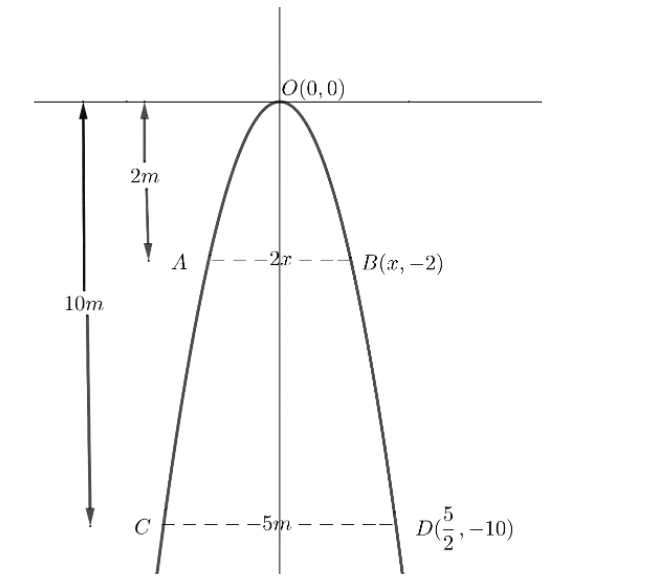
From the given figure, we see that the equation of the parabola opening on the negative y axis is given by $ {x^2} = - 4ay $ .
We need to determine the value of the focus, that is $ a $ for the given parabola, to proceed further.
Since the point $ D\left( {\dfrac{5}{2}, - 10} \right) $ lies on the parabola, it will satisfy the given equation of the parabola.
Substitute $ x = \dfrac{5}{2},y = - 10 $ in the equation of parabola $ {x^2} = - 4ay $ .
$ {\left( {\dfrac{5}{2}} \right)^2} = - 4a( - 10) $
$ \dfrac{{25}}{4} = 40a $
$ a = \dfrac{{25}}{{4 \times 40}} = \dfrac{5}{{32}} $
So, the equation of the given parabola becomes,
$ {x^2} = - 4\left( {\dfrac{5}{{32}}} \right)y $
$ {x^2} = - \dfrac{5}{8}y $
Now to determine the width of the arch, when measured $ 2 $ m from the vertex of the parabola, say the width is $ 2x $ m. From the given parabola figure, we need to determine the value of $ x $ , when measured $ 2 $ m away from the x-axis. That is, we are required to determine the coordinates of the point $ B(x, - 2) $ . Here, $ - 2 $ represent that the point $ B $ is towards the negative side of the y-axis, hence $ y = - 2 $ .
Since this point $ B $ lies on the parabola, it will satisfy the equation of the given parabola represented by $ {x^2} = - \dfrac{5}{8}y $ .
Substitute $ y = - 2 $ in this equation ,
$ {x^2} = - \dfrac{5}{8}( - 2) $
$ {x^2} = \dfrac{5}{4} $
Taking the square root on both sides of the equation
$ x = \pm \sqrt {\dfrac{5}{4}} $
$ x = \pm \dfrac{{\sqrt 5 }}{2} $
Since the width represents the length, we will not consider the negative value of $ x $ , hence \[x = \dfrac{{\sqrt 5 }}{2}\].
Now, since the width is $ 2x $ m, so
\[2x = 2 \times \dfrac{{\sqrt 5 }}{2} = \sqrt 5 \approx 2.23\]
So, the width of the arc is approximately $ 2.23 $ when measured $ 2 $ m from the vertex of the parabola.
Note:
For a parabola having the equation $ {x^2} = 4ay $ , the axis of symmetry is the y-axis and vertex lie on the origin. And for a parabola having the equation $ {y^2} = 4ax $ , the axis of symmetry is the x-axis and vertex lie on the origin. If the value of $ a $ is positive, then the parabola will have focus on the positive side of the axis of symmetry, and if the value of $ a $ is negative, then the parabola will have focus on the negative side of the axis of symmetry.
Complete step by step answer:
It is given that an arch is in the form of a parabola with its axis vertical and the arch is $ 10 $ m high and $ 5 $ m wide at the base. So, to illustrate it in the form of a figure, let us take the vertex of this parabola to be at origin $ (0,0) $ . Then it will form a parabola such that its vertical is at origin and the directrix is along the negative y-axis. To represent it diagrammatically, we have,
From the given figure, we see that the equation of the parabola opening on the negative y axis is given by $ {x^2} = - 4ay $ .
We need to determine the value of the focus, that is $ a $ for the given parabola, to proceed further.
Since the point $ D\left( {\dfrac{5}{2}, - 10} \right) $ lies on the parabola, it will satisfy the given equation of the parabola.
Substitute $ x = \dfrac{5}{2},y = - 10 $ in the equation of parabola $ {x^2} = - 4ay $ .
$ {\left( {\dfrac{5}{2}} \right)^2} = - 4a( - 10) $
$ \dfrac{{25}}{4} = 40a $
$ a = \dfrac{{25}}{{4 \times 40}} = \dfrac{5}{{32}} $
So, the equation of the given parabola becomes,
$ {x^2} = - 4\left( {\dfrac{5}{{32}}} \right)y $
$ {x^2} = - \dfrac{5}{8}y $
Now to determine the width of the arch, when measured $ 2 $ m from the vertex of the parabola, say the width is $ 2x $ m. From the given parabola figure, we need to determine the value of $ x $ , when measured $ 2 $ m away from the x-axis. That is, we are required to determine the coordinates of the point $ B(x, - 2) $ . Here, $ - 2 $ represent that the point $ B $ is towards the negative side of the y-axis, hence $ y = - 2 $ .
Since this point $ B $ lies on the parabola, it will satisfy the equation of the given parabola represented by $ {x^2} = - \dfrac{5}{8}y $ .
Substitute $ y = - 2 $ in this equation ,
$ {x^2} = - \dfrac{5}{8}( - 2) $
$ {x^2} = \dfrac{5}{4} $
Taking the square root on both sides of the equation
$ x = \pm \sqrt {\dfrac{5}{4}} $
$ x = \pm \dfrac{{\sqrt 5 }}{2} $
Since the width represents the length, we will not consider the negative value of $ x $ , hence \[x = \dfrac{{\sqrt 5 }}{2}\].
Now, since the width is $ 2x $ m, so
\[2x = 2 \times \dfrac{{\sqrt 5 }}{2} = \sqrt 5 \approx 2.23\]
So, the width of the arc is approximately $ 2.23 $ when measured $ 2 $ m from the vertex of the parabola.
Note:
For a parabola having the equation $ {x^2} = 4ay $ , the axis of symmetry is the y-axis and vertex lie on the origin. And for a parabola having the equation $ {y^2} = 4ax $ , the axis of symmetry is the x-axis and vertex lie on the origin. If the value of $ a $ is positive, then the parabola will have focus on the positive side of the axis of symmetry, and if the value of $ a $ is negative, then the parabola will have focus on the negative side of the axis of symmetry.
Recently Updated Pages
Basicity of sulphurous acid and sulphuric acid are

Master Class 11 English: Engaging Questions & Answers for Success
Master Class 11 Physics: Engaging Questions & Answers for Success
Master Class 11 Computer Science: Engaging Questions & Answers for Success
Master Class 11 Chemistry: Engaging Questions & Answers for Success
Master Class 11 Social Science: Engaging Questions & Answers for Success
Trending doubts
Difference Between Prokaryotic Cells and Eukaryotic Cells
Two of the body parts which do not appear in MRI are class 11 biology CBSE
One Metric ton is equal to kg A 10000 B 1000 C 100 class 11 physics CBSE
10 examples of friction in our daily life
Draw a diagram of nephron and explain its structur class 11 biology CBSE
What will happen if the mucus is not secreted by the class 11 biology CBSE